Thursday, July 11, 2013

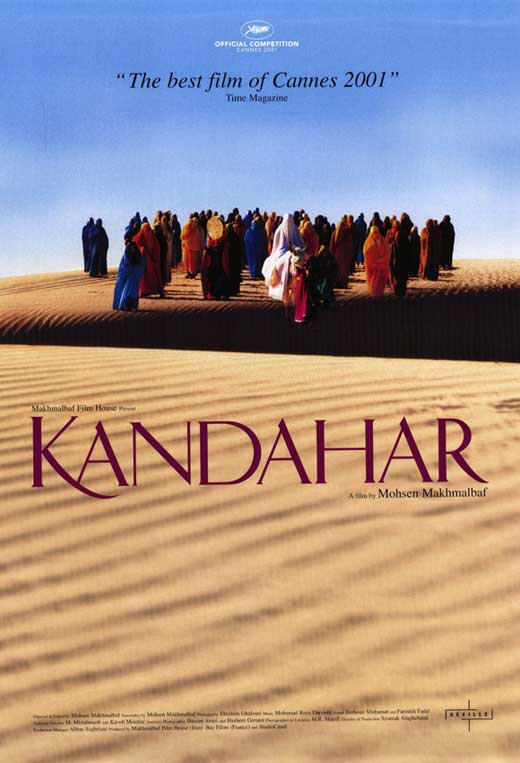
Film #99: Kandahar (2001)


Original Farsi Language Title: Safar e Ghandehar

Director: Mohsen Makhmalbaf

Times Previously Seen: none

Rapid-Fire Summary (No spoilers)

Afghan refugee-turned-reporter returns to her country of origin to find and hopefully rescue her suicidal sister. Is helped and hindered by various locals.

Extended Summary (Including Spoilers. Fair warning)

In the year 2000, Nafas (Nelofer Pazira) is a reporter who, a decade prior, fled from Afghanistan to Canada with most of her family. Now, she is returning to find her sister, who was accidentally left behind when the family left the war-torn country. Nafas has received an alarming letter from her sister, stating that her sister will commit suicide on the evening of the final eclipse of the 21st century, citing her overwhelming depression at her situation in a country falling more and more firmly into the grip of the ultra-conservative Taliban.

Nafas, having re-donned the burka (face covering up, at the moment) in order to traverse the ultra-conservative regions of her home country.

With two days remaining before the coming eclipse, Nafas must first don the full-body covering burka and pose as a wife of a local man who, with his family, is attempting to return to their home village in Afghanistan by crossing from the Iran border. She and the family only get so far into the country before they are robbed and left stranded by their driver. In the nearest village, she finds Khak (Sadou Teimouri), a young boy who has just been expelled from a Koranic school. Khak agrees to help Nafas get to Kandahar for cash payment.

After some arduous travel on foot over the desert landscape, Nafas becomes ill from drinking water from a local well. In the next village, she meets a doctor, Tabib (Hassan Tantai) who she soon learns is actually an African-American man who is helping the locals with their various ailments. The exact path that Tabib took to get where he is remains a mystery, but he has a genuine desire to help the people in Afghanistan in whatever ways that he can. Nafas leaves Khak behind, and Tabib takes her in his carriage back into the desert.

A little farther along, Tabib and Nafas arrive in a Red Cross camp, where international nurses are assisting local people in getting prosthetic legs to replace those that so many of them have lost to landmines scattered throughout the country. Among these men is a shifty, one-armed man named Hayat, who has pestered the nurses into giving him a set of legs. Nafas now must use Hayat as her guide, as Tabib must turn back from the strictly-Taliban controlled Kandahar region, which is now within reach. Nafas and Hayat both don burkas and join an all-female wedding party, hoping to slip past any Taliban sentries that they might meet along the way.

Black-clad females working with the Taliban search the wedding party for paraphernalia that goes against their strict Koranic beliefs. 

Upon nearing Kandahar, the wedding party is met by several Taliban guards. After searching the entire party for any contraband that they deem defies strict Islamic law, the guards pull several members of the party aside, including Hayat, whom they have uncovered as a man. Hayat joins the other separated members, and we are left to wonder what punishments face them.

Nafas gets past the guards and rejoins the wedding party. Now, with the sun setting on the final day before the eclipse, Nafas can see Kandahar in the distance.

My Take on the Film (Done before any further research)

Kandahar is certainly a hard-hitting film, and one that is still just as relevant as it was upon its release over a decade ago. While I can quibble over the technical merits of it as a film, the subject matter will force anyone, especially anyone in the United States, to take notice, considering how our country is still embroiled in a seemingly never-ending war in Afghanistan.

The only real demerits that can count deal with the acting and an occasional lack of clarity. The acting, I assume out of necessity, is not of the highest quality. It seems that the filmmaker opted to use authentic, amateur actors, in order to convey authenticity. The actors, I assume, are all Afghans. I also assume that, in such a war-torn area, the talent pool for actors is quite shallow. As such, the deliveries of lines are not always very natural.

The lack of clarity only emerges from viewers possibly not knowing much about strict Islamic laws and cultural patterns. I, myself, know just enough about the harsh rules imposed upon women in this part of the world, especially in the Taliban-controlled areas such as Kandahar, so I understood why the doctor Tabib needed a sheet between himself and the women he was treating. There are many other cultural norms that might seem puzzling to a viewer unfamiliar with them, and there are not really expositions given to explain them. Of course, this also solidifies just how these things are norms for these people, so explicit explanation would likely come off as being unnatural.

The highly memorable and perplexing moment when Tabib meets and "examines" Nafas. The sheet is meant to prevent a Muslim man from laying eyes on any woman who is not his wife.

Aside from these two areas, the movie is incredibly effective. The world that Nafas must negotiate in order to reach her sister is truly saddening and terrifying. They are all the more-so because they were and are still the reality for many people in this part of the world. There are more than a few scenes that, once you see them, you’re unlikely to ever forget. The scenes in which the young boy Khak is expelled from the Koranic school are just a few examples. Seeing rows and rows of young boys being fully brainwashed to alternately recite the Koran and give descriptions of the various weapons that they are holding (including sabers and machine guns) is harrowing. Scenes like this give some explanation as to why this country has never been conquered in history – a strictly-enforced, unwavering inculcation into religious zealotry and warfare.

Other scenes are equally heart-breaking. The Afghan men with one or both legs lost to landmines. The widowed women sitting in the middle of a dusty graveyard, nothing more to do but keep themselves under their burkas and bemoan their lost family members. The large troop of women moving along the desert, fully covered with their strikingly vibrant burkas. The images are so arresting that one would be tempted to think that they are completely contrived and staged. However, I never felt this way. The sad truth is that I have little doubt that all of these scenes depict the brutal realities of the lives of these people.

One of the many unforgettably heart-breaking scenes in the film - when men missing legs from landmines rush across the desert plain to chase prosthetic limbs being air-dropped from planes flying overhead.

Kandahar is the kind of movie that every person should see at least once. It’s bound to not only raise one’s awareness of how much some people in the world struggle for mere survival, but it can also make one appreciate just how many liberties most of us have. The purpose of the filmmakers was clearly to show the rest of us just how many of the things that we take for granted have been reduced to unrealistic dreams for people in this particular part of the world. It’s not an enjoyable message to receive, but one that we should receive nonetheless.

Upon Further Review (Done after a little more research)

This film has a few incredible facts behind it, one of which is the single most shocking thing that I’ve read in relation to any of the nearly 100 films that I’ve reviewed for this site.

I watched a 20-minutes documentary on the film and learned a few extremely fascinating, and ever more upsetting, things about the film. But this did not contain the shocker.

The primary one is that the film’s star, Nelofer Pazira, is actually playing a very close version of herself. The story of Nafas is a very close approximation of her own life as an Afghan refugee who risked the highly dangerous return to her home country to try and find a friend who she was worried might kill herself out of despair. After receiving her journalism degree in Canada, Pazira, who was only in her late twenties at the time, went through and witnessed many of the situations depicted in the film. Amazing, but this was still not the major shocker.

Nelofer Pazira, in the middle of one of the countless speaking engagements she has done since the movie was released. She has since been a tireless spokeswoman for civil right in the home country from which she and her family fled.

Another point of interest is how the film vaulted to world consciousness. It was initially released in May and August of 2001 at a few film festivals, where it received solid critical acclaim. Then, of course, September 11th of that year happened. All of a sudden, interest in the Taliban skyrocketed for obvious reasons. At this point, the film and Nelofer Pazira were launched into global awareness, and Pazira began a tireless series of public speaking engagements through which she informed people about the brutal realities in which she grew up and from which she and her family had escaped. It all puts a very real face, one that can be seen prominently, in the movie. This is all extremely important, but it is still not the major shock.

The major shock relates to the man billed as Hassan Tantai, who plays the doctor who assists Nafas. When you see the film, it is easy to note that the man has a pitch-perfect North American English accent. I couldn’t help wonder how a man from the U.S. ended up in an all-Afghan film. Here’s how: Hassan Tantai is a stage name for Dawud Salahuddin – one of the most notorious assassins in United States lore. His given name was David Belfield, and he was born in North Carolina to a southern Baptist family. He converted to Islam in the 1970s, adopted extremely conservative Muslim values, and earned the trust of the Republic of Iran’s secret service. In 1980, on U.S. soil, he assassinated a former Iranian diplomat who the Iranian secret service had said defamed the Ayatollah Khomeini. Salahuddin fled the U.S., his relationship with the U.S. has been murky ever since, though is still listed as “wanted” by the F.B.I.

Dawud Salahuddin, from U.S. citizen to Iranian assassin to actor. His is a strange life that begs the question why he was cast in the film. The director's words (below) help shed some light on the decision.

With all of this in mind, it was very interesting to see a quote from the film’s director, Mohsen Makhmalbaf. He said that Salahuddin, “…is also a victim – a victim of the ideal that he believed in. His humanity, when he opened fire against his ideological enemy, was martyred by his idealism.” Very profound and controversial ideas, indeed.

Knowing all of this, I can only hope that people take some valuable lessons from the film and Pazira’s story. Though it is technically a fictional drama, the reality that inspired it can only spur one to think far beyond what is seen in the 85 minutes of the film.

That’s a wrap. 99 shows down; 6 to go.

Coming Soon: The Lord of the Rings: The Fellowship of the Ring (2001)


On a much brighter and more frivolous note, I next get to revisit Middle Earth, as Peter Jackson so wonderfully brought it to screens. 

Please be sure to pick up all empties on the way out.

Saturday, June 29, 2013

Film #98: Ulysses' Gaze (1995)


Original Greek Title: To vlemma tou Odyssea

Director: Theo Angelopoulos

Initial Release Country: Greece

Times Previously Seen: none

Rapid-Fire Summary (no spoilers)

Successful, mixed-heritage film director takes a bizarre, dream-like journey through eastern Europe to track down reels of film. Looks awfully confused or pensive throughout.

Extended Summary (Spoilers included)

An American film director, unnamed in the film but credited as “A” (Harvey Keitel), goes to Greece to begin a search for three lost reels of film that were produced by the Manakis brothers in their earliest years as Yugoslavian filmmakers.


The first shot of the film, and the first of many sweeping shots that make effective use of negative space. On the left, "A" looks out over the sea at the beginning of his odyssey.

“A”s journey takes him from Greece to Albania, Macedonia, then Bulgaria, Romania, Belgrade, and finally Sarajevo. Along the way, various couriers’ and companions’ identities meld with “A”’s recollections of his own past in these areas, some of which he had spent time and emigrated from as a child. Relatives and lovers from his past emerge from his memory to interact with him once again. Within these dream-like moments, “A” relives past joys and sorrows, but never gives up his quest for the three Manakis brothers reels.

At the end of his journey, in a war-torn Sarajevo, “A” finds the man who has the reels – a film archivist who has nearly perfected the long-lost chemical formula that will allow him to properly develop the film. Shortly after he does this, though, he and his family are shot and killed in the middle of a firefight on the city streets. “A” sadly returns to the blasted movie theater to watch the films, only to find that they are blank, offering only vacuous white screens.

My Take on the Film (Done before any further research)

More than once while watching this one, the words “inaccessible” came to my mind. Not that I was completely baffled by Ulysses’ Gaze, but there was clearly much more going on than I was able to grasp on this single, first viewing. There are clearly many themes and elements of great depth presented in the movie, and there is a hypnotic quality to its presentation that is compelling enough for me to make the effort for its full three hours. On the whole, though, I’m not sure that I would watch it again, and I certainly cannot recommend it to any but the most patient and avid fans of film.

The story of “A”s quest for the reels of film is interesting enough, as it sets up the traditional “quest” plot device. The film’s title is the first clear indication that Homer’s grand epic, The Odyssey, is a major inspiration. Of course, “A” is not traversing the Aegean Sea and besting monsters or other mythological hazards to return home. “A”s journey is a metaphorical search for his psychological and artistic roots, and he has to move past very real dangers in the highly treacherous Balkan regions in the middle of war-ravaged 1990s. This grand theme is fairly interesting, as it is only revealed in bits and pieces as the film moves along.


"A" rows his "Circe" along the river. His interaction with her is one of the more bizarre among the several time- and person-warping interactions that he has along the way.

The pace and tone of the film are what will tax many a viewer’s patience. In a style that I can best compare to the films I’ve seen of Russian director Andrei Tarkovsky, Angelopoulos uses many slow, measured, and meditative shots to draw in the viewer. I found these quite effective, as it gave me time to ponder the ultimate meaning of “A”s actions and purposes, as well as mull over the stunning compositions placed within the camera’s frames. Like the Tarkovsky films Andrei Rublev, Stalker, and others, Ulysses’ Gaze demands that the viewer embrace the quieter, slower moments in order to allow a certain moody gravity to overcome him or her. Most of the time, it works very well. However, there were a few times when it seemed slightly pretentious or contrived to me. I have to admit to occasionally suspecting being hoodwinked by the notion that just because the filmmaker isn’t spelling it all out for you, you must be missing something. I’ve found that, in my case, this is actually true at times. Sometimes, I am missing something, and maybe that was true when I was watching this film. Whether for this reason or simple impatience on my part, I found myself trying to urge the film forward at times.

From what I could tell, the visuals are fairly amazing. However, there is a caveat here. This film is, oddly enough for the 21st century, extremely difficult to get a hold of. It has not been in print for several years, and there really has not been a well-produced restoration done to my knowledge, which does not allow the film to be seen in all of its majesty. From the mediocre-quality DVD that I was able to procure, it is clearly a film that would be best served by being seen on the big screen. The sweeping shots of the blasted landscapes, meandering rivers, and foggy streets of the Balkan regions convey a bleakness that seems part and parcel of the mental distress that “A” is battling through. Had I been able to watch a higher-quality copy, I might have even more praise for this aspect of the movie.

The acting is rather strange. I love Harvey Keitel, and he often shows a decent amount of range. However, I’m not sure if he was the best choice for this role. Whether through his own interpretation or at the behest of the director, he shows odd shifts in demeanor, posture, and emotion as the story moves on. At many times, it is clear that these shifts represent “A” psychologically shuffling between his present quest and his past memories as son, lover, and brother. During most of the “modern” scenes, though, he delivers his lines as if he were in a trance. I realize that this is probably what the story calls for, as an urge far greater than himself is pulling him towards the Manakis brothers’ film reels, but I found that it almost dehumanized him. This was especially the case when the other modern character around him were acting much more naturally. Added to this is that Keitel, in his many roles in U.S. films, is one of the greatest “naturalistic” actors of the past several decades. A final puzzling thing to me about Keitel’s casting is my question of “Why him?” For much of the film, he’s delivering lines in English or short phrases in Greek, while almost everyone else is speaking the local languages. I suppose that this is likely another layer of the story that I failed to grasp, but it was a bit disorienting.


This is often how Keitel looks in this film - staring off into the distance, while others try to interact with him in more natural, organic ways. It fits the tone of the movie at times, but during some moments, it simply baffled me.

I have to say that, if nothing else, Ulysses' Gaze is a novel film that suggests great depth. I have no doubt that there were more than a few elements and strata that were simply over my head, which led to a bit of frustration and impatience as I viewed it. Still, I enjoyed the process of attempting to piece together the different visual, narrative, and thematic elements in the movie. I certainly was not completely successful, so that I currently have a disjointed impression of the film. I hope that the next section of this review will remedy this…

Upon Further Review (Done after some further research on the film):

I did this portion of the review after reading this very thorough and insightful synopsis at the Internet Movie Database.

Well, it’s quite clear that I missed several key elements that the director implemented. In short, if you plan to watch this movie, there are two things that will help: (1) a general knowledge of Homer’s Odyssey, and (2) patience. When one keeps these in mind, it becomes easier to see why the list-creators at TIME decided to include this film on their “All-TIME Great Films” list.

While I was watching it, I was able to pick up several of the plot points and interactions that mirrored Odysseus’s epic journey to Ithaca. There are many characters who represent the long-archetypal roles of Penelope, Calypso, Telemachus, and many others from the Greek classic tale. However, there are even more that I did not pick up on. One such is how “A”s journey into Sarajevo represents Odysseus’s descent into Hades. Obvious really, when it’s pointed out to you. If a viewer has a rich knowledge and love of the source material, then watching this film would provide a very deep experience.

Another thing that the author of the review points out is some of Angeloupolos’ film style. Beyond just giving a mere synopsis, the writer explains some of the deeper meaning of the long periods of silence in the film, confirming my suspicion that these are meant for the viewer to contemplate far beyond the mere screen action. We are constantly reminded that the region of the Balkans has a rich and often sad history. The long, slow shots give ample time for the mood and weight to settle into our minds. These realizations also give “A”s journey more meaning, as he remains steadfast, despite every sign that tells him to turn back.


A scene from Sarajevo - the "Hades" of "A"s Odyssey. These scenes are obviously and carefully staged, which will put off some viewers. For those who look beyond the unnatural setup and focus on what things represent, the film becomes much more engaging.

As profound as this film is, I still cannot say that I would rush to watch it again. Knowing now much more about the symbolism throughout, I would consider it. However, I would only do so if it were restored to a very high quality. The settings are already dreary enough, without having to watch them on a low-quality print. This one would be a prohibitive recommendation.

That’s a wrap. 98 shows down, 7 to go.

Coming Soon: Kandahar (2001)


Another film that I know almost nothing about. I know it involves Afghanistan and the Taliban, two hot-button topics even today, over a decade after this film was made. We’ll see how it stacks up.

Please be sure to pick up all empties on the way out.

Friday, June 14, 2013

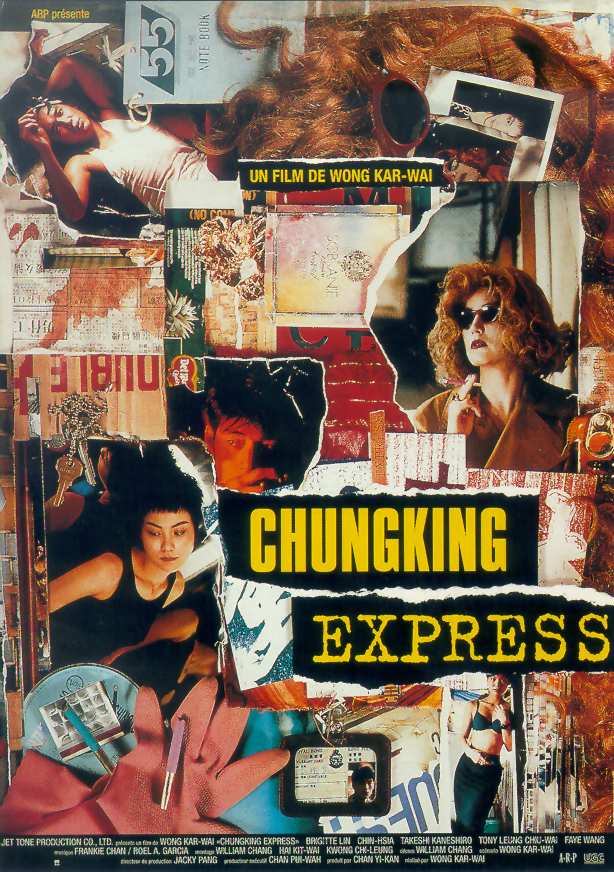
Film #97: Chungking Express (1995)


Original (Cantonese) Title: Chung Hing sam lam

Director: Wong Kar-Wai

Initial Release Country: Hong Kong (China)

Times Previously Seen: none

Semi-Rapid-Fire Summary

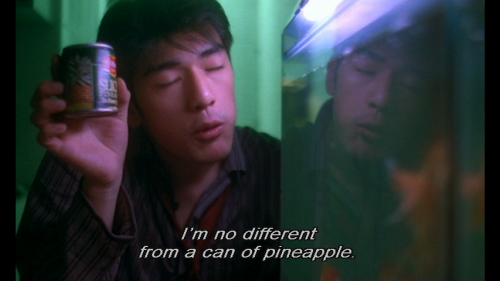
In 1990s Hong Kong, young police officer #223, He Qiwu, is battling loneliness in the wake of a lost love. His girlfriend has broken up with him just a few weeks prior, and he tries to deal with it by leaving voice messages for her on a daily basis. He has also given himself a deadline of 30 days, which he counts using expiration dates on can of pineapples, within which to hear from her. He tells himself that if he does not hear from her, he will abandon his hope of a reconciliation.

When the 30 days is up, Qiwu devours all of the cans of pineapples and heads to a bar to drown his sorrows. After several drinks, he spots and comes on to a beautiful woman in a blond wig. Unbeknownst to Qiwu, the icy woman is embroiled in a drug smuggling double-cross and is in the bar for some quietude. Still, she eventually succumbs to Qiwu’s persistent overtures and brings him up to her hotel room. Any amorous hopes that Qiwu may have are dashed, though, as the woman promptly falls sound asleep, leaving him to eat room service food and watch movies on the hotel television.

Qiwu tries to move past his former love with booze and some pick-up moves.

The day after, Qiwu has left the woman in the hotel room, and he seems on the verge of mentally moving past his ex-girlfriend. However, he receives a birthday message from her, perhaps giving him some shred of hope.

At a short-order restaurant frequented by Qiwu, another police officer, #663, is battling his own romantic breakup. Between getting coffee and food at the restaurant, he reminisces over a romance with a beautiful flight attendant. He copes by simply doing his duty as a cop and making humorous observations to the inanimate objects in his apartment, many of which belonged to his ex.

Taking notice of 663 is Faye – a somewhat flighty young woman who works the counter at the restaurant. Very secretively, Faye’s interest in 663 grows. In a turn of events, she ends up with a letter and apartment key from 663’s ex. Rather than passing them along to the dejected officer, Faye keeps the letter and uses the key to explore his tiny apartment while he is away at work. At first, she simply looks around, but eventually she begins to clean and care for the dwelling. This seems to be the only way that the socially awkward young woman can try to connect with the object of her infatuation.

Cop #663, lost in his own thoughts as the love-struck Faye gazes on.

After a few weeks of her clandestine care-taking, Faye is caught in the apartment by 663. Though shocked, the man is not critical. In fact, he allows Faye to stay a while and the two fall asleep on his couch. The following day, 663 and Faye plan to have an actual “date” at a nearby restaurant and bar. However, Faye stands up 663, leaves her job at the restaurant, and actually departs Hong Kong altogether. In a perhaps not-coincidental turn, she becomes a flight attendant in order to see the world. One year later, Faye returns to find that 663 has bought and is renovating the restaurant. The two talk a while, though we cannot be sure whether they will have any kind of future together.

My Take on the Film:

Chungking Express is a good movie that certainly shows a lot of skill from a then-young director. It’s quirky, thoughtful, and stylish in places. I can’t say that I was blown away, though.

In telling the story of the two lonely police officers, we get some very heartfelt slices of life in the hyperactive East Asian metropolis of Hong Kong. The stories of He Qiwu and Cop 663 are ones that come across as very authentic, and you can’t help but feel for both men. They seem to represent two of presumably countless other people in the vast city that can’t seem to find the romantic connections that they crave. The ways that they deal with their loneliness are quite different from one another, but show them both to be very sympathetic in their humorous attempts to cope with their dilemmas. It all has a feel rather reminiscent of the French New Wave films of Godard and Truffaut from the 1960s. In particular, Band ofOutsiders has the same genuine playfulness mixed with a tragedy that, admittedly, is more palpable.

Only being loosely connected to one another, the movie comes off as really two shorter films, stitched together only by the short-order food stand that they both frequent. The first story, that of Qiwu, I found to be the more engaging of the two. Qiwu is love-struck and pines away over his ex-girlfriend by marking off the days after their breakup by buying cans of pineapples, all of which will expire 30 days after his April Fool’s Day dumping. He tells himself that he will give his ex until May 1st to allow him back into her life. It’s a funny little system that reflects the little ways that we lie to ourselves in order to cling to past happiness. In Qiwu’s case, though, it clearly doesn’t work very well, as he falls in love with the mysterious woman in the blonde wig. The evening of unsatisfied amore in the hotel room is another slightly comical yet sad moment in his life. You end up feeling for him, though in a very realistic rather than classically romantic way.

Qiwu's loneliness is cast in a rather humorous light, through his pineapple can counting system.

The tale of Cop 663 is one of a different sort. It has its own feel, but it has some of the same lighthearted wistfulness of Qiwu’s story. 663 is a slightly older man who seems more controlled and world-weary than Qiwu. Tony Leung, who is phenomenal in this as well as Kar-Wai’s later film In the Mood for Love, has the amusing quirks of consoling his household goods while seeming oblivious to some of the most obvious things. Faye’s initial quiet interest in 663 is charming at first, but for me it lapses into disturbing stalker behavior – something akin to a more eerie version of the title character’s antics in the playful French film Amelie. I don’t know that this was Kar-Wai’s intent, but it is the impression I came away with. Nevertheless, the story certainly held my attention, even if I wasn’t left completely satisfied at the end.

Aesthetically, the film is rock-solid. Thanks to excellent camerawork, the film conveys Hong Kong as a vibrant, ever-churning mass of bodies, buildings, and colors. Some of the scenes in Qiwu’s story use an impressionistic, herky-jerky style of editing that I’m not a fan of, but it didn’t distract. A lot of the movie is simply enjoyable to look at, something that is also further honed in In the Mood for Love.

663's observations of and to the various inanimate objects in his apartment add a really warm, amusing layer to his seemingly passive demeanor.

One little nuisance has stuck with me since I watched this movie several days ago. In 663’s story, Faye is obsessed with the song California Dreamin’ by the Mamas and the Papas. The song is played no less than four times within a forty-five minute span, and it wore me out. Ever since I watched it, I can’t get the song out of my head, it was so firmly jack-hammered into me by the movie. I don’t care how appropriate a song is in a film story or even how good a song it is, no tune should be played this many times in any movie. It just wears thin.

Will I watch this movie again? I doubt it. I would, however, recommend it as a good one.

That’s a wrap. 97 shows down. 8 to go.

Coming Soon: Ulysses’ Gaze (1997)


I’ve had a hell of a time even trying to find a copy of this one. I have to be skeptical of a “masterpiece” that’s not even in print, in this day and age when everything you could imagine is at your fingertips. Maybe I’ll be surprised…


Please be sure to pick up all empties on the way out.

Saturday, March 2, 2013

FIlm #96: Pulp Fiction (1994)


Director: Quentin Tarantino

Initial Release Country: United States

Times Previously Seen: around nine or ten, at least (last seen about five years ago)

(Relatively) Rapid-Fire Plot Synopsis

*For those who haven’t seen it, Pulp Fiction is told in non-linear style, making summation a rather odd task. I will present it in the only way that I can manage to keep it reasonably concise. However, I am aware that events play out in the film in a different order. Bear with me…

Los Angeles, the early- to mid-1990s. Jules Winfield (Samuel L. Jackson) and Vincent Vega (John Travolta) are low-rent hit men for local crime kingpin, Marsellus Wallace (Ving Rhames). The two appear at the apartment of a few younger guys who have a briefcase belonging to Marsellus. Jules and Vincent spend some time intimidating the young men before killing them and taking the case. After they kill two of the young men, a hidden third man nearly kills them, though all six of his shots freakishly miss their targets, from virtually point-blank range. Jules and Vincent kill their assailant, but Jules feels that God had a hand in saving him from death.

Jules and Vincent complete their executions of the unfortunate rubes who tried to rip off Marsellus Wallace, the kingpin of Los Angeles.

Shortly after, in their car with their inside informant, Marvin, Jules and Vincent debate whether their escape from certain death was an act of the Almighty. In the midst of the discussion, Vincent accidentally shoots and kills Marvin – the result of careless handling of his pistol. Jules and Vincent then hurriedly get their car to a friend’s house, where they spend the next hour or so in a race against he clock to clean their car and dispose of the body. With the help of a professional “cleaner,” Winston Wolf (Harvey Keitel) the men are able to dispatch the car and body, though not without a fair amount of tension.

After the ordeal, Jules and Vincent have some breakfast at a diner. They continue their discussion of their avoidance of death earlier, and Jules decides that he is going to give up his life as a hit man and become a wanderer who rights wrongs. Vincent is highly skeptical and all but mocks his colleague. While Vincent is in the restroom, a pair of boyfriend/girlfriend thieves rob the diner. When the man attempts to rob Jules of Marsellus Wallace’s briefcase, Jules turns the tables and pulls his gun on the robber. After several minutes of tense discussion, Jules explains that he has given up killing people, pays off the robber, and lets him and his girlfriend go, all of this to the great chagrin of Vincent.

A day or two after, Vincent has an assignment to be a guard and companion to Marsellus Wallace’s wife, Mia (Uma Thurman). Vincent takes Mia to a retro restaurant, where the two engage in stimulating discussion and even win a dance contest.

The unlikely dancing duo of hit man Vincent and mob wife Mia. This joyous routine will soon be followed by a harrowing drug overdose that puts a serious damper on the evening.

Back at the Wallace residence, as Vincent struggles in the bathroom over his growing attraction to Mia, she discovers a bag of heroin in Vincent’s discarded coat pocket. Thinking it to be cocaine, she snorts it, goes into immediate shock and collapses. Vincent discovers her and rushes her to the house of his drug dealer, Lance (Eric Stoltz). Vince and Lance get through their extreme panic and manage to revive Mia with an adrenaline shot directly to her heart. After these harrowing events, Mia and Vincent amicably agree to keep the entire affair a secret from Marsellus, and they go their separate ways for the evening.

Several days later, a major boxing match takes place. Aging but capable boxer Butch Coolidge (Bruce Willis) shocks Marsellus Wallace by actually winning a fight that the crime boss has bribed him to lose. Butch, in a supremely risky double-cross, took the cash from Wallace, wagered all of it on himself, and won big. The only thing that he needs to do is quietly flee from the country the next morning. This simple plan is foiled, however, when Butch learns that his girlfriend, Fabian, has left his most prized possession - an heirloom watch that his forebears took unspeakable pains to pass down to him. Butch must risk returning to his apartment to retrieve the watch.

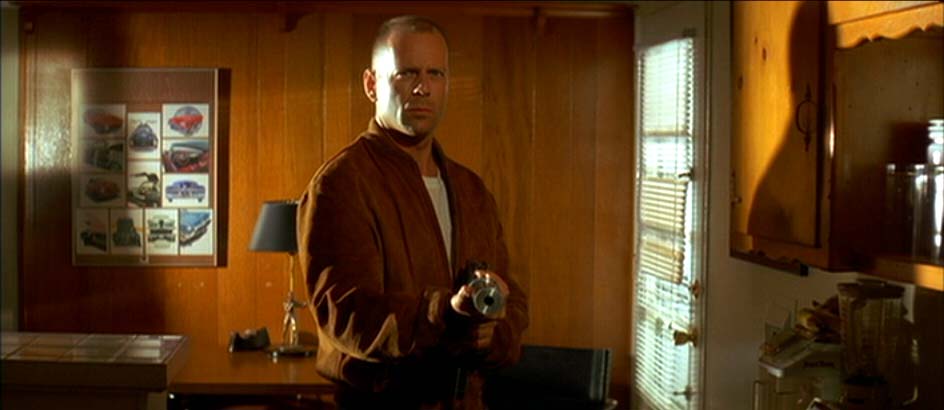
Butch carefully returns to his apartment, which at first seems to be empty. He grabs the watch, and then notices a silenced machine gun sitting on the kitchen counter. In an odd turn of luck for Butch, the hit man sent to stake out his apartment is in the bathroom at the exact moment Butch has arrived. When the assassin emerges, it turns out to be Vincent Vega, whom Butch quickly kills with his own weapon.

Butch prepared to take out Vincent, the man who would have killed him had the careless hit man not left his gun outside of the bathroom.

Upon fleeing his apartment in his car, Butch unfortunately runs across Marsellus Wallace himself. Wallace chases Butch into a pawn shop run by a redneck, Maynard. Maynard pulls a shotgun on them both, knocks them out, and brings them to the basement where he and his perverted companion, Zed, make clear that they will take sexual advantage of both men and kill them. While Maynard and Zed have their way with Wallace, Butch quietly manages to free himself. Rather than escaping and leaving his adversary Wallace to a horrible fate, however, Butch decides to save him. After the rescue, Wallace grants Butch a sort of amnesty, telling him to leave L.A. for good. Butch readily accepts, returns to pick up his girlfriend, and leaves.


My Reaction to the Film (Done after this most recent viewing)

I think I could go another 50 years before watching this film again, and I still could not see it with fresh eyes. That is how much of an impact it had on me when I first saw it, and that’s how much impact it’s had on countless films since its release.

Back in 1994, I was 19 years old when I saw Pulp Fiction for the first time. I had no idea who the director was, but the movie blew me away. I had never seen a film so funny, engaging, tense, entertaining, novel, and just plain fun. There were so many different things to soak up that I went back to the theater to watch it three more times, over the course of the next few weeks. Any time I found a friend who hadn’t seen it, I would bring them immediately. It quickly became a mainstay of the pop culture landscape, and references to nearly everything in the film have abounded ever since.

Now that nearly 20 years have passed and Quentin Tarantino has released several other movies, it’s become rather easy to deconstruct his work and view it as overdone and perhaps a bit too heavy on style at times. Still, this doesn’t take away from just how novel a blend it all was back in 1994, and it still shows his style as a brilliant one that is, as the saying goes, “often imitated, never duplicated.”

Of course, the dialogue is the most engaging part of watching Pulp Fiction the first, third, or even tenth time you see it. Basically every line shows a certain amount of wit or unexpected humor. Tarantino’s hallmark of seasoning the dialogue with pop culture references was put on full display in Pulp Fiction. He had done it to a degree in his previous film, Reservoir Dogs, but not to this extreme. In the same way that details and references make a good stand-up comedian funny, the running spoken interplay between characters in Pulp Fiction is as entertaining as it gets. Virtually every line from the film is quotable, and I was just like millions of others in going back to the theater repeatedly in order to soak it all up and commit it to memory.

Vincent and Jules in the diner. Arguably the best of the many great conversations in the film. Samuel L. Jackson's take on Jules's introspection earned him a well-deserved Oscar.

When describing a Tarantino film (especially the earlier ones), fans will never have the word “cool” very far from their vocabulary. The characters themselves are all great archetypes of “cool.” The stony-eyed hit men, the mythically-powerful mob boss, the aging boxer with one last shot to hit it big – these major characters were all drawn from countless noir and pulp stories from the previous several decades. Tarantino cast them into modern settings masterfully and made them fun to watch. Even all of the minor characters – Pumpkin and Honeybunny, Lance the drug dealer, Maynard and Zed the perverted rednecks, Winston Wolf, and all of the others have become almost iconic, based on amazingly composed vignettes. Tarantino is obviously a lover of what he terms “badasses,” and Pulp Fiction probably has the highest badass factor of all of his movies.

Yet another element to the Tarantino film is the music. Never before had I taken in a movie in which the music enhanced the atmosphere so effectively. From the moment that Miserlou relentlessly kicks in during the opening credits, the soundtrack deepens the mood with every song. Once again, the word “cool” finds its way to the forefront.

Though I’ve seen this movie at least ten times, and I know it basically by heart, one thing was more noticeable to me this time around. I had never really taken in just how obviously “cinematic” it all is. Sure, there is a certain amount of realism to some of the settings, and the actors’ deliveries of the dialogue are astoundingly naturalistic. Still, when you focus on the costumes, the set designs, and the composition of the other elements, it’s abundantly clear that the world of Pulp Fiction is just that – fiction. From the eye-popping colors of Jack Rabbit Slims to the minimal yet memorable suits of Jules and Vincent, and even the obviously phony backdrop in the cab that Butch takes from the boxing arena, there are plenty of moments that remind you that you are, indeed, watching a movie. Sure, there are really tense and violent moments (something for which Tarantino has been recognized and criticized for two decades now), but it is quite clear that these are, in many ways, comic book characters. In film, this makes for pure cinema through a concoction that very few directors can manage.

Butch peruses which weapon he will use to kill a couple of deranged hillbillies. This visceral scene is one of several almost cartoonish ones that show off Tarantino's skill with the nearly-lost art of visual storytelling.

I don’t know if Pulp Fiction will be as enjoyable thirty, twenty, or even ten years from now, when the pop culture references lose their sparkle and meaning and more and more filmmakers try to ape its magic. But no critic can ever diminish the effect it had on the cinematic landscape. It’s still a really fun movie to watch, and may be the quintessential “1990s American” movie.

Some Final Thoughts on Tarantino:

As stated, I became a tremendous fan of Quentin Tarantino after Pulp Fiction, and I still go to see every movie that he either directs or for which he writes the screenplay. Here are my quick thoughts on each of his major motion pictures:

Reservoir Dogs (1992): Outstanding crime flick, featuring everything that a Tarantino fan could love. The sharp dialogue, intensity, and non-linear storytelling are all tight, and the acting is absolutely top-notch.

True Romance (1993): Director Tony Scott took Tarantino’s script and fashioned another great movie. It has one of my all-time favorite movie scenes – in which Dennis Hopper and Christopher Walken stare each other down and engage in a captivating exchange.

Natural Born Killers (1994): Director Oliver Stone took Tarantino’s basic story and some of his script and created an uneven mess. Stone can never help himself from making grandiose statements, and he went way over the top in this one, often drowning out the strengths of the Tarantino-penned script.

From Dusk ‘Till Dawn (1996): Directed by Robert Rodriquez, a great vampire movie that combines Tarantino’s strengths with crime writing and vampire lore. Over-the-top fun that I still occasionally watch and enjoy.

Jackie Brown (1997): The sleeper Tarantino movie. It’s actually my second favorite, behind Pulp Fiction. Adapting an Elmore Leonard novel, Tarantino put together his most accessible movie, for those who are put off by the graphic violence in most of his movies. I always recommend this one to people who haven’t seen it.

Tarantino's most underrated film, in my view. Great direction and acting bring a cracking Elmore Leonard tale to life. If you dig crime movies, check it out.

Kill Bill, volumes 1 and 2 (2003, 2004): Tarantino’s homage to kung-fu and spaghetti western movies. They work very well in some places, and they’re quite a bit of fun; however, they became a bit tiresome by the end of the second part. The movie gore hits new heights in these ones.

Grindhouse/Deathproof (2007): This is where my patience with Tarantino started to wear thin. This is his most self-indulgent, tiresome film. There is some great acting and decent verbal exchanges, but Tarantino was clearly in love with his own dialogue just as much as the B-movie exploitation horror films that he was channeling. Not a bad movie, but I’ll never watch it again.

Inglorious Basterds (2009): Still overly enamored of his own dialogue, Tarantino nonetheless made a solid World War II flick. It’s a preposterous re-imagining of history, but still an entertaining watch. Could have been edited down a bit, but I enjoy it. Christoph Waltz and Brad Pitt help with excellent performances.

Django Unchained (2012): Very much like the previous movie, only set in the 1850s old West. Again, Tarantino falls back on his passion for spaghetti Westerns, but does it with his own panache. Also a bit long, but still a solid movie. Like “Basterds,” it’s worth watching just for Christoph Waltz.

As of now, I still consider myself a fan, but I now qualify it a bit more. At this point, I would really like to see Tarantino get away from the same wells that he’s drawn from for years now – exploitation, kung-fu, and spaghetti western films. I understand that these are his strengths and passions, but I think he’s a capable enough filmmaker to try something a bit different. Although, with word coming out that there is a “Kill Bill, part 3” in the works, I probably shouldn’t hold out much hope.

That’s a wrap. 96 shows down. 9 to go.

Coming Soon: Chunking Express (1994)


 I know a few of director Wong Kar-wai’s movies, and I’ve liked them. I’ll see how this early work of his stacks up.

Please be sure to pick up all empties on the way out.

Monday, February 25, 2013

Film #95: Legend of Drunken Master (1994)


Original Chinese Title: Jui kuen II

Directors: Chia-Liang Liu, Jackie Chan

Original Release Country: Hong Kong (China)

Times Previously Seen: once (about 14 years ago)

Kung-fu Quick Summary:

China, approximately the 1930s or 1940s. Young man Wong Fei-hung (Jackie Chan) is returning by train with his father from a business trip. His father is a respected herbalist, and they have been on a buying expedition. The impetuous Fei-hung gets caught up in trying to smuggle some ginseng onto the train, to avoid paying a tax, and his plant gets swapped with an antique stone. After a few fights and further confusion, Fei-hung, his father, and their assistant arrive home safely.

After arriving back at his father’s shop, Fei-hung and his clownish step-mother cover up their father’s missing ginseng through various tricks. Amidst all of this, Fei-hung gets caught up in a street fight in which he utilizes his “drunken boxing” style – a form of kung-fu that is virtually unbeatable but requires the practitioner to consume ever-increasing amounts of alcohol. For this reason, Fei-hung’s father forbids it.

Fei-hung, getting loaded in the middle of just one of many ass-whippings that he delivers in the movie. Sure, the idea of alcohol-fueled martial arts invincibility is ridiculous. But it's fun.

Fei-hung and his family are eventually visited by Master Fu Wen-Chi, China’s top counter-intelligence officer, and a man whom Fei-hung had fought during the train ride that set all of his trouble in motion. Wen-Chi explains that the antique stone that Fei-hung had found is one of an entire hoard of Chinese historical treasures that are being stolen and smuggled out of China by a corrupt British diplomat and his regional Chinese cronies.

With the help of miners abused by the diplomat’s henchman and Master Fu Wen-Chi, Fei-hung leads an assault on the thieves headquarters – the mines from which they are excavating and stealing the national treasures. Fei-hung fights his way through a gauntlet of ever-more skilled adversaries and, by embracing his drunken boxing skills, defeats them all. The treasures are returned to their rightful owners, the Chinese people, and the fiendish British diplomat is banished.

My Gut Reaction to the Film (Done after this most recent re-viewing)

I assume that this film was put on the “All-TIME 100 list” because it is considered the absolute pinnacle of what kung-fu movies can offer.

If this is the case, then I can now say that kung-fu is simply not a genre that holds my attention.

In an odd way, my feelings towards the kung-fu genre are similar to the way I feel about the musical or even dance film genres. I can appreciate the planning, skills, and execution that they all require, and I can even marvel at these things for a while. Eventually, though, I’m always left wanting more narrative and emotional substance. Legend of Drunken Master is no exception.

Whether you're a fan of martial arts flicks or not, you have to marvel, even if only for a few moments, at the physical skill exhibited throughout the movie.

Story-wise, you have a nationalistic tale that is threadbare and so simple that it almost insults your intelligence. While the thievery of Chinese treasures of antiquity has been and is a real problem, this film’s treatment of it makes it clear that it is only meant to imbue the goofy Fei-hung with some sort of heroic purpose. I guess even Hong Kong kung-fu movies need their McGuffin.

In reality, the nefarious thievery acts more like whatever throw-away premise would get used in a W.C. Fields movie – it’s simply something that serves as an excuse for the star to do what he is best known for. In Fields’ case, it was begin a drunken, wise-cracking buffoon. In Jackie Chan’s case, it is being a lightning-quick contortionist/martial artist who dispatches hordes of enemies. The reason is completely inconsequential, so long as the star gets to do his thing. This keeps things rather simple, which can be both good and bad.

Interestingly, this film’s connections to the movies of long ago do not lie in its simplistic plot alone. One can easily see a very heavy dose of silent-film era shenanigans in Legend of Drunken Master. Between Chan and his step-mother, played by Anita Mui, the goofy slapstick is never very far. Chan himself often channels the great Buster Keaton, as far as pulling off effortless acrobatic and gymnastic moves, even when doing what would otherwise be routine movements. At times, I was also reminded of a quote I once heard about Fred Astaire – that he was “always dancing,” even during non-dancing scenes. Chan doesn’t “always” dance through his scenes, but when he does, it is to excellent effect. However, I must say that the slapstick eventually became more sophomoric than amusing to me.

The thing that makes this movie stand out is, of course, the action sequences. Jackie Chan and co-director Chia-Liang Liu (also a long-time stuntman in Hong Kong martial arts flicks) concocted and executed some phenomenal sequences in this movie. The speed and precision of the movements create a ballet of violence that will mesmerize any viewer. At least, for a little while. This was my problem. Like the slapstick elements of the movie, what begins as magnetic eventually became tiresome to me. The latter half of the film, with Chan facing down dozens and dozens of generic thugs and henchman, had lost its luster. I realize that not everyone feels this way. There are plenty of kung-fu movie fans who live for this stuff, and those fans would surely love every minute of every fight scene in this movie. I, however, grew weary of them.

One other gripe I have regarding the action sequences is their authenticity. One legitimate claim to fame that Chan has always had is that he and everyone in his movies perform all of their own stunts. However, in Legend of Drunken Master, it is quite clear that suspension wires are used during several of the fights and stunts. This is a bit disappointing since part of the intrigue of these movies is seeing just how far the stuntmen and women can push the limits of the human body, in terms of agility, flexibility, and coordination. Some of this wonder is diminished, though, when I can tell that they are “cheating” somewhat by using tools that any old “action” star could use. It would be like seeing Swan Lake when you know that the ballerina is using support wires. Not nearly as impressive.

One of the most obvious of several scenes that used wires to hold the actors up, allowing them to preform stunts and moves that seemingly defied gravity. Rather cheap, in my view. 

So I’m pretty much done with kung-fu movies. Perhaps there are still some out there that show the depth and development that I’ve always found lacking in them. Unless I hear of an unusually thoughtful or meditative film like the previously reviewed classic, A Touch of Zen, or the much more recent Crouching Tiger, Hidden Dragon, I’ll be staying away from this brand of film.

That’s a wrap. 95 shows down, 10 to go.

Coming Soon: Pulp Fiction (1994)


“Bring out the gimp.”

Please be sure to pick up all empties on the way out.

Saturday, January 19, 2013

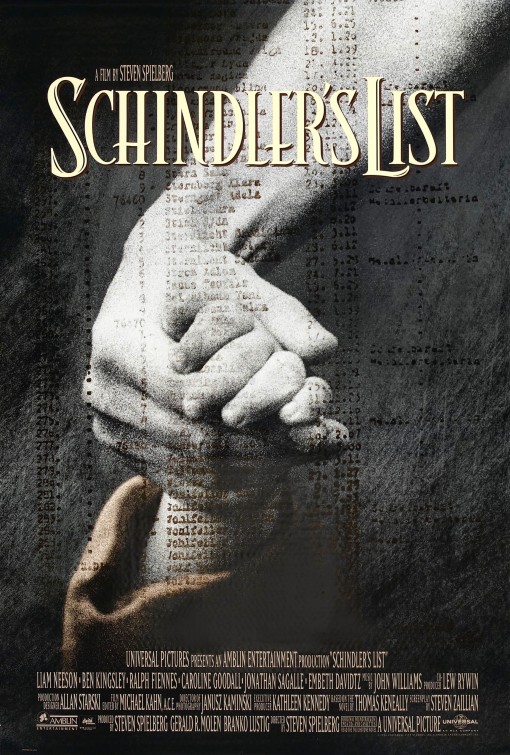
Film #94: Schindler's List (1993)


Director: Steven Spielberg

Initial Release Country: United States

Times Previously Seen: twice (last time about twelve years ago)

Rapid-Fire Summary

For a complete plot synopsis, check here at imdb’s website.

In 1940, the Nazi machine is taking hold in Poland. They are starting to herd all Jews together and force them into ghettos. Amidst these massive and horrific changes, the Czech-German businessman Oskar Schindler (Liam Neeson) arrives in Krakow with dollar signs in his eyes. Through clever business machinations and a flare for panache, Schindler quickly ingratiates himself to Nazi high commanders, secures a factory and a Jewish prisoner labor force for himself.

Over the next few years, business is good for Oskar Schindler. His factory produces quality pots and other metal goods, and his chief accountant, the Jewish Itzhak Stern (Ben Kingsly) sees that the factory runs smoothly and profitably. IN the early going, the only seeming bump in the road is the assignment of Nazi officer Amon Goeth (Ralph Fiennes) as the commander of the labor camp in Krakow. Goeth is an unpredictable and homicidal maniac who kills Jews without rhyme or reason. Schindler, however, manages to become civil, if not friendly, with the treacherous killer, in the name of keeping the money flowing in.

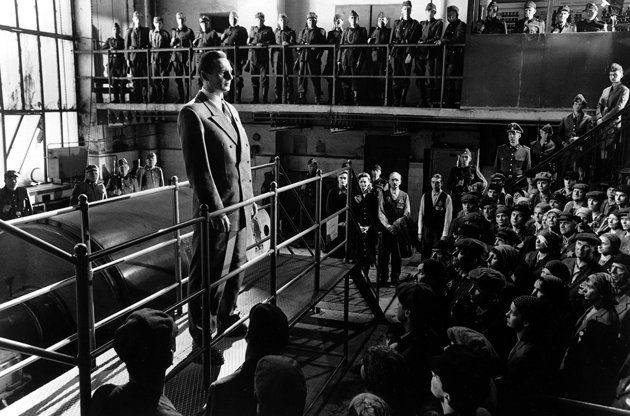
Oskar Schindler - in the middle of one of his many negotiations. These eventually evolve from purely self interested to completely altruistic.

Gradually, Schindler begins to have a change of heart, though a somewhat quiet and slow-building one. Upon seeing the murderous brutality of the Nazis against the Jews, Schindler, on the gentle but unwavering urging of Stern, begins to bring more Jewish laborers into his factory. He tells everyone that it is simply to maintain efficiency, but those who are closest to him can see that his sympathies for the Jews are growing. Schindler even tries, unsuccessfully, to change the brutal nature of Goeth. This failure aside, he continues to take Jewish prisoners into his factory to save them from the horrors of working in the labor camp every day.

As the War enters its final year, things become more desperate. Word comes down that Hitler has ordered the complete extermination of Jews – the so-called “Solution.” In the face of this, Oskar Schindler takes all of his massive profits, and even convinces a few other businessmen to do the same, and purchases over a thousand Jewish laborers. He assures Goeth that it is merely for convenience, as these laborers and their children are known commodities. The deal is made, and Schindler even ensures their safe transport to Czechoslovakia after his Jewish workers are mistakenly sent to Auschwitz and nearly killed, along with thousands of their fellow Jews.

At the official surrender of the Nazis to the Allied forces, Schindler addresses the hundreds of people that he has saved. The following day, as an ultimate irony and sacrifice, he must flee punishment for the crime of war profiteering.

When the war ends with the unconditional surrender of the Axis powers, the Jews are free, but Oskar Schindler is now, officially, a war criminal for profiteering. With the blessing of the thousand that he helped save, Schindler and his wife flee into the night.

My Take on the Film (done after this most recent viewing)

This was the third time that I’ve seen this movie, and my feelings haven’t changed – it’s a very good film in many ways, but there are a few things that irk me.

Schindler’s List is definitely one of the boldest of Spielberg’s films. The movie portrays the stark and horrific actions of the Nazi regime against the Jews in a way that I had never seen before. It goes far beyond mere sensational, almost action/suspense route that could have been taken. Seeing silent, morose masses of Krakow’s Jewish citizens, lined up to be classified and segregated by the conquering Germans has much more authentic emotional power. This is one of many subtle details that the movie exhibits in order to convey the crushing reality of the Holocaust.

As always, Spielberg is a master of the technical aspects of film. The man has always known how to tell stories through the moving picture, and Schindler’s List is no exception. From the opening scenes of Oskar Schindler schmoozing his way into the good graces of the Nazi commanders, to and through Goeth’s failed attempt at becoming a forgiving overlord, the movie balances dialogue and visuals to tell the tale as well as anything Spielberg has ever done.

The maniacal Goeth and the savior Schindler, during one of their many talks. The two are dark-and-light reflections of one another. This scene displays how effectively Spielberg used the black and white medium. No one can say that the man doesn't know what he's doing with a camera.

Unfortunately, as important as these things are, and as well as the movie does them, there are several gripes that I have. One is that I have always found a certain flatness to the main characters. Oskar Schindler’s soul goes through a massive transformation, and yet we are left with virtually nothing to explain why this might have occurred. Aside from a few ponderous gazers at the horrors around him, we are left in the dark as to why, exactly, this self-absorbed capitalist would abandon his fortune to save a group of people whom he has only seen as a means to his financial ends. There are moments when we get hints, but I’ve always felt a little cheated when it comes to this aspect of the film. There is also an enigmatic quality to Goeth. The character never feels completely real to me – almost more of a monster construct than a person who actually could have existed.

The idea of constructs is another problem I have with the film. Far too many times, I felt as if I could see Steven Spielberg’s hand prints on the movie, and not in a good way. He was clearly trying to present a “realistic” look at the terrors of the Holocaust, and in some notable ways, he succeeded. However, there are a few too many scenes and moments that feel very contrived to me. One is the “secretary” scene, when the libidinous Schindler is “interviewing” potential secretaries by watching them type. This sequence, with no dialogue, is a very wink-wink, nudge-nudge, humorous moment in the movie. In other words, it seems way out of place. There are several others, but none so egregious as the final scene in which Schindler is walking towards his car, about to leave behind all of the people he has saved. In a scene that seemed straight out of a hackneyed melodrama from the 1940s, the hundreds of Jews quietly stand around him as he slowly starts to cry and despair over how many more lives he could have saved, had he not been so selfish. On paper, it seems to make for a great scene. On film though, to me, it seems rather artificial.

The final scene, in which Spielberg and Neeson overplay their emotional hands (in my opinion). The melodrama becomes thick to the point that it does a disservice to the reality upon which the film is based.

Related to this is something that has been a bugaboo in virtually every Spielberg film – shying away from truly, completely shocking the audience, even when it may be appropriate. The particular scene I have in mind is towards the end of the movie, when Schindler’s Jews have all been mistakenly taken to Auschwitz. The women are all stripped naked and forced into a large warehouse, which they and we the audience all presume to be a gas chamber in which they will all be killed. Just at the height of our fears, water rather than gas rains down from the shower heads, merely cleaning the terrorized women. I don’t know whether this event actually occurred, but it struck me as strange that the director, who has already shown us multiple brutal murders in the movie, would shy away from presenting perhaps the most disturbing crimes perpetrated during those years – the mass executions of helpless innocents. I’m not saying that I would have enjoyed seeing such a thing, but this film is clearly not about enjoying what you are seeing. It is about witnessing the atrocities committed against the Jews, and it only seems right to witness the greatest of those atrocities.

Schindler’s List is one of those films on historical tragedy that merely makes me want to learn more about the actual story, not unlike The Last King of Scotland or Hotel Rwanda. In fact, the scene that has by far the most impact on me, and the only one during which I cry, is at the very end, when the credits start to roll. We shift to 1993, when the film was released, and we watch the surviving “Schindler’s Jews” and some of their descendants process towards the real Schindler’s grave and place flowers along it. This is when the reality of the story hits me, and this is when I feel a real sense of loss.

I ultimately think of Schindler’s List as a “near miss.” It tells an important story, and it does many things well. However, I feel that, had the few “Hollywood” moments been eliminated and had Spielberg gone more minimalist in a few of his techniques, the movie would have had even more power.

In other words, three times in more than enough for me. I don’t need to watch this movie ever again.

That’s a wrap. 94 shows down; 11 to go.

Coming Soon: The Legend of Drunken Master (1994)


Ahhhh. A nice breath of fresh air, after emotional weightiness of the prior three movies. Kung-fu action up the wah-zoo. As of writing this, apparently Jackie Chan is in some hot water for an anti-American rant. Whatever. I just want to see one guy jumping around, kicking the stuffing out of a bunch of other guys. 

Sunday, January 6, 2013

Film # 93: Farewell, My Concubine (1993)


Original Chinese Title: Ba wang bie ji

Director: Kaige Chen

Initial Release Country: China

Times Previously Seen: none

Rapid-Fire Summary

For a more complete synopsis, you can check out this one at wikipedia. Here is my simplified version:

In China in 1924, the young boy Douzi is given by his prostitute mother to an academy for opera performers. His mother even goes to the extreme length of chopping off little Douzi’s unusual sixth finger, to make him appealing enough to the school’s exacting headmaster, Guan. This is just the first of many forms of suffering that Douzi will face in the course of his next decade of training. For another decade, Douzi and his peers are put through a brutal regimen – one which even results in the suicide of one of his closest friends. Douzi does, however, become very close with Shitou, who becomes his “stage brother” in operatic performances.

Douzi and Shitou graduate from the academy and become opera sensations, taking on the stage names of Cheng Dieyi (Leslie Cheung) and Duan Xiaolou (Fengyi Zhang). The two are most noted for their performances of the classic Chinese opera, Farewell, My Concubine, with Cheng playing the role of the royal concubine and Duan playing the role of the king. Cheng clearly has deeper feelings for Duan and wishes for them to be together in all ways, not merely as operatic partners. Duan, however, refuses Cheng’s advances and eventually marries Juxian, a courtesan who manipulates Duan into the union.

Cheng (right) prepares Duan's makeup before another of their famous performances. The care shown here echoes the tenderness that Cheng harbors for his stage brother.

Over the succeeding four decades, Cheng and Duan’s relationship undergoes several changes, due in no small part to the massive political upheavals of the times. From the Japanese invasion in the late 1930s to the return of nationalism in the late 40s, and all through Mao’s forms of revolution, the two actors experience equally tumultuous emotional shifts. Though they continue to perform their most famous opera intermittently, they must fight through Cheng’s opium addiction, accusations of being counter-revolutionaries, and the ever-present resentment of Cheng towards Juxian. In 1966, after the Cultural Revolution, the two men are forced by a raving communist mob to turn on each other and abandon their passion for the opera and each other.

In 1977, eleven years after their public renunciation of each other and their craft, the two men join up one more time. As they are practicing for a return performance of Farewell, My Concubine, they share a tender moment of recollection at how their close friendship began several decades earlier. Then, in imitation of the forlorn character that he has played so famously, Cheng commits suicide.

My Gut Reaction to the Film:

For as long and ultimately tragic as the story is, I found this movie quite compelling. Though it may be a case of trying to do more than can be done in 180 minutes, there’s still a lot to be said for how strong a film this is.

The most immediately striking feature to anyone who watches even a few brief moments of the movie is the visual aesthetic. The vibrancy and majesty of the emotional, political, and artistic themes explored in the movie come through the stunning sets and costumes. Put simply, the movie is a joy to look at. It calls to my mind another fantastic Chinese epic film – The Last Emperor, which made similar use of color, shading, and lighting to build atmosphere so effectively.

This still shot of Duan and Cheng in costume only gives the slightest hint of just how lavish the film's visuals are. Virtually every scene, including those away from the opera stage, is brilliantly composed and drawn the eye.

The visuals, though, are the window dressing for the real heart of the movie – the tortured existences of Cheng and Duan. The story of these two men could easily be seen as the struggle of artistry and human emotions against overwhelming social pressures towards conformity. Even before the political upheavals begin, it is clear that the Chinese cultural concepts of fate and hard work leave the young Douzi and Shitou no option but to be beaten into what society tells them – actors. There is beauty in the tragedy, as seen by the successes that the two men find on the stage, but it is ultimately doomed to be crushed by blind ideologies that do not seem to allow for individual feelings. Normally, I would not be so interested in the emotional turmoil of a depressive dramatist such as Douzi/Cheng. Yet with this film, I found the tale extremely engaging.

One of the amazing feats of this movie is its dealing with desire and sexuality. I honestly don’t know what the popular Chinese conception is of homosexuality, but it is presented in Farewell, My Concubine as a simple matter of course. Yes, Cheng is gay and seeks to be the lover of his stage partner, but Cheng’s homosexuality is not really the focal point of the issue. The movie makes clear that the driving force is his fierce desire for something that cannot be.

In similar fashion, the tale’s portrayal of political machinery is pleasantly unpatriotic. China is, without a doubt, one of the more fiercely nationalistic countries in the world. I can only assume that a fair amount of “art” produced there in the last century can well be classified as mere propaganda. A film like Farewell, My Concubine not only avoids that label, but even castigates such hive-mindedness by showing how damaging it is to individual liberty. The psychological toll on Cheng and Duan both transcends and is dwarfed by the onward march of Chinese history, making their story both intriguingly regional and surprisingly universal.

As the communist revolution sweep the country, a frightening zeal for conformity and blandness overtakes the populace. Independent thinkers and artists are just some of the many who suffer the rise of this humorless movement. 

There are some aspects of the film that would most likely prevent me from watching it again, however. In a general sense, there is a certain cultural gap that I, as an American, couldn’t completely traverse. Though I consider myself more culturally aware and sensitive that most people, some of the behaviors and attitudes in the film seem to require an understanding of the subtler aspects of Chinese codes and mores. There is a reverence for the Confucian master/student relationships that is puzzling, if not outright perplexing, to someone of my Western upbringing. It can be fascinating at times, but frustratingly enigmatic at others.

On a technical level, the pacing of the film is occasionally herky-jerky. I suppose that it is inevitable when trying to tell a tale that spans 50 years while maintaining emotional depth, and the film probably does it as well as possible. Still, there are some tremendous time jumps that are a tad disorienting. This is exactly the kind of story that would benefit from being told as a television series over the course of six or eight hours, rather than crushed into three.

My most subjective, and probably most lasting, gripe is my feeling towards classic Chinese opera, something that understandably and necessarily is featured throughout the picture. I find the singing style absolutely intolerable. I know, I know. This is my “ethnocentric, Western ear,” but I can’t help it. Try and I might (and I tried the same thing with Japanese noh theater when I lived in that country for two years), I can’t find any pleasure in listening to the high, whining vocalizations that are the hallmark of the art. I’m sure someone with an ear for it would find Cheng’s performances breathtaking. Alas, I found myself simply wishing them to be over so that the story could continue.

The actual opera performance scenes are visual spectacles, but I simply do not have the ear to appreciate the style of the art. 

Farewell, My Concubine is a great film, and I one that enjoyed. It features all that any fan of epic tales of touching, personal tragedy would surely enjoy. I don’t see myself watching it again, but it’s an easy one to recommend.

That’s a wrap. 93 shows down, 12 to go.

Coming Soon: Schindler’s List (1993):


And rounding out the current trilogy of tragedy is Spielberg’s holocaust offering. I’ve seen it a few times, and I found it flawed. I’ll see if my opinion holds after this next (and probably final) viewing.

Please be sure to pick up all empties on the way out.