Sunday, October 7, 2012

Film # 88, Part One: The Decalogue Parts I to III (1988)


Note: The Decalogue was initially released as a ten-part television series, with each episode being a story in and of itself, though there is some crossover. As such, I will be offering my review in 3 parts – one for the first three films, another for the middle four, and a third for the final three episodes.

Director: Krzysztof Kieslowski

Initial Release Country: Poland

Times Previously Seen: none

Part I Rapid Fire Summary:

A boy of around ten years old spends time with his father. The two share a love of mathematics, and the boy seems to show a special gift for computers, electronics, and the logical thinking that is the hallmark of scientific geniuses. The boy’s mother is away, in some unknown, faraway country, for an unspecified reason.

The father clearly loves his son, and the only area of tension seems to be that the boy’s aunt seems to be disappointed in the lack of religious faith in his life. His father is a man who has put his full faith in the laws of physics and mathematics, and he seems to quietly eschew any notion of a supernatural God figure.

Father and son bond over some breakfast. The two quietly share a lover for both each other and the seemingly incontrovertible laws of science.

One evening, as Christmas nears, the boy asks his father if he can go ice-skating. The two excitedly do some calculations on the father’s computer to determine if the weather conditions and width of the ice are safe. Their computations point to the situation being safe, and so the boy goes out with a few friends to skate at night.

The next afternoon, the father notices the occasional sirens of police cars and fire trucks passing by his apartment complex. Though not concerned at first, he begins to worry when his son does not return from a planned tutoring session. Hours pass and he eventually joins a crowd standing next to the nearby river. His horror slowly mounts as he realizes what may have happened. His worst fears are realized when he sees rescue teams fish his dead son’s body out of the river. The ice had broken, and his son had fallen in and frozen to death.

The father staggers to a nearby religious shrine and shoves down the altar, enraged that his son would be taken from him.

Part I, My Take on the Film

This episode is incredible. I can’t say that it’s in any way uplifting or “fun” to watch, but it is simply a brilliant piece of film.

The telling of this father/son tragedy is so well done that the heartbreak at the end is that much more gutting. Every interaction between the two feels completely organic, and every little glance, gesture, and smile carries so much weight that it’s amazing to think of how simple it all seems. “Seems” being the operative word. I have a feeling that, were it that simple, many more filmmakers would be able to do it.

When thinking about the theme of The Decalogue – the Ten Commandments of the Judeo-Christian faith – I have to assume that this film’s would be “thou shalt not believe in false idols,” with the “idol” being the supposed infallibility of mathematics. If so, it’s a very challenging theme, and one that doesn’t take the easy route. A cuddlier filmmaker would certainly have had the father learn a life lesson from his son’s death, and he would turn towards God. In this tale, however, the man’s atheism seems to turn to blind rage. I am reminded heavily of the final lines of the Graham Greene novel (adapted into a very good movie), The End of the Affair. In that, the atheist protagonist, much like the father in The Decalogue Part I, is all but forced to admit God’s existence and he utters the lines, “I hate you. I hate you as though you existed.”

It’s an amazingly powerful start to the series.

The quiet bonding moments between the father and son make the end of their story that much harder to watch unfold. 

Part II Rapid-Fire Summary

A middle-aged woman anxiously waits while her husband suffers from a debilitating and worsening disease. She happens to live in the same apartment complex as her husband’s attending doctor (also the same as the father and son from Part I), and she presses him for information about her husband’s condition. The doctor, in an oddly cold fashion, refuses to break hospital protocol and tell her anything. The doctor, a widower, lives alone and keeps to himself.

Eventually, the doctor does give the anguished woman a bit of information about her ailing husband. She presses him, however, for a more honest opinion. She explains that she is pregnant with another man’s child and is contemplating an abortion, should her husband live. The doctor advises her not to have the abortion, and he tells her that her husband will almost certainly die. She follows his advice and does not receive the abortion.

Miraculously, her husband recovers. She decides to stay with him and break off her relationship with the father of her child. However, it is unclear whether she actually tells him that the child is not his.

The anxious wife and the doctor. Their interactions are often fraught with emotional tension that only become clearer as they work through their own difficulties.

Part II, My Take on the Film

This episode is just as emotionally complex and powerful, though not as straightforward, as the first. One common element is the naturalism of the acting, characterization, and environment. Even though the situation is an extreme one, just as in Part I, the way that the characters deal with them and the way they are portrayed by the actors is wonderfully absorbing. While Part I’s subject of a child’s death was no picnic, Part II doesn’t exactly let its foot off the gas pedal, emotionally. It is clear by this point that filmmaker Krzysztof Kieslowski is not interested in mundane emotions, but rather the raw emotions that typical people deal with when something extraordinarily trying occurs. As with Part I, this one is not what I would call “enjoyable”, but it is a great piece of film that is very compelling.

Which of the ten commandments is the touch point? Much harder to say for this episode than for the previous one. It could be “thou shalt not commit adultery,” “thou shalt not covet thy neighbor’s wife,” or even “thou shalt not kill”. My guess is that it will become clearer after I watch the remaining eight parts, but pinpointing the specific commandment is already becoming academic. The power of the story is not from being able to identify which commandment is associated with it, but rather it is in the story and characters’ emotions.

Part III Rapid-Fire Summary

In an episode that is a bit less dour than the first two, it is Christmas Eve. A taxi driver is called away from his wife and children under a desperate ruse by a former lover. This former mistress of his claims that her husband has gone missing, and the taxi driver allows himself to pulled along on a wild goose chase for the entire night. After driving from one place to another, searching for his mistresses’ husband, she admits that it was all a lie in an attempt to rekindle their past romance. Her husband has, in truth, left her. The taxi driver does not give in to her overtures, and the two part somewhat amicably.

The former lovers' tale is one mostly shot at night, which fits the rather murky and shadowy emotions at play. Of the three first tales, this one's characters were the most difficult for me to get a good hold of.

Part III, My Take on the Film

This part did not carry the emotional impact of the first two, but it is still fairly interesting. Director Krzysztof Kieslowski is now showing that he refuses to spell out everything for the viewer at the beginnings of his stories. There often seem to be important plot elements missing in the first ten or fifteen minutes of each tale, but they are all answered by the end. Behavior that seems totally perplexing is always explained through further actions or dialogue. Such is the case with our taxi driver in this episode. Over the course of the 55-minute tale, the nature of the pair’s relationship is slowly revealed, adding new layers to the ways that we understand their interactions.

Of the three episodes so far, this one has been my least favorite. It’s not that the acting is any weaker or that the vision is any less clear than the first two. Mainly, it is that the woman in the story was difficult for me to take. Though ultimately harmless, she was clearly an emotional wreck, which always makes me cringe to watch. There is a feeling of some redemption at the end, as the taxi driver returns to his wife and family with his dignity intact, but watching him get there was not as engaging as watching the previous two stories in the series unfold.

In relation to the ten commandments, my guess is that the inspiration is either “thou shalt not commit adultery” or perhaps “thou shalt not covet thy neighbor’s wife”.

That is not a wrap. Still seven more episodes to watch and review, so come on back for my reviews of Parts IV through VII.

INTERMISSION…
Saturday, September 22, 2012

Film #87: Nayakan (1987)


Director: Mani Ratnam

Initial Release Country: India

Times Previously Seen: none

Semi-Rapid-Fire Summary:

A young boy, Velu Naiker, in the Tamil region of India sees his union-leader father brutally shot by local government officials. Naiker flees to a massive slum in Bombay, where is taken in and fostered by a Muslim man who smuggles local goods and uses his profits to help those in poverty like himself.

When he becomes a young man, the clever and capable Naiker decides to help his foster father with a smuggling run. Naiker is successful, but his father is discovered and killed. Naiker takes revenge by finding the man responsible, a corrupt police official, and killing him in the middle of the slum. Naiker’s neighbors witness the act, but see him as a brave protector against the government, so they all support him rather than turn him in.

Over the next several years, Naiker continues to expand his smuggling empire, while also defending the poor in his foster neighborhood. His status grows into a man who is respected by other organized criminals, loved by his neighbors, and feared by the privileged elite. Naiker marries a former prostitute and has two children with her.

The young Naiker, complete with high-rise bouffant hairdo, ruminates in the presence of his future wife.

Nearing middle age, Naiker is stricken by tragedy when his wife is killed during an attempt on his life, as revenge by one of his criminal rivals. In retaliation, Naiker kills all of those responsible, further consolidating his power hold on the Bombay underworld.

More years pass, and Naiker’s two children are nearing their late teens. Despite his father’s desire that he have nothing to do with his criminal empire, Naiker’s son wants to involve himself in the organization. He takes it upon himself to set up an assassination of a potential witness against his father. The witness is killed, but Naiker’s son is also killed in the process. Naiker is grief-stricken, and his daughter leaves the family, so as to remove herself from the death surrounding them.

About another decade passes, and Naiker is now a patriarchal crime overlord. A new, young police commissioner launches an all-out war on Naiker, in an attempt to take him down. Unbeknownst to either Naiker or the officer, the officer’s wife is Naiker’s daughter. When Naiker is finally captured and brought to court, his daughter helps to negotiate a peace between them. Naiker actually escapes conviction, as he is far too beloved for anyone to testify against him. However, he is assassinated upon exiting the court by the deranged son of the corrupt policeman whom he had killed when he was a young man.

The aged Naiker, shortly before he is acquitted and then assassinated.

My Take on the Film:

Nayakan is billed as “India’s answer to The Godfather”, according to many summaries. If so, then it’s a rather weak answer, in my opinion.

Maybe I would have a different feeling about it if I weren’t so heavily steeped in the high-quality film making and masterful execution of The Godfather, Parts I and II. It is quite clear that, while having its own Indian influences and adaptations, Nayakan rather shamelessly takes more than a few elements from Mario Puzo and Francis Ford Coppolla’s classic movies. So many that it nearly crosses the line between “homage” and “rip-off”.

The Naiker character is a very thinly veiled Tamil version of Vito Corleone – a young man on the run from corruption who enters the criminal world out of survival, and whose intelligence, personal integrity, and character set him apart from other criminals. These kinds of stories are usually compelling, and maybe Nayakan’s would have been as well. Except for the fact that it really is Vito Corleone’s story – one that I’ve watched at least half a dozen times.

The young Velu Naiker, facing off against the corrupt cop who eventually kills his father, a la a young Vito Corleone in Sicily. This is just the first of many aspects that the movie apes from The Godfather films.

Granted, it’s not a wholesale rip-off. The tale of Velu Naiker involves social and political themes that are nowhere to be found in The Godfather story. Naiker represents a dark defender of the absolute poorest of the poor in Bombay. His refusal to buckle under the pressure of selfish and power-hungry authoritarians puts a different twist on the familiar story, and it makes him sympathetic in a way somewhat different from Vito Corleone. This is one of the few novel strengths of the picture.

Another way that Nayakan pales in comparison to The Godfather is character depth. Naiker himself is actually rather well fleshed-out, and is easily the most complex character in the movie. His wife and children also show some range. Virtually every other character, though, is at best two-dimensional. Aside from the Naiker family, nearly everyone else is either a sneering, leering, scuzzy criminal or simply not given enough time to show any depth beyond blind loyalty to their benefactor. This lack of time for development is at least partially due to another hallmark of Indian films – the music.

Ahh, the music. First of all, I am no fan of musicals, as I have chronicled in my reviews of Meet Me in Saint Louis and Singin’ in the Rain. At least in that latter film, though, the music was integrated into the movie in a logical way. Nayakan, just as literally every movie produced in India, has a handful of musical and dance numbers. A few of them fit into the story somewhat organically, and the theme song is actually really good (I might even download it on iTunes). Most of them, however, are shoe-horned into the tale in ways that are really bizarre and awkward. I’m sure that, to a viewer from Asia Minor, this does not seem in the least bit odd. For someone like me, though, it’s completely incoherent. It was a far cry from the mostly enjoyable melodies in the other Indian film I reviewed last year, Pyaasa.

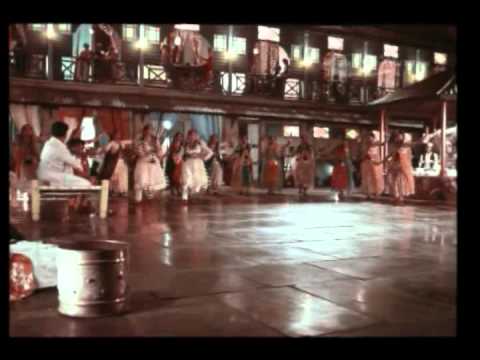
The setting of the first music and dance number of the film - the brothel where Velu meets his future wife. While there isn't a massive amount of musical numbers in the picture, most of them are oddly placed and break up the coherent tone of the film.

As far as the filming goes, there is actually a bit of merit. While this movie was made in 1987, it was clearly working on a budget of, I would guess, around $87. The visuals and sound effects have that cheap, grainy quality of the cheesiest of Kung-Fu Theater movies from the 1970s. Despite these limitations, there are actually some really well-framed and choreographed shots. Also, some of the long shots in Bombay are rather stunning, capturing the different regions of that massive, ancient city. For the most part, the cinematographers did a lot with very few resources.

A final problem I had with the movie is something that could not be controlled by the filmmakers – the subtitles. Nayakan is not an easy movie to get a hold of, and there has seemingly been no high-quality version of it produced for Western audiences. The subtitles were sometimes linguistically clunky and sometimes grammatically mangled. Also, multiple characters’ lines would pop up on the screen simultaneously, often before the second or third person would even speak. This added to the “Kung-Fu Theater Effect”. If a company like the Criterion Collection could get the rights to this movie, polish it up, and do the translation justice, it would help immensely.

Actor Kamal Hassan does a good job of bringing the necessary intensity and heart to the role of Velu Naiker. Unfortunately, it wasn't enough to overcome the elements that I didn't like about the movie.

Ultimately, I have no real idea exactly why the reviewers at TIME magazine put this movie on their “All-TIME 100 Movies” list. While there are some clear merits and strengths to it, Nayakan did not give me anything original. It recycled one of the most famous film stories, and did it with weaker visuals, far less character development, and shoddier execution. Will I ever watch it again? I think you know the answer to that question.

That’s a wrap. 87 shows down. 18 to go.

Coming Soon: The Decalogue (1989):


 This is another film “series”, consisting of ten one-hour movies by the famed director of the Red-White-Blue trilogy, Krzysztof Kieslowski. These will take me a while, but I’m going to do multiple posts on it, so stay tuned.

Please be sure to pick up all empties on the way out. 

Saturday, September 15, 2012

Film # 86: Der Himmel uber Berlin


Title for us English-speaking Types: Wings of Desire

Director: Wim Wenders

Initial Release Country: Germany

Times Previously Seen: once (about 12 years ago)

Rapid-Fire Summary:

In 1987 Berlin, Germany, angels are watching the citizens of the city. With quiet and stoic curiosity, dozens of angels (distinguishable to us by their trench coats and short ponytails) watch living humans, though the angels are completely invisible to people they observe. The angels are even able to listen in on these people’s innermost thoughts, be they benevolent, deeply philosophical, petty, or any other range of quality.

One particular angel, Damiel (Bruno Ganz), becomes intrigued with the notion of actually living as a human. Growing tired of merely chronicling life along with his immortal angelic brethren, Damiel becomes more and more curious about feeling emotions as a human does.

The angel Damiel, looking down on Berlin from on high.

Damiel focuses his desires on Marion, a female acrobat in a small-scale local circus. Marion is a pretty young French woman whose thoughts run towards the very deep and introspective loneliness that Damiel seems to understand. After observing Marion on and off for a few days, Damiel renounces his immortality and enters the vibrant world of human existence.

After a day or so of wandering Berlin, getting his bearings, and receiving a little help from a fellow former angel – the actor we know as Peter Falk – Damiel seeks out Marion. He finds her at a Nick Cave concert in the city. The two meet, exchange some epigrammatic words, and spend the night in each others’ arms.

Damiel and Marion are together the next day, with Damiel assisting Marion in her acrobatics routine. He ponders just how much fuller his life has become since becoming human and finding the woman who appears to be his soul mate.

Though she cannot see him in his angel form, Damiel watches and listens to Marion with growing interest and attraction.

My Take on the Film:

This movie had me totally enthralled. For about 30 to 45 minutes.

It’s not that I found Wings of Desire a complete bore, or that it totally ran out of steam at the 45-minute mark. There are actually some excellent moments in the latter half of the film. In total, though, some aspects of the movie got to be a bit tedious by the end.

The premise of the movie is certainly an interesting one. Watching immortal angels peer into the thoughts of humans at various moments in their lives is compelling. Especially since some of those moments reveal not only thought-provoking observations, but also the silly, cheap, and illogical things that pop into people’s heads. It’s often fun to simply sit back and see what the next person on the screen is going to “think”. I do have to say, though, that the people’s thoughts were generally of the much more positive and amusing type. The director clearly did not want to get into anything overly vicious or nasty. This may have been because Berlin at the time was still dealing with the Wall and the decades-long cultural fallout of World War II. Perhaps the specter of the Wall was enough torment to present in the film.

The primary tale of Damiel is also a time-honored and engaging one. The emotionless immortal pining for mortality is certainly the stuff of romance. Actor Bruno Ganz is excellent at playing the desiring angel, wanting to embrace human emotion, and doing so with a very genuine blend of fear and excitement. His meetings with Peter Falk have a very organic warmth to them that are arguably the movie’s greatest assets.

Peter Falk plays a version of himself as a former angel-turned-human. His conversations to and with Damiel are some of the most touching and amusing scenes in the movie.

Despite the interesting premise, meditative themes, and some solid acting, the movie dragged to me and somewhat disappointed towards the end. Virtually all of the first two-thirds of the film are in black-and-white, to convey the bland perspective of the angels. This makes perfect sense, and it actually works very well for a while. As the film open with long, panning shots over Berlin, along its streets, and inside some of its more striking buildings, it is easy for the viewer to adopt the calm, thoughtful mood required. After about 45 minutes, though, I found myself a bit weary of the constant “deep thoughts” moments that ran virtually non-stop through the picture. It almost became a repetitive drone at times.

Again, one thing that rescued it from being a total drone was the presence of Peter Falk. As a fallen angel himself, he adds a welcome amount of dry humor and fraternal affection that lets you know that the movie still has a pulse.

Maybe the biggest disappointment is the character Marion and Damiel’s ultimate meeting with her. Through her thoughts, we see that Marion is a deeply introspective woman who seems to find pleasure in rather simple things, such as performing in a low-rent circus. However, she does yearn for a larger stage and to find a companion with whom she can be her “whole self”. This is all understandable and admirable, but it is all expressed through thoughts that come across like philosophical treatises. And it really never changes. Even when Damiel finds her and they begin to interact, there isn’t the slightest amount of visible human passion. Marion instead regurgitates some of her thoughts in a bland monotone. Now, I’m no romantic and I don’t need melodrama (I hate it, in fact), but this final scene was like watching two Terminators trying to express their feelings for one another. It was rather a letdown to me.

When it shifts to the human perspective, the film becomes one of color. This is what makes this eventual meeting between Damiel and Marion all the more disappointing - I found virtually no human passion in this scene. 

I do have to say that, even though I have a lukewarm overall opinion of this movie, Wings of Desire has clearly been an influential film. The entire notion of “seeing” into people thoughts in such a panoramic way has been aped countless times since the movie came out in 1987. One example is the R.E.M. “Everybody Hurts” video from the early 1990s, but there are plenty of others. The movie also ties together many extremely heavy and touchingly lighter elements of humanity in a novel way. All the same, I don’t feel any urge to watch the film again, or even watch the sequel movie, Faraway, So Close! (1993).

That’s a wrap. 86 shows down, 19 to go.

Coming Soon: Nayakan (1987):


 Supposedly, this is the India/Bollywood version of “The Godfather”. Or at least, is an epic gangster movie. I have no idea what to expect here, which is sometimes a very good – or very bad – thing.

Please be sure to pick up all empties on the way out.

Friday, September 7, 2012

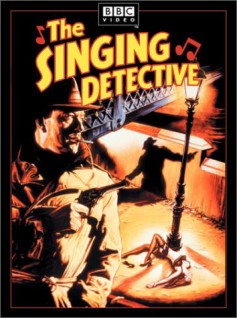
Film #85: The Singing Detective (1986)


Director: John Amiel 

Initial Release Country: United Kingdom

Times Previously Seen: none

Rapid-Fire Summary:

In the mid-1980’s, detective crime fiction writer Philip Marlow is in a hospital ward, crippled by debilitating condition resulting in severe arthritis and massively inflamed and flaky skin. Surrounded by fellow invalids, Marlow fights his way through the pain and frustration by losing himself in his own mind, mostly in his own history and his own detective stories.

As he slips in and out of bouts of pain, three distinct aspects of Marlow’s life come to the fore. The earliest is his childhood in a small village in the English countryside. Though a clever young child, Philip has to deal with his parents’ marital strife, including witnessing his mother’s infidelity with one of his father’s friends.

The second aspect is once of Marlow’s detective novels, The Singing Detective. Though the plot is never completely spelled out from start to finish, it involves World War II espionage and intrigue. Shady characters drift around a dark and foggy London, and an inevitable mysterious death is involved. The primary villain looks exactly the same as Marlow’s mother’s lover, while Marlow himself is the suave private detective who is trying to solve the case.

The hero of his own detective novels, Marlow sees himself as far more dashing and heroic than the crippled figure that he throughout most of the "real" story.

The third aspect is in the modern world. As his illness first worsens and then dissipates, Marlow begins to imagine a nefarious plot involving his semi-estranged wife. He imagines that she is working with a rogue film producer, a man who also looks like the villain from the other two elements from his life that Marlow focuses on. The two are trying to steal a film script of Marlow’s and sell it to Hollywood.

In the end, we see that the Singing Detective novel and the modern tale of the backstabbing wife are all the stuff of a fiction writer’s imagination. However, Marlow’s troubled childhood is clearly very real, and has had a profound effect on his mind and imagination. He leaves the hospital under his own power and with his wife, seemingly not too worse for wear in the end.

My Take on the Film:

This is another one of those shows where no summary can really do it justice. The Singing Detective asks a lot of its audience, to the point that I’m surprised that it was no network television.

First off, patience is a must with this story. The summary I gave above may seem rather straightforward, and perhaps even boring. I assure you, though, that it takes most of the series’ six-and-a-half hours for all of the plot points and connections to become at all clear. Once you get to around the third episode, though, you can see that the show was put together very carefully, and you start to build faith in where it is taking you. Initially, though, you have to have a strong stomach.

A stark contrast to the stylish hero of his own novels, the real Marlow is a physically hideous shell. His illness drives him to hallucinate and verbally lash out at most of the people around him. If you can take it, though, there is far more to him than his repulsive exterior would suggest.

The show certainly wasn’t what I expected, based on the standard summary on the DVDs. I expected far more of the noir elements, which had me rather excited. (Anyone who’s read my reviews of other noir films, like Double Indemnity or Out of the Past can see why). Therefore, it was initially a bit of a letdown to see that a great part of this show is given over to seeing Philip Marlow suffer in a hospital ward. His dreadfully horrid skin condition and his visible anguish over his arthritis is difficult to stomach at times. It actually works well, in that it gives a sense of relief when Marlow retreats into his own head.

These meanderings into his own mind are, of course, what set this show apart from other films and shows that attempt to tap into the psychology of the writer. The Singing Detective seems to get it dead on, in so many ways. Anyone who has ever tried any form of creative storytelling knows that the creative process often involves blurring the lines between fantasy and reality. This is sometimes intentional, but often is deeply subconscious. We can see this happen over and over as the various aspects of Marlow’s life and mind bleed into one another and begin to shift and change upon each interaction. It’s pretty fascinating to watch it unfold over the course of the series.

These shifts do result in some rather surrealistic scenes. This may not be every person’s bag, and it’s not necessarily mine, but it fits the tone of the show extremely well. Seeing a couple of standard 1940s noir goons, complete with trench coats and fedora hats, barge into a 1980s hospital ward and start shooting up the place, is plain bizarre on the surface. But when you realize that it’s the culmination of all of Marlow’s frustrations at his surroundings, then it takes on a different meaning. The series has innumerable examples of this, and attempting to explain them all would take far more words that you want to read or I want to write. Suffice it to say that it is a highly effective way of conveying a complex mental state.

I should mention that the series is far from some gloomy sludge through one man’s torment and misery. There is a very healthy dose of humor throughout the story. Sometimes it’s in the form of songs that break out in the middle of nowhere, and often it is in Marlow’s pitch-black sardonic humor. Whatever the case, there is plenty in the show to prevent it from becoming too depressing.

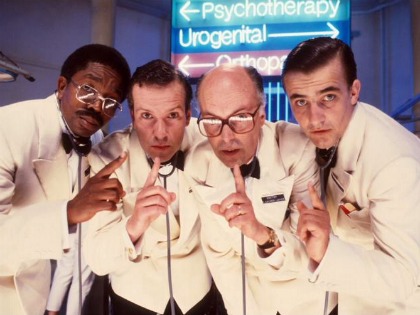
One of Marlow's many fever dreams, in which he envisions the hospital's often detached staff doing song-and-dance numbers in the ward. These scenes are almost reminiscent of Monty Python, but not nearly as heavy on the zaniness. 

Even more than the humor is the very genuine humanity behind it all. Between the many strange hallucinations and disorienting splicing of elements are the very real and powerful emotions of the characters. Whether it is the young Marlow's sorrow at his disintegrating family or the spiteful adult Marlow's attempts avoid embarrassing himself to the people around him, there are several highly memorable and ground-breakingly earnest moments. Along with the humor, these things contribute to an amazing balance to the entire show.

The acting is incredible. The title role is done great service by Michael Gambon, now a staple British actor with many a feather in his cap. Virtually all of the other actors do great work, especially considering the range of grave, bizarre, and outright goofy performances that their parts often required.

The visuals are nothing to speak about. As with a lot of great BBC shows in the past, the crew seemed to be working with a very limited budget, but they made the absolute most of it. The show has a grainy, sometimes washed-out look to it, which can add to the sense of despair in a lot of places. Still, it is not the visuals whereby this show finds its strengths.

Would I watch this show again? Probably not. Even though I think it is an excellent piece of work, and exceptionally unique in its boldness, I don’t know that repeated viewings would offer me much. Once is probably enough for me to appreciate it and agree with its place as an all-time great.

That’s a wrap. 85 shows down. 20 to go.

Coming Soon: Wings of Desire (1987):


 I saw this German flick a number of years ago. It’s about a love-struck angel, and it’s got Peter Falk and Nick Cave in it. What more do you need to know?

Please be sure to pick up all empties on the way out.

Sunday, August 26, 2012

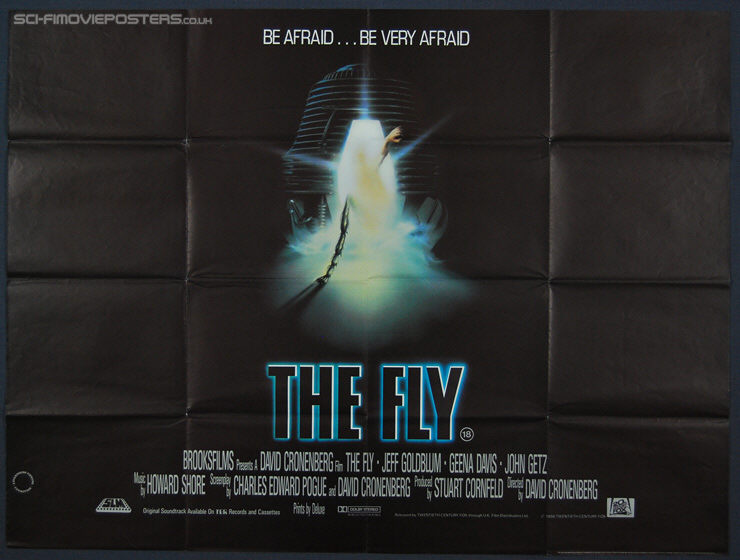
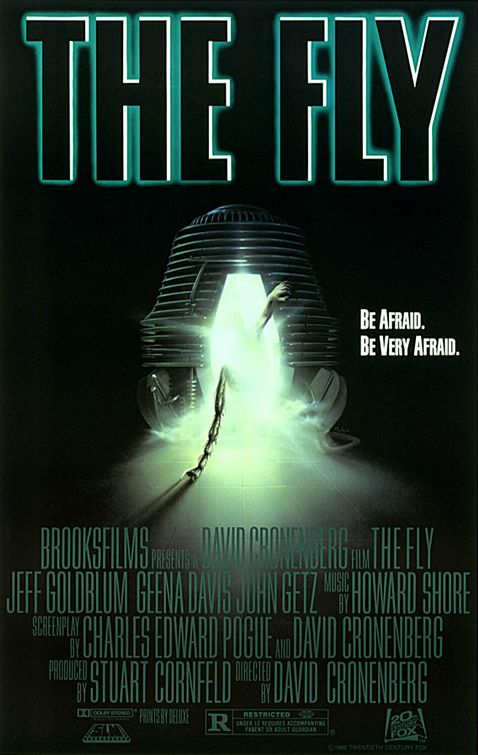
Film #84: The Fly (1986)


Director: David Cronenberg

Initial Release Country: United States

Times Previously Seen: around 5 or 6 (last time probably 20 years ago)

Rapid-Fire Summary:

At a science convention, an eager young journalist, Veronica Quaife (Geena Davis) meets an eccentric and enthusiastic man named Seth Brundle (Jeff Goldblum). Brundle swears to Veronica that he is sitting on the invention that will change human history. Though skeptical at first, Veronica is curious enough to follow Brundle to his warehouse laboratory and finds that he has created telepods – mechanical devices that can transport matter instantaneously from one location to another. The only problem is that it can only work on inorganic objects. Brundle proclaims, though, that he will work this out soon enough.

Over the next few weeks and months, Veronica chronicles Brundle's attempts to solve the “organic matter” problem, and begins a romantic relationship with the quirky yet charming genius. He eventually figures out how to transport organic matter, though he waits before attempting it on a human. One night, however, in a drunken fit of daring, Brundle steps into the pod and successfully transports himself. What he doesn't know, though, is that a housefly has flown into the pod at the same time, and that they have both been fused on a genetic level.

As the next few days and weeks unfold, Brundle begins to undergo and gradual yet steady transformation. At first, he shows phenomenal strength and energy levels. Eventually, though his skin starts to change and he begins to exhibit territorial and violent tendencies. Brundle discovers the truth about how he and the fly are now becoming some sort of mutated hybrid of each other, and tries to discover some way to stop it. His efforts fail, however, and he continues his horrifying metamorphosis.

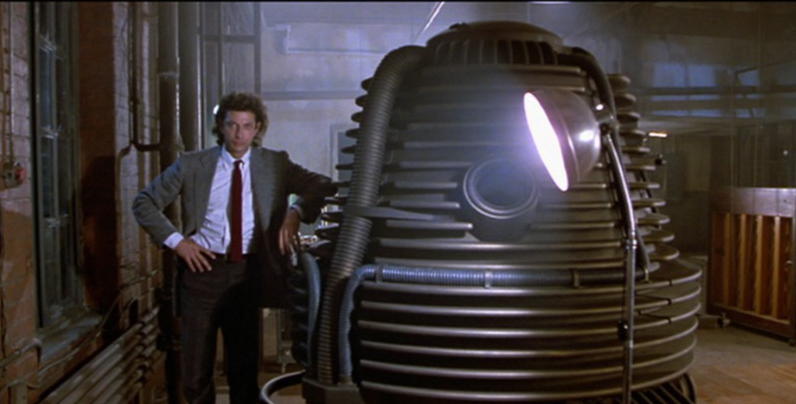
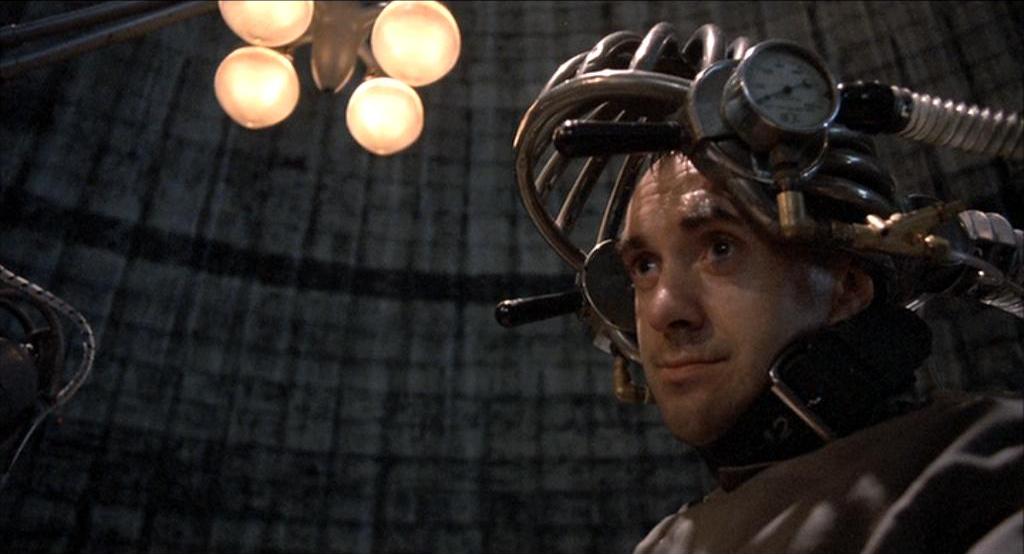
Dr. Seth Brundle, next to his greatest invention, and the very thing that will spell his grisly doom.

Making matters even more terrifying is the fact that Veronica discovers that she is pregnant with Seth's baby. While she had previously been attempting to help Seth find a cure, she has had to flee from his increasingly brutal and warped nature. When she goes to have an abortion of their child, Seth abducts her from the hospital and brings her to his lab. The now-barely recognizable Brundle hopes to enact a mad plan by which he will transport and fuse himself, Veronica, and their unborn child into one creature. Brundle almost succeeds, if not for Veronica's past lover and current editor, who fends off Brundle long enough for Veronica to escape.

In the end, a mishap with the telepods leaves the Brundle/fly creature fused with part of the pod. The creature claws its way to Veronica and begs for the mercy of death, which Veronica grants by shooting it.

My Take (Done after this most recent viewing):

This movie still packs every bit of punch that it had 26 years ago.

The Fly is as horrifying as it is compelling. I'm not any kind of horror film buff, but I'll take one in every once in a while. From what I have seen in the decades since David Cronenberg's science-fiction horror show, I can't think of another film that is as powerfully hypnotic and terrifying.

As stated at the end of my last review, I remember watching this movie many times when it was available on VHS, back when I was 12 and 13 years old. I was certainly freaked out by it back then, and I'm pretty sure that I'll have a few nightmares after this most recent viewing as well. As a kid, I was enthralled by the special effects that transformed Jeff Goldblum into the titular creature. These were, of course, the very things that brought The Fly to popular consciousness back in 1986. To this day, they hold up amazingly well, and they illicit the same visceral reaction now that they always have and always will.

This montage shows the stomach-turning devolution of Dr. Brundle. Watching it unfold throughout the film is part of the macabre magnetism.

The visuals, though, tell only a part of what makes this movie so powerful. Primarily, it is that, right up to the end, you care about the people involved. This includes, surprisingly, the monster that Dr. Brundle becomes. In the early going, we quickly see that he is quirky, brilliant, and oddly charismatic. The love that develops between him and Veronica feels very genuine. This is what makes his slow and terrible transformation and destruction so tragic.

The character of Veronica amplifies this even more. Through the entire macabre affair, she tries to help Brundle, even towards the end, when virtually nothing of the man that she loves is left. Arguably the most powerful scene is the final one. As the Brundle creature emerges from the telepod, now an utterly grotesque fusion of the man, the fly, and hulking parts of an inanimate telepod, the tale does not go the traditional horror movie route. In nearly all horror films, the monster makes a final lunge at the fleeing humans, only to be killed in self defense. In The Fly, instead, the monster crawls up to Veronica and makes a final plea for the release of death by gently drawing the shotgun to its own head. This shows that there is some final shred of humanity, if only in the form of self-pity, left inside of it. It is a pathetic emotion, but one that inspires just enough compassion to give the tale its final cruel and tragic twist.

A less obvious theme in the film is that of primal, animal attraction. In the beginning stages of Brundle's transformation, when he still appears to be human, he shows phenomenally enhanced strength and drive. One just has to look at the faces of Veronica and Tawny during these stages to see how attracted they are to his seeming virility, while at the same time being slightly afraid. These are two very basic, very tightly interwoven compulsions in humans, whether we want to admit it or not. It is also these same two aspects that Cronenberg explored more overtly in A History of Violence.

Through most of the movie, including most of his repulsive metamorphosis, Goldblum makes Seth Brundle a far more sympathetic character than you might expect.

The storytelling is incredibly tight. Even though there were plenty of the quieter, more interpersonal scenes that I had forgotten from my childhood viewings, the movie never slows down. Right from the opening scenes, we get caught up in the wonder of discovery and the potential for what Dr. Brundle has created. We then get the thrill of watching him improve and develop his invention so that it can transport organic matter. Once he teleports himself, not knowing that the fly has been fused with him, it's almost impossible to stop watching. Especially if you haven't seen the movie before, waiting to find out just how far Brundle's physical appearance will deteriorate is a bizarre magnet, pulling us along.

The performances certainly enhance, if not necessarily make, the movie. Geena Davis does a fine job expressing the compassion, disgust, and revulsion that the part requires. More than her, though, is Jeff Goldblum. Once you see this movie, it is no mystery as to why he has been typecast as “the creepy yet charismatic scientist” in no less than a half dozen films. In The Fly, Goldblum exhibited probably the widest range of his acting life, going from the shy, witty, brilliant innovator to the brute creature, while retaining an oddly charming gallows humor through nearly the entire gut-wrenching affair. It was a feat that few actors could have pulled off.

The Fly is one of those films that is powerful in so many different ways that I can see why it is considered “great”. That being said, it is disturbing and grotesque enough that I can't see myself watching it again for at least a very long time. Fortunately, though, it is a film that imprints itself so strongly in one's mind, that watching it twice in a short time is an effort in redundancy.

That's a wrap. 84 shows down. 21 to go.

Coming Soon: The Singing Detective (1986):


This promises to be a more light-hearted affair than the last made-for-TV film series that I watched, Berlin Alexanderplatz. I really don't know anything about it, though. This is often a very good thing, and I'll find out soon enough.

Please be sure to pick up all empties on the way out.

Monday, June 25, 2012

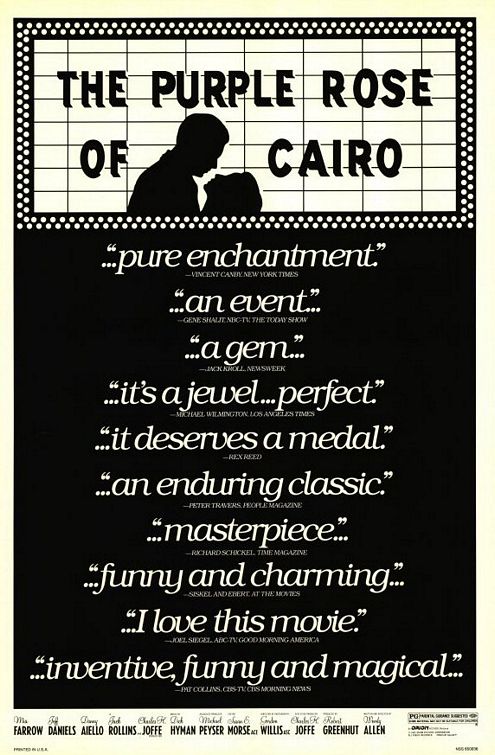
Film # 83: The Purple Rose of Cairo (1985)


Director: Woody Allen

Initial Release Country: United States

Times Previously Seen: once (about 2 years ago)

Teaser Summary (No spoilers)

Depression-era dame escapes from the drudgery of her life at the movie theater, only to have one of the screen characters come to life and pursue her.

Extended Summary (More detailed synopsis, including spoilers. Fair warning.)

New Jersey, the Great Depression. Cecilia (Mia Farrow) is feeling the full brunt of the economic malaise that the country is in. She lives in a tiny, run-down apartment and struggles to maintain a monotonous waitressing job at a local diner. To make matter much worse, her husband Monk (Danny Aiello) is a complete leech. He wastes his time gambling with friends and cavorting with other women rather than looking hard for a job. He also drinks too much and abuses the meek Cecilia regularly.

Cecilia’s only real pleasure in life is watching movies. She is a regular at the local theater and voraciously watches everything that plays. She knows all of the films’ stories, actors, and actresses, and she adores the romantic personalities and stories on the screen. Even though no one around her, including her sister and her husband, shares or understands her passion, Cecilia is perpetually enthralled by movies.

Cecilia (in the front), slogging through her waitress job. Her sister, like everyone else close to her, dismisses Cecilia as a flighty dreamer.

One day, Cecilia goes to see the latest film release – The Purple Rose of Cairo – which is a standard 1930s adventure/screwball comedy/romance picture. She loves the film, especially the character Tom Baxter (Jeff Daniels), who is a handsome, well-spoken and well-mannered explorer from a rich family. Cecilia tries to explain her love of the picture to her sister at her job the next day, but gets distracted, drops several plates (something she has done several times before), and she gets fired. She returns home to find Monk drinking and joking with another woman, both of whom drunkenly stagger out into the night. Cecilia decides to go back to the movie theater.

Over the next few days, Cecilia continues to watch The Purple Rose of Cairo repeatedly. Suddenly, in the middle of her fifth viewing, the Tom Baxter character on the screen turns and makes eye contact with Cecilia. He then begins to address her directly. Cecilia, stunned at first, then replies. They talk briefly about how much Cecilia must love the movie, and then Tom Baxter literally walks out of the movie – from the black and white screen to full-color “real” life with Cecilia. All of the theater-goers witness the same thing, but before they can do anything more than stammer, Tom and Cecilia leave the theater.

Through the evening, Tom and Cecilia stroll around town and talk. It becomes clear that Tom, though now in the real world, is still very much a fictional construct. He is brave and adventurous, and he has highly romantic notions about love, sex, and the world around him. Cecilia is highly captivated by Tom, and she almost seems to be falling in love with him; however, she pulls away on account of her being married. They part ways, but Cecilia promises to return the next evening.

Cecilia and Tom get to know one another, despite the massive divide of one being a real human and the other being a fictional character come to life.

Back at the movie theater, The Purple Rose of Cairo is still showing, sans Tom Baxter. The rest of the characters in the movie, rather than continuing on with their parts, have stopped what they were doing and are directly addressing the audience. It seems that they cannot continue the movie until Tom returns. Word of this gets out and makes it all the way back to Hollywood, where the movie studio that produced The Purple Rose of Cairo begins to panic about possible ramifications of a rogue movie character that has entered reality. On top of this, other “Toms” in other movie theaters around the country have begun trying to “escape” the screen.

The studio goes into action. They contact the actor who plays Tom Baxter, Gil Shepherd (Jeff Daniels). Shepherd is a self-involved rising star in Hollywood, and he is interested only in advancing his career. When he hears about the escaped Tom Baxter and the potential fallout for his career, he jumps on a plane to New Jersey.

The next day, Tom Baxter explores the city, unintentionally ending up in a brothel. There, his naivete and charm woo the prostitutes, though he has no intentions of sleeping with any of them, due to his impossibly pure sense of nobility and honor. Elsewhere, Cecilia accidentally runs into Gil Shepherd, who has arrived to track down Tom. The two men looking exactly alike, Cecilia first mistakes him for Tom, but soon realizes that she is talking to Gil, an actor whose work she has admired for years. The two pair up to seek out Tom and sort out the entire situation.

Through the day, Cecilia and Gil seem to grow close. As they roam the town searching for Tom, Cecilia shares her love of movies with Gil. Gil, completely egoistic and narcissistic, is all too happy to soak up her admiration. In a moment of seemingly true affection, the two end up in a music shop and play several songs together, Cecilia playing a ukulele and Gil singing. A real romance seems to be budding, and this forces them to find some sort of solution to their strange dilemma.

In the middle of their search for Tom, Cecilia and Gil seem to find the beginnings of a legitimate romance. Little does Cecilia expect the awful truth.

Eventually, Cecilia and Gil find Tom back at the movie theater, where the screen characters of The Purple Rose of Cairo still wait impatiently for Tom to rejoin them. Tom and Gil both engage in a war or words for Cecilia’s affection, with Gil eventually convincing Cecilia to let Tom return to the screen, so that she can join him. Gil tells her to return to Hollywood with him, where they can be together. Cecilia chooses Gil, and Tom reluctantly reassumes his place on the silver screen.

Gil returns to his hotel, with a promise to meet Cecilia so they can go back to Hollywood together. Cecilia goes to her own rickety home, packs her bags, and bids a very short farewell to her befuddled and angered husband, Monk. When Cecilia gets to Gil’s hotel, though, she is told that he has already left. We briefly see that this is true, with Gil on a plane already headed back to California. Apparently, his “love” for Cecilia was mostly a ruse to get her help in forcing his Tom character back to the screen. Though Gil does seem somewhat guilty over his machinations, he does not return for Cecilia.

Back in New Jersey, Cecilia is now without a lover, home, job, or husband. She returns to her one place of refuge – the movie theater. There, she loses herself in the latest film – Top Hat, starring Fred Astaire and Ginger Rogers, who gleefully dance about the screen, possessed of a joy that Cecilia may never come close to knowing.

Take 1: My Gut Reaction (Done after this most recent viewing, before any further research)

I enjoyed this movie a bit more than the first time I watched it, and I can see why it is widely considered Woody Allen’s best and most accessible movie.

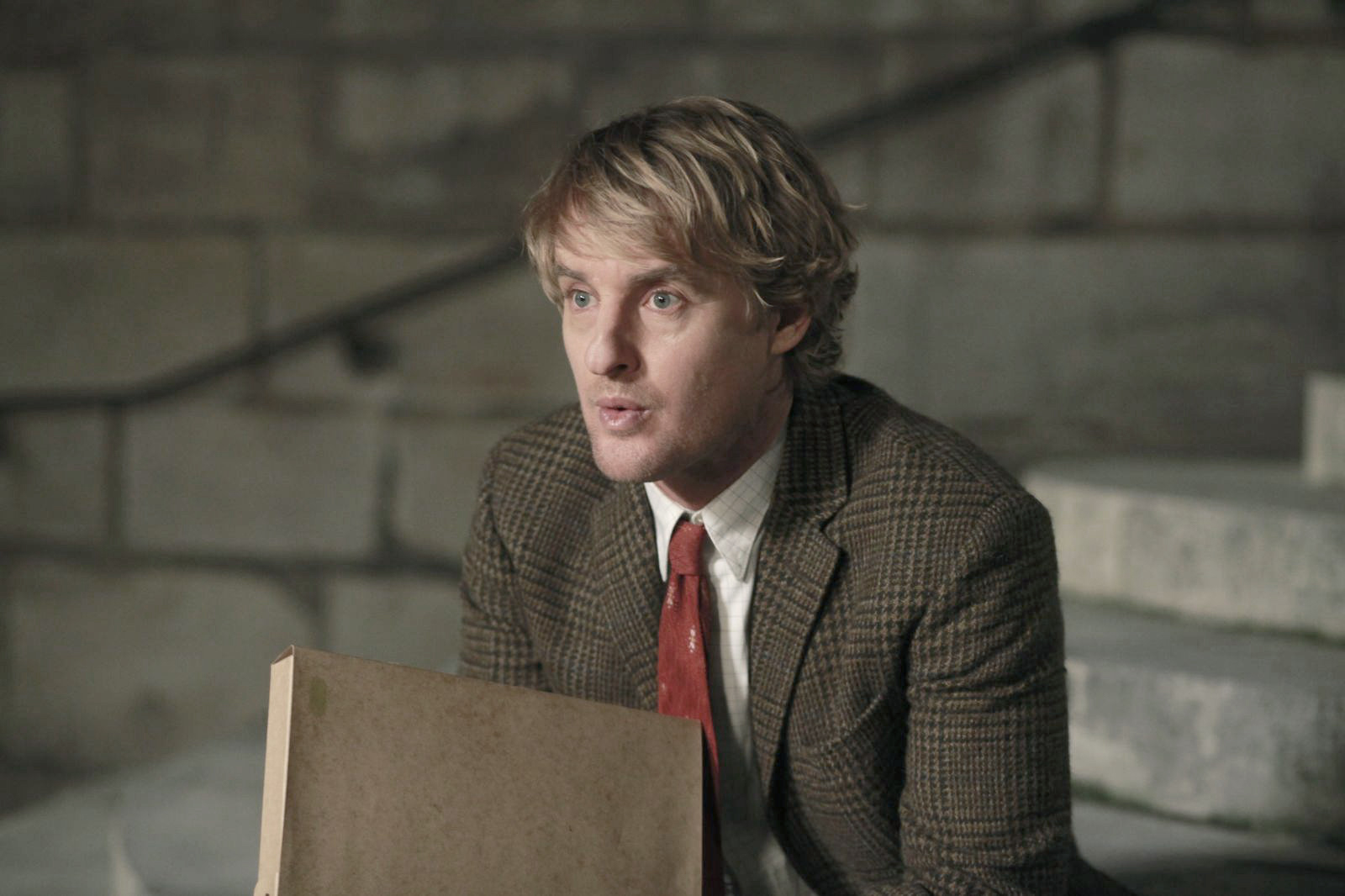
For people who either don’t know or don’t like Woody Allen movies, The Purple Rose of Cairo is one of the least “Woody Allen” of them. By this, I mean that it is the very rare Allen movie in which Allen himself does not appear and there is no “Woody Allen” proxy, as we find in films like Bullets Over Broadway, Celebrity, or Midnight in Paris, in which the “Woody” is played by another actor like John Cusack, Kenneth Brannagh, or Owen Wilson, respectively. For anyone who finds Allen’s ever-neurotic intellectual persona annoying, this is a major merit in favor of The Purple Rose of Cairo.

Owen Wilson, the de facto "Woody Allen" in Midnight in Paris. For those who don't care for these characters, Purple Rose  is blessedly absent of them and their predictable neuroses.

Another feature that often shows up in Allen’s movies is the intellectual vibe, which is something that the Purple Rose of Cairo mostly lacks. This is a good thing. Often, Allen’s movies feature jokes that require a viewer’s knowledge of literary or cinematic history. This is easily seen in his most recent film, Midnight in Paris, in which most of the gags are lost if you don’t have some background knowledge of Ernest Hemingway, F. Scott Fitzgerald, and the like. While I personally enjoyed the jokes in that film, I find them somewhat exclusionary at times. The Purple Rose of Cairo is a movie that requires no such prior knowledge on the part of the viewer. It is self-contained, and thus can be enjoyed by nearly anyone.

Purple Rose does, however, bear certain other hallmarks of Woody Allen storytelling. The entire concept of a movie character literally coming to life shows some of the zaniness that you get in some of his other films, again most notable in Midnight in Paris, in which the protagonist is able to cavort with various literary figures from the past. Similarly, The Purple Rose of Cairo is a flight of fancy that sets up some really humorous and thought-provoking interactions and conversations.

This brings up what, to me, is the strength of the film, though one that doesn’t quite go far enough – the study of we viewers’ relationships to films and the film industry. All of us who watch fictional movies are, to some degree, escapists. We seek to escape into some other world and dwell there as passive observers for a time. The character Cecilia is far more dedicated (one could say “addicted”) than most, and with good reason, given that her reality is so miserable. For her, films are the one place where things make sense and are pleasurable. However, this far from tells the whole tale.

The hopelessly transfixed Cecilia, whose attraction to film goes beyond affection and well into the realm of dependency. There are probably far more Cecilias out there than we care to acknowledge these days.

Once Tom jumps off of the screen and Gil becomes involved, the tale begins to approach a criticism of movie magic and the film industry in general. One can start to see Cecilia as a dupe who has been lured by the carefully crafted, artificial glitz and glamour of Hollywood. Not just the films themselves, but also the entire culture surrounding movie stars. This is typified by the Gil Shepherd character. While it becomes clear early on that Gil is totally self-obsessed with becoming a film star, we and Cecilia are led down a romantic path of “true love”, only to be left high and dry at the end. I can’t help but see Cecilia as being the eternal mark for various con artists – her deadbeat husband, the fantasy world of popular movies, and the movie business itself. All of these elements in her life, exemplified in the film by Monk, The Purple Rose of Cairo, and Gil Shepherd, extort her for everything she has. While I felt that Woody Allen was making these criticisms, I think he eased up just a tad, so as not to make the film overly depressing or to rob it of its oft-comic tone.

It is this “going half way” feeling that I have that prevents me from considering this movie an absolute great. There were a few too many topics that were either half-baked or incompletely explored. For instance, the Tom Baxter character often explains his actions as “being written into his character”, as if they were set in stone and unchangeable, such as his duty to defend Cecilia by getting into a fist fight with Monk. Yet, there are certain moments when he makes realizations about the “real” world and starts to adapt, such as when he insists on running out on an expensive dinner check. These conflicts of innate character could have been delved into a bit more and given an even-more thorough treatment. If we’re going to start mashing up fiction and reality, let’s see what the ramifications will be, especially on people like Tom and Cecilia.

On the technical side, The Purple Rose of Cairo is all but flawless. It’s a great film to look at, hear, and just take in, especially for film lovers. Woody Allen’s affection for cinema is very clear, despite an implied condemnation of its overall effect on certain people. The film paints an evocative portrait of the Depression in the U.S., even though it only covers a handful of geographic areas. Anyone who enjoys 1930s styles and attitudes would certainly love the aesthetic of The Purple Rose of Cairo.

It's not hard to bask in the look and feel of many of the scenes in the film. Especially in the movie theater, the Art Deco style does a great job of transporting us back to a time when very few of us were alive.

For a fairly light-hearted movie like this, I often ask myself “Would I watch it again?” My answer is “Yes,” which speaks to its staying power. However, I wouldn’t go quite so far as calling it a “great” film. I don’t know that it broke any barriers or showed any particular mastery of the medium. I find it to be a clever, imaginative, and well-told story, but not one that I feel compelled to return to again and again.

Take 2: Why Film Geeks Love this Movie (Done after some further research.)

Since The Purple Rose of Cairo is not some epic, laborious task of a film, there’s not a ton of insight to be found in researching it. This is not a film with the combative release history of Brazil, or a film that was the target of hardcore blacklisting like Citizen Kane. Thus, analysis and criticism of it is somewhat limited and narrow. Also, none of it adds much that one can’t see upon viewing the movie for oneself. There are a few interesting thoughts, though:

One is the point that the movie ends on such a down note. This is something that may very well take a first-time viewer aback, given the otherwise playful tone of the rest of the film. In fact, the distributor Orion Studios wanted Allen to change it (here we go again, with the U.S. film industry wanting the “happy ending” to beef up the bottom line). Like other filmmakers with integrity before him, Allen absolutely refused. This truly did make for a much more poignant and thoughtful film. Had Cecilia been able to fulfill her dream of escaping her sad life with either Gil or Tom, the deepest and most meaningful points of the movie would have been lost.

On these deeper points, uber-critic Roger Ebert did a nice job of summing it up in his original review. Ebert does a good job of explaining its understated strengths, and signs off on his critique with the great sentence, “The more you think about "The Purple Rose of Cairo", and about the movies, and about why you go to the movies, the deeper the damned thing gets.”

I can’t say it better myself.

That’s a wrap. 83 shows down. 22 to go.*

Coming Soon: The Fly (1986)


 This movie scared the absolute hell out of me when I was 11 years old. All the same, I watched it no less than half a dozen times. Why would I do that to myself? Maybe I’ll figure it out when I watch it again.

Please be sure to pick up all empties on the way out.

*It has come to my attention that a mere few weeks ago, the main film critic at TIME magazine, Roger Corliss, has thrown a curve ball. Corliss helped compose the original “100 Great Movies” List that I have been using for this blog, but he has just added 20 films to the list, ranging the entire chronological spectrum from 1923 to 2011. I may try to add what I can, but here are his additions, if you’re curious.

Thursday, May 31, 2012

Film # 82: Brazil (1985)

Director: Terry Gilliam

Initial Release Country: United States

Times Previously Seen: twice; last time about 10 years ago.

Teaser Summary (No spoilers)

Lonely bureaucrat in an Orwellian alternate reality seeks to escape his society’s trappings to find romantic love.

Extended Summary (More detailed synopsis, including spoilers. Fair warning.)

In an unspecified time, in an unspecified European country, Sam Lowry (Jonathan Price) is a mid-level bureaucrat working for the massive government machine. He works in a dismal factory environment crammed with pipes, papers, and employees who spend plenty of time shuffling around both themselves and various order forms. Amid all of this, Lowry has daydreams of flying among the clouds as an angel, seeking out a beautiful, unnamed woman who is trapped in gossamer netting.

One day, his office receives notice of an error made by one of the countless departments within the system – a typo has led to the brutal arrest, retrieval, torture, and death of an innocent man, Harry Buttle. Buttle has been mistaken for Harry Tuttle (Robert De Niro), a known “renegade and terrorist” engineer who runs around the city, illegally fixing people’s electrical problems without the proper paperwork. Lowry recognizes the mistake and volunteers to bring a pittance check to the bereaved widow.

 Sam assists his lazy boss in sorting out the "error" that led to Buttle's death. This kick-starts Sam's quest for his dream girl, Jill.

At the Buttle widow’s apartment, Sam comes in contact with Jill Layton (Kim Greist), the Buttles’ upstairs neighbor, who also happens to be the very vision of the woman in his dreams. Since Buttle’s erroneous arrest and death, Jill has been working her way through the endless government channels to find who is responsible for her neighbor’s wrongful death. Her tireless pursuit of justice through these channels has also earned her status as a fellow terrorist aid to the renegade Tuttle. Sam tries to pursue her, but Jill offers no information and flees, fearing anyone from the government.

Back at his apartment, Sam runs into the real Harry Tuttle, who barges in so that he can fix Sam’s broken air conditioner. While efficiently fixing the problem, Tuttle explains that he was a government engineer, but left because the amount of paperwork. Before Tuttle leaves, Sam also helps him deal with a pair of government workers who show up (many hours late) to fix his air conditioner.

Now obsessed with finding Jill, Sam decides to take a previously-offered promotion into the Ministry of Information Retrieval, the department in charge of all information gathering. Sam had refused the offer, which was the result of the machinations of his image-obsessed and vain mother, due to his contentment with his low-level, low-stress job. Now, he accepts and becomes an Information Retrieval officer.

After obtaining some general information about Jill, he comes across her in the office building as she continues to seek justice for Buttle’s death. Sam finally reaches her. Jill at first tries to shake Sam away from her, but he eventually convinces her that he is, indeed, deeply infatuated with her. With government officers on her trail, Jill goes with Sam into hiding. Sam sneaks back to the Ministry of Information Retrieval and falsifies the records so that Jill shows up as “deceased”. He returns to her and the two share a romantic evening together.

 Though unglamorous and unassuming in real life, Jill is the object of Sam's self-destructive pursuit of love.

The next morning, the state police barge in and take Sam away. He is run through the draconian, yet clinically anaesthetized legal process, and ends up in a torture room. Just as he is about to be tortured (by his old “friend”, Jack Lint (Michael Palin) from his previous job), his torturer is shot through the head by Harry Tuttle and a gang of terrorist raiders. The raiders pull Sam out of the building, and he flees with Tuttle.

The world around Sam starts to become more fantastic and dreamlike during his escape. He and Tuttle run into a shopping center, where Tuttle inexplicably becomes shrouded by massive amount of flying papers. When Sam tries to pull the papers off, Tuttle seems to have vanished altogether. Sam runs into what appears to be a church, in which a funeral is taking place. The deceased is announced as one of Sam’s mother’s frenemies – a fellow plastic surgery addict who had been growing ever-more deformed through botched procedures. Next to the coffin is Sam’s mother, now transformed into a woman who appears to be in her mid-20s, and who looks exactly like Jill. She is being fawned over by eager young men, and she brushes Sam away from her.

Retreating outside, Sam is once again in a world even bleaker than anything we’ve yet seen – the buildings are cold, rigid, flat, gray structures that tower over him. A gang of policemen pick up their pursuit of him again, chasing him into a massive wall of the flex-piping that is ubiquitous in Sam’s life. After frantically digging through the pipes, Sam finds himself in a trailer being driven by Jill. Once again united with his lost love, the two drive off in seeming bliss.

However, this perfect happy ending abruptly ends when we see Sam back in the torture chair deep within the Ministry of Information Retrieval. In fact, the entire escape from the torture room was a pure fantasy brought on by the torture. Sam, now thoroughly insane, has sought refuge in his unrealistic and childish fantasies of escape from the system that has now effectively destroyed him.

Sam's destiny ends here - in the torturer's chair, completely insane and disconnected from his warped reality.

 Take 1: My Gut Reaction (Done after this most recent viewing, before any further research.)

A very brief history: I love Terry Gilliam. I’m not a blind worshipper, by any means, and there are a few of his films that have fallen flat for me (The Fisher King and Tideland, specifically). Most of his work, though, I find wonderful, in the truest sense of the word. From the moment I watched Time Bandits as an 8–year old child, I was hooked. With this movie, and others like The Adventures of Baron Munchausen, I got a great combination of childlike wonder, fun adventure, and humor that magnificently ran from silly to wry.

With Brazil, it was only upon this recent viewing that I can say that I now fully appreciate it. It really is his best film, and it is not difficult to see just why it made the TIME 100 list.

Brazil is not Gilliam’s gravest or most serious work, but it is his most artful and will ultimately be his most lasting. By drawing from the more timeless themes of the human condition, namely individuality versus conformity, he sets this work above all of his others and makes a visually arresting statement about human psychology in the post-Industrial Age. It was something that writers and observers had been doing for decades prior to Brazil, but Gilliam was the first to express it so stunningly in cinema.

It’s not hard to see in the protagonist, Sam Lowry, the essence of George Orwell’s Winston Smith in the seminal novel 1984. Lowry, like Smith, is part of a totalitarian system in which a sprawling and invasive government has molded its citizens into a populace that has sacrificed its creativity and freedom for the “security” of bland superficiality. The various “Ministries” in Brazil are virtual parallel to those in 1984. The contribution that Gilliam made in his film is that we can now see the results in the form of revolting starkness. Between the towering grey buildings and the endless miles of piping in Brazil, a viewer feels totally crushed and hemmed in on all sides. As a viewer, I found myself yearning for the more colorful, fantastic dreams that Lowry would drift into, childish and unrealistic as they might be.

 Sam's dream self. These play out like the fantasies of a 13-year-old boy, which is what Sam is, emotionally.

It is this childishness of Lowry that was my grand revelation upon this most recent viewing. When watching this film times past, I never quite realized that Lowry is meant to be seen as completely out of touch with his own reality. This is something that, at one point, Jill expresses to him in those exact words. Once Lowry sees Jill for the first time, he becomes possessed of a completely juvenile mania to track her down, in the process destroying his own life and any chance of happiness. I realized that this is not due to a lack of intelligence on Sam’s part, but rather the fact that he has been so repressed by the hulking system around him that he is not capable of handling emotions such as love (or at least, infatuation) as a mature adult. Instead, he charges headlong after Jill and is inevitably crushed in all ways possible.

Someone who hasn’t seen the movie and reads my previous paragraphs would think that Brazil is a humorless slog through dour sociopolitical commentary. Far from it. As with all of his other films, Terry Gilliam gives us plenty of humor to carry us through. Gilliam was an original key member of Monty Python, and it’s not hard to see it in any of his films, including Brazil. No, there are no “Lumberjack” songs or overtly silly antics, but a certain “Python” tone is there. Whether it’s the goofy hats that the government electricians wear or the willful obliviousness of a professional torturer, there are plenty of comedic moments, light and pitch dark, alike. It’s not stuff of gut-busting hilarity; rather, it’s humor calculated for extreme effect. It all conveys just how unaware nearly all of the characters in the film are to their situation.

One of the best examples of this lack of admission is when Lowry tracks down the Ministry’s “Information Retrieval” department on his mission to find Jill. When he reaches the office, he hears the bloodcurdling screams of a “detainee” being tortured in an otherwise stately-looking office. Once the session is finished, Sam walks in to see the back of the torturer (the Jack Lint character played by Monty Python alum Michael Palin), hunched over as he sobs uncontrollably. Once Sam announces his presence, though, Lint turns and composes himself in a split second, utterly refusing to face just how horrific are the acts that he performs on a daily basis. This perpetual denial is arguably the most lasting notion of the entire film.

 Jack Lint, covered in blood from his latest victim, though putting on the eternal "good show" of a smile to others.

And it is scenes such as this one in which Gilliam’s humor is a tremendous asset to the movie. The entire tone of the scene is one of chilling horror, and yet you almost can’t help but chuckle when Sam confronts his former coworker. It is one of dozens of moments that elevate Brazil from straightforward social commentary into more Swiftian satire. It was this entire angle that had eluded me in previous viewings, and which I am very glad to have noticed this time around.

As you may glean, Brazil is not a barrel of laughs. Anyone familiar with Gilliam’s other more popular, much more “Python-esque” movies should not expect a sibling of Time Bandits, Holy Grail, or similar ilk. Rather, Brazil is those movies’ distant, dark cousin. A dark, brooding, and far more intelligent cousin whose somewhat silly gags can mask brutally sardonic observations.

Take 2: Why Film Geeks Love This Movie (Done after some further research.)

The story of Brazil’s creation and execution is rather interesting, but nearly as interesting and highly publicized as its studio release.

When you watch Brazil, you’ll probably be highly amused, if not dazzled, at some of the brilliantly funny lines of dialogue. If so, then you probably won’t be surprised by the fact that one of the co-writers was Tom Stoppard, accomplished writer of witty gems like Rosencrantz & Guildenstern Are Dead. As gifted as Gilliam is, he needed some help adding narrative cohesion and sharper dialogue to his tale, and Stoppard obliged.

Reading about Gilliam’s filmmaking reveals a few things. Often, his crew has nightmares about the scenes that he writes, due to their highly fantastic nature. One can easily say (as Gilliam himself probably would) that his artistic visions usually push or pass the boundaries of practicality, in terms of actual production. This is something that links to one of Gilliam’s favorite filmmakers – Federico Fellini. In Fellini’s 8 ½, the very subject is a talented director’s disconnection from reality and how this plays out in both his life and his films. While I can’t speak to Gilliam’s personal life, it is a problem that has almost always been a characteristic of his movies, which often get squeezed or completely crushed by financial backers who will not fund the grand designs of Gilliam’s dreams. When they do happen, though, the results are often magical.

 Executing shots like this has always been a nightmare for crews who work on Gilliam's films, but the end results are often stunning and impressive.

An interesting side note about Gilliam, based on past interviews – he has a real chip on his shoulder about certain directors, namely Steven Spielberg and George Lucas. He has considered them as panderers to the masses, and overly commercial. In addition, he sees Lucas as particularly personifying the uglification of movies through overuse of CGI. I have to agree, as my own sentiments echo Gilliam’s, regarding the StarWars prequel trilogy.

The eventual release of Brazil is probably the most interesting tale behind the finished product. To make a long story short, the studio executives did not see Brazil as “commercially viable”, being too long, too dark, and too quirky for a wider audience to enjoy. Gilliam, who had contractual final cut on the movie, staged something of a guerrilla war against one particular executive who stalled the film’s release and who pushed for a much-altered version of the film. A quick look at the two versions is very telling.

Gilliam’s version (as described above) is obviously very dark, making the point that the society portrayed in Brazil is so bleak and entrenched that a lone, unrealistic dreamer never stands a chance. It’s a bold and interesting, if not exactly uplifting, statement. The studio, and one man in particular named Sid Sheinberg, had the fantasy sequences almost completely eliminated, pared the film by over 40 minutes, and gave the film a happy ending with Sam and Jill living on a “happy valley” farm outside of the totalitarian city in which they had lived. This is interesting since it is almost exactly what was encountered by Ridley Scott’s Blade Runner several years prior.

 One of the final shots of the legitimate Gilliam ending. The serene landscape in the background contains the "happy ending" that Sheinberg wanted to release. If he had had his way, Brazil would not only have been forgettable, but also probably a plain old, bad movie.

Gilliam flipped. He refused to put his name on any such film, as it so distorted the story that he was telling. What followed was a drawn out back-and-forth between studio, Gilliam, and a gaggle of lawyers. In the end, Gilliam’s version of Brazil was released, much to the delight of certain parties who were fighting for its artistic integrity.

The critical reaction was actually rather mixed upon its release in late 1985. Some hailed it as a masterpiece work, and it won several regional awards. Other groups of critics all but ignored the movie, or gave it lukewarm reviews. Commercially, it managed to just break even.

In the 17 years since its release, Brazil’s stature has grown impressively. While no one is going to call it the greatest movie of all time, it is widely considered exceptional, and is easily one of the most singular and interesting films of the 1980s. It also served as a clear inspiration for later films, such as the Coen brothers’ The Hudsucker Proxy and others. The “retro-future” designs of the costumes and sets, which blend older Victorian-era styles with hyper-Industrialized and futuristic elements, has also been seen as an inspiration for the “steam-punk” sub-culture.

Gilliam himself looks back at Brazil with overall fondness. Despite the insane headaches that its final release caused, and the fact that he shot himself in the foot, in terms of Hollywood, he still sees it as a success for “the little guy”. Ultimately, it was an off-kilter movie that was made and shown as he intended. It’s not hard to see the parallels between his fight for his movie and his character Sam Lowry’s pursuit of his own dream. The difference is that Gilliam got the satisfying ending that he denied Sam.

That’s a wrap. 82 shows down, 23 to go.

Coming Soon: The Purple Rose of Cairo (1985)


Woody Allen makes the list. The neurotic little New Yorker is hit or miss with me. The one and only time I watched this movie, it was a miss. I’ll try again very shortly. Come on back to see if I change my mind with this little historical flight of fancy.

Please be sure to pick up all empties on the way out.