Friday, November 26, 2010

Film #39: Ugetsu (1953)


Director: Kenji Mizoguchi

Initial Release Country: Japan

Times Previously Seen: none

Teaser Summary (no spoilers)

Pair of overly ambitious, 16th century farmers run into seriously nasty business while chasing money and glory.

Uncut Summary (The full plot, including spoilers. Fair Warning)

In 16th century Japan, the land is torn by civil war. In a tiny village, two neighboring farmers, Genjuro and Tobei seem to have the necessities – land to tend and loving wives. Genjuro even makes pottery in his spare moments, which he sells for extra money. Despite having their basic requirements satisfied, both Genjuro and Tobei seek more.

With a far-reaching civil war nearing their village, the two men see a chance to chase their ambitions. Though the village head cautions them to stay with their lands and families, Genjuro and Tobei make for a nearby city. Genjuro hopes to sell his wares for a hefty profit, and Tobei dreams of finding a lord under whom he can become a great samurai. Genjuro does make a tidy sum selling his pottery, but Tobei finds only bitter disappointment. He finds a general and throws himself at his feet, only to be mocked and pushed away. He is taunted due to being a peasant and not even having a spear or armor to fight with.

On returning to their wives in the village, the men undergo a change. Having tasted some financial success, Genjuro begins work on a massive amount of new pottery, with a plan to sell it for a greater profit in a much larger city. Tobei, still tasting his humiliation, is far from discouraged and assists Genjuro with his pottery. His hope is to be able to afford the armor and spear he needs to join an army and find martial glory.


Gejuro and Tobei take their families with them to chase their dreams.

On the day that the two men finish their batch of plates, cups, and other earthen wares, the village is attacked in a nighttime raid by one of the nearby armies. Genjuro and Tobei, with their families, manage to escape capture and to save the pottery. In a difficult moonlight sojourn, they run across various victims of the armies, but eventually make it to the largest city.

In the city, things finally start to look up. The men's pottery is selling very well in the hustle of the market. Then, Tobei sees the object of his desire – a stately general whom he wishes to follow. He grabs a fistful of his and Genjuro's coins and runs madly after the general, despite his wife Ohama's pleading that he stay with her. Tobei evades her, buys the required spear and armor and abandons his wife.

Back at his stall, Genjuro continues to sell his pottery when a beautiful noblewoman, Lady Wakasa, appears with her elder handmaiden. Genjuro, who is stunned by the Lady Wakasa's looks and bearing, sells them several items and is told to deliver them to the Wakasa estate just outside of town.

Without his wife, Miyagi, or child, Genjuro delivers the pottery to Lady Wakasa, who invites the humble craftsman inside her home. She showers Genjuro with praise for his goods, and Genjuro expresses the honor he feels at such accolades. Lady Wakasa then makes the bold proposition that Genjuro remain with her and marry her. She courts him with a traditional love song, after which she and her servant hear the voice of her long-dead father, the daimyo Kawasa. The deceased patriarch apparently approves of his daughter's proposed marriage to this simple farmer. Genjuro, now hypnotized by the phantasmic atmosphere and the Lady's strange beauty and sorrow, accepts and stays.

Their husbands now in the throes of military and marital glory-seeking, Ohama and Miyagi are left to fend for themselves. Tobei's wife Ohama is soon beset by a gang of thugs who rape and humiliate her. Miyagi and her son try to make their way back home, but have to fend off starving transients and other peasants. The women are surviving, but only with the greatest of perseverance.

Tobei eventually gets his chance. He happens across an injured general who has just been willfully beheaded by his lieutenant. Tobei rushes in, steals the general's head, and presents it as a trophy to a rival general. He is then showered with a title, a horse, and vassals. With his new platoon, he goes to celebrate in a local brothel, where he finds none other than his disgraced wife Ohama, who is now a prostitute. After Ohama heaps scorn upon him, Tobei realizes the errors of his ways; the two reconcile, to a degree, and agree to head back to their village and continue to make amends.

At the Wakasa Estate, Genjuro is experiencing otherworldly delights. The grounds of the estate are heavenly, and his new wife seems utterly, obsessively devoted to him. However, he does sense that something is amiss. On his first return trip to the city by himself, a traveling monk sees Genjuro and detects what he calls “a hint of death” on him. It is revealed that the entire Wakasa family has been dead for years, and that Genjuro must be in the thrall of the demonic spirit of the Lady. The monk paints wards of protection on Genjuro's body. Upon returning to the estate, Lady Wakasa and her servant sense Genjuro's betrayal and try to tempt him to remove the wards, so the he can remain Wakasa's wife for eternity. Genjuro resists the temptation and escapes their grasp for good.

Genjuro enjoys a heavenly picnic with his spirit bride.

Back in the village, Tobei and his wife are finding a new kind of happiness. Tobei has rededicated himself to his work on his land and has abandoned any hopes of becoming a great soldier. He and his wife have found some form of peace.

Genjuro finally makes it back to his village in the deep of night, where he finds Ohama oddly awake and calmly tending the home fire while their son sleeps. Seemingly, they made it back home safely while Genjuro was in the clutches of the demon Wakasa. Genjuro expresses his relief at seeing Ohama and their son, apologizes for his foolishness, and lays down in exhaustion.

In the morning, the village head wakes Genjuro and his son. When Genjuro calls for Ohama, the confused village head tells him that Ohama has died a month prior, and that his son had been at the village head's house being taken care of. Genjuro makes the slow realization that he had been welcomed home not by his wife, by by her spirit.

Take 1: My Gut Reaction (done after 1 viewing, before any research)

Pretty cool movie. I was genuinely unnerved at a few moments, too.

Really, the whole thing amounts to a supernatural cautionary tale/parable. In this sense, it wasn't too hard to see where it was going from the start. The method of getting to that ending point, though, is the strength of this movie and why I really enjoyed it.

For the first portions of the film, it just seems like two average Joe's (or Ichiro's, I guess) who overreach themselves. Any viewer who's read an Aesop's fable or Grimm's Faerie Tale or two can see where it's heading for these two fellows – a painful lesson in knowing one's limitations and enjoying the good things that life has given you. In this sense, it's a very Japanese tale in that the men's ambition's are punished rather than rewarded, and this is the interesting part of the story to me.

The tale of the foolish Tobei is pretty obvious; the man is an obvious buffoon from the start, so it's no surprise that he makes bad decisions and that he and his wife suffer greatly for it. The unusual tale is the relatively upstanding Genjuro's. The man isn't necessarily avaricious. He seems to simply want to make enough money to buy his wife, whom he loves, the occasional kimono. While in a capitalistic society, such an attempt to modestly improve one's material lot in life is lauded, in the story of Ugetsu it invites demonic predation. This is actually the frightening part of the tale and what sets it apart from a more juvenile cautionary tale – Genjuro really isn't that bad a guy, but he's put through emotional hell for showing a tad of initiative.

On the horror aspect of the movie, it's incredibly effective. This is certainly not a “horror” movie, but the supernatural elements are so well-played that they are brilliant. For most of the movie, things are very straightforward, from the characters, the plot, and even the camerawork and visuals. For nearly 45 minutes, the acting and story are very naturalistic and commonplace. This is why, when Genjuro first goes to the Wakasa estate and I heard the deep, echoing murmurings of the dead general, it cut right to my gut. Following on the footsteps of a chilling song by the Lady, this whole scene is like cold, sharp razor blades tickling the back of your neck.

Here's the geisha dance that Lady Wakasa uses to lure Genjuro into her clutches. We Westerners may not find it appealing, but it has a very haunting quality due to Noh techniques of power acheived through minimalist movements and sounds:


Enhancing the effect of the supernatural portions of the movie is the cinematography. As mentioned, most of the movie is very traditional in its filming - it's solid, but nothing creative. Then, when the Lady appears, things shift. We start seeing some parts of the story from unusual angles. The costumes and set designs take on a polished, dreamlike quality. Even before Wakasa's true nature is revealed, we can sense that there is something artificial an untrustworthy about her and her home. This technique is not hard to pull off in a color film, and with modern technology, but in Ugetsu it was done in black and white. In an intellectual way, this is more impressive to me.

Ugetsu is, in my mind, a classic case of the whole being greater than the sum of its parts, as impressive as some of those parts are. The story is certainly interesting, but far from novel. The dialogue is engaging, but not exactly fresh. The acting is refreshingly naturalistic, but not amazing. However, with the filming and themes providing cohesion, and the fact that the movie is a very efficient 95 minutes, I find that I'd certainly watch it again.

Take 2: Why Film Geeks Love This Movie (done after some further research)

Lots of interesting analyses written about this movie, all of which add several layers of appreciation for me.

Unlike several other films on the TIME list, Ugetsu was recognized internationally as a masterpiece right away. It's clear from this original TIME review that not only was its international release not delayed (as opposed to the years-long wait for Ikiru), but it was showered with critical acclaim.

In reading essays on the movie, a few things stand out. One is the use of camera and sound, and the way that director Mizoguchi made such effective use of distinctively Japanese artistic elements. This essay by Keiko McDonald describes how Mizoguchi drew from canvas painting, noh and kabuki elements to evoke myriad feelings, such as the connection between farmers and land, and the supernatural aspects of Genjuro's interactions with Lady Wakasa.

Another is Kenji Mizoguchi's storytelling. Ugetsu, taken from an 18th century collection of short stories, is meant to describe the overall effects of war on the common person. As with many of his scores of earlier films, he uses the plight of common women to illustrate it. In this essay, critic Philip Lopate points out something that alters my previous opinion. While I had suggested that Ugetsu is really a cautionary tale, Lopate suggests that it is, rather, a realistic look at the effects of war. It is not meant to moralize, but rather to simply focus one's gaze upon the way humans behave. In Mizoguchi's visions, men often seek aggressive change, causing pain and sorrow, even if unintentionally, to themselves and those whom they truly love.

I guess it's this last idea that makes Ugetsu both a uniquely Japanese film and one that connects with any group: it's a beautifully artistic look at a rather sorrowful truth about humanness. It's certainly not an overwhelmingly cheery message, but there is some hope for contentedness, if not joy.

Here's the final scene, in which Genjuro recalls his loving wife, while her benvolent spirit comforts him with the wisdom of acceptance:


That's a wrap. 39 down, 66 to go.

Coming Soon: Tokyo Story (1953)


The final of the Japanese ichi-ni-san panchi (1-2-3 punch, English speakers). I've this sad little number about geriatrics before, and am not overly relishing a second viewing. Maybe an older, wiser me will appreciate it more. Or I'll just get tired of looking at mama- and papa-sans.

Please be sure to pick up all empties on the way out.

Friday, November 12, 2010

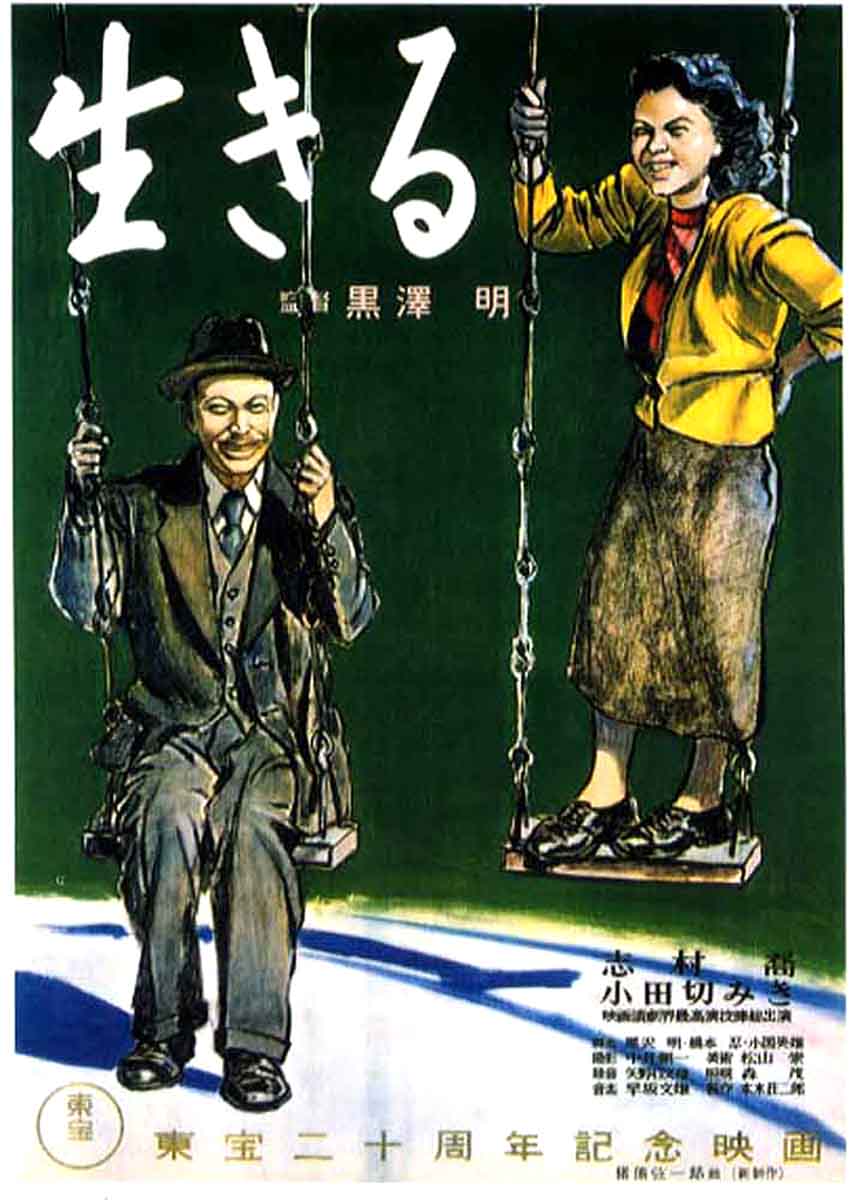
Film #38: Ikiru (1952)


Title for Us English Types: “To Live”

Director: Akira Kurosawa

Initial Release Country: Japan

Times Previously Seen: none

Teaser Summary (no spoilers)

Crusty old bureaucrat is diagnosed with stomach cancer, seeks for ways to squeeze some life out of his remaining months.

Uncut Summary (the full plot, including spoilers; fair warning)

In a stuffy Japanese city hall building, the aging Kanji Watanabe (Takashi Shimura) sits at his desk for the section chief within the massive bureaucracy. He does nothing more than robotically stamp forms, a task that he has done for over thirty years.

And then, a change. He learns that he has stomach cancer. This shakes him to his very fiber, as he begins to realize that he has done nothing of substance with his life. He begins to dwell on his relationship with his son, whom he lives with, and realizes that they are totally detached emotionally. This is clear through his son and daughter-in-laws' plans to edge Watanabe out of his own house and pension. This becomes known to the now-terminal man, but he is lost in his search for his soul. He decides to try and spend his remaining months living. The problem, however, is that after 30 years of being an automaton he doesn't know how.

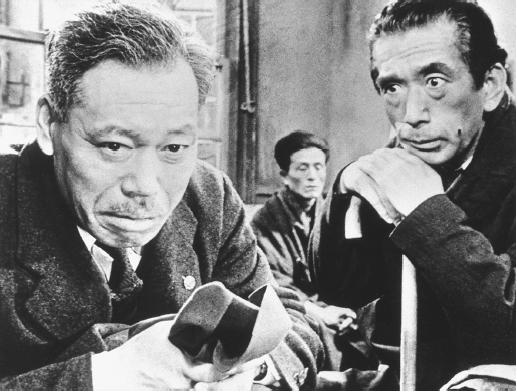
Kanji Watanabe (left) beginning to realize his mortality & wasted life.

He begins by trying the hedonistic route. While drinking heavily at a local bar, he confesses his condition to a young pulp writer. The writer takes Watanabe out for a wild night of drinking, dancing, singing, and women. Watanabe begins by having some fun, but in the end is left with a hollow feeling of being unsatisfied with this definition of “living”.

The next morning, Watanabe runs into his co-worker, Sakai, a lively and friendly woman young enough to be his daughter. Watanabe becomes taken with her vitality and general happiness, and begins to spend time with her. Sakai is happy to oblige at first, and the two enjoy each others' innocent company, but Sakai eventually becomes nervous about Watanabe's obsessive fascination with her. In the end, she leaves her job at the city office to work in a toy factory. When Watanabe finally grills her on how she can always be so cheerful, she responds that making toys for children simply makes her happy. This is the small spark Watanabe needs.

After his two mysterious and unprecedented weeks away from work, Watanabe returns with a new mission: to make some kind of difference in the world before he dies. He reviews old cases in his stacks of papers and finds a past request to have a children's park built in a small, squalid neighborhood. He decides to finally stop the “pass the buck” system of his offices and take charge. He gathers his staff and heads out to the potential park site.

Flash forward five months. Kanji Watanabe has just died and the mourners are all at the wake in the family home. In attendance are several of the more prominent politicians from city hall. It soon becomes clear that the park of Watanabe's quest has not only been built to phenomenal success, but the credit for it is being taken by the mayor. This claim of responsibility, however, is up for serious debate.

As Watanabe's co-workers, family, and acquaintances pay their respects and recall the final months of the deceased's life, it becomes clear that Watanabe was, indeed, the singular force that led to the park's construction. Through sheer force of will and a quiet, unwavering refusal to take “no” for an answer, he got the plan passed through every stodgy section in city hall, even openly defying local gangsters and the mayor himself. After overseeing the park's construction, it was here that Watanabe chose to die on a snowy winter night, finally succumbing to the cold while singing the forlorn old tune “Song of the Gondola”.

In recounting their co-worker's tale of dedication, the still-living bureaucracts make drunken pledges to reform their ways and begin to perform their tasks with more active compassion. Of course, their talk is only so much hot air. In the end, nothing changes at the city offices. However, we are left with the joy of young children playing in the glittering new park that was left by Watanabe's iron will. It was here that he decided to pour all of his remaining life energy, and we are left with children's joyous laughter to echo the final acts of a man who, in the end, figured out some way to imbue his otherwise forgettable life with some meaning.

Take 1: My Gut Reaction (done after 1 viewing, before any research)

Ikiru is another great movie that I'll likely never watch again.

I came into this one expecting an outright depressing tale, based on the synopsis on the DVD cover, and that's what I got for a while. In the last 45 minutes, though, an interesting transformation took place within the film itself and in my connection to it.

For the first 90 minutes or so, things played out not unlike I expected. A man learns that he has 6 to 12 months to live, begins to seriously examine his life and try to find the vitality that he's let drain out of himself for the previous three decades. In going to the likely areas of first vice, then young love, there are no great surprises. Still, there is something there that sets Ikiru apart from other end-of-life, soul-searching movies. It has the gumption to stare the abyss right in its terrifying face.

Throughout the various episodes Watanabe experiences, he perpetually wears a haunting death mask. His distant, eerie gaze belies the fact that he has turned his sight inward to the extent that he becomes downright creepy. During most of these moments in the film, there is absolutely no music or sound. If you allow yourself to become lost in Watanabe's stare and try to ponder the existential questions that consume him, you may find yourself in the same very real place as this loosely fictional man. We all may end up right where he is, and what, exactly will you think of your own life when you can see the end of the road coming? I found myself getting quite pensive at times during the watching.

Here's a haunting scene from Kanji's night on the town, when he breaks into a forlorn love song from his youth:


Back to the narrative. The last portion of the movie took me by surprise, as there is a severely abrupt jump from a Watanabe newly rejuvenated by the new park project, to his funeral five months later (the narrator dedicates about 3 seconds to explaining this to us, the addled viewers). From there, the movie becomes a series of flashbacks that tell the rest of the tale. In that final 45 minutes, the movie says so much about the value of living personal dedication while condemning the ineffectiveness of stale, bloated bureaucracy. In watching all of Watanabe's coworkers lament Watanabe's death, we see nearly every possible facet of humanity. They all go through periods of reverie, nostalgia, sycophancy, guilt, defensiveness, and in the end, dedication that they will become true difference-makers in their offices. These final booze-drenched promises, of course, come nowhere close to getting fulfilled. This leaves us with perhaps the ultimate message of the film: why is it that only a person who has nothing to lose is the only one who helps others in need?

In this, you can see that the themes and narrative are the true strengths of the movie. Some other aspects of the film are not exactly world-beating to me. The acting is old-school. It's solid, especially for its era, but there were still some conventions that were prevalent in a lot of acting of the day that stand out to me in a negative way. Mainly is the very slight overacting at certain moments of higher emotion, especially laughter or sorrow. It's not enough for the actors to chuckle naturally – they have to erupt with ear-piercing cackles. They can't just cry – they have to collapse into a heap on the floor. It's not as bad I may make it seem, but a few moments stood out to me.

One thing I can't knock is, as you may imagine, the directing and cinematography. Akira Kurosawa was an absolute master. Before this film, I had seen many of his dozens of films, including epic action masterpieces like The Seven Samurai or Throne of Blood, more humorous adventure tales like Yojimbo, and the more measured psychological crime dramas like High and Low. Even though I already thought it before, the humane Ikiru confirmed my notion that Kurosawa was incredible at any cinematic story he decided to tell. Between the camera work and use of sound, the meditative, somber mood is set beautifully.

The movie is pretty long, clocking in at 2 hours, 20 minutes, and to be honest, it sometimes feels like it. However, it's clear that there is no wasted time. By the time you get the end, with the near-death but redeemed Watanabe gently swaying back and forth on the park swing, contentedly singing the lonely lyric, “life is brief”, you can't help but feel that you've joined him on a spiritual journey every bit as epic as Ulysses or Beowulf.

Take 2: Why Film Geeks Love This Movie (done after further research)

Wow. Researching this movie is almost akin to a religious or epiphanal experience, not unlike the film itself.

While not exactly opening my eyes to anything in the film that I didn't notice upon first watching it, the thematic depth is confirmed and expanded upon. In reading several different essays and reviews, it becomes clear that, among Akira Kurosawa's brilliant films, Ikiru is often cited as his true masterpiece. This undoubtedly is for doing something that writer Alexander Sesonske points out as being exceptionally difficult: create a film about death that carries very real emotional power from start to finish. In this essay, Sesonske agrees that Ikiru is a masterwork, but he feels that Kurosawa's sexier tales of the samurai still have an equal place among the great films of the world. I agree.

Writer Donald Richie goes deep into analyzing the film's place among great existentialist tales in history with this piece. He reminds that Kurosawa's favorite writer was Dostoyevsky, whose stories sometimes featured protagonists very much like Kanji Watanabe – those who need their death to become tangible in order for them to enact a meaningful life. One can endlessly debate what “meaningful” is, and Richie points out that this is a hallmark of great tales – that they can be interpreted differently throughout time and among different peoples.

I think that, of all of the different summations of the ultimate message of Ikiru, my favorite comes from the original TIME magazine review, written upon Ikiru's delayed release in the U.S. in 1960:

“To live is to love; the rest is cancer.”

Watching it in isolation robs it of its emotional punch, but here's the extremely touching and iconic ending:


That's a wrap. 38 films down. 67 to go.

Coming Soon: Ugetsu (1953):


The second of a cluster of three movies done in the Land of the Rising Sun in the 1950s. I'll see how this one does in the wake of such a weighty film like Ikiru.

Please be sure to pick up all empties on your way out.

Sunday, November 7, 2010

Film #37: Singin' In The Rain (1952)


Directors: Stanley Donen, Gene Kelly

Initial Release Country: United States

Times Previously Seen: once (about ten years ago)

Teaser Summary (no spoilers)

Cheeseball silent film star stumbles through transition to talkies while finding love and dancing, wearing a shit-eating grin.

Uncut Summary (The full story, including spoilers. Fair warning)

It's 1927 and silent film stars Don Lockwood (Gene Kelly) and Lina LaMont (Jean Hagen) are the toast of Hollywood. They are in the middle of a string of commercially successful, if formulaic romance/adventure movies. Despite their obvious film success, however, the two could not be more different in real life. Don is a happy-go-lucky man who, with his closest friend Cosmo (Donald O'Connor) has worked his way up through the entertainment world by building his singing and dancing chops in all manner of low-brow acts. Lina is a no-talent, dim-witted, high maintenance egomaniac who seems to believe herself a princess simply because she plays them in the movies.

Along comes the landmark film The Jazz Singer – the first talking picture. While most of Hollywood dismisses it as a novelty gimmick, the film's smash success sends all other studios scrambling to follow suit, including Don and Lina's. The transition could not be rougher. Though Don has some trouble, the biggest problem is Lina, whose pretty face is no longer enough. Her high, shrieking New York “city goil” accent cannot be tamed into anything listenable. Not even costly enunciation lessons can can break through her thick skull or provincial, nasal voice.

To the rescue comes Don's new love, Kathy Seldon (Debbie Reynolds), an adorable, spunky little entertainer whose remarkable dancing ability is only outdone by her incredible singing. Cosmo hatches the idea of using Kathy's voice as an unseen proxy for Lina. Since Lina's is the beautiful face that viewers know and love, they'll have her lip synch the dialogue and songs as Kathy sings them.

Cosmo, Kathy and Don rip through one of their many happy little tunes.

The plan works, and the latest Don Lockwood/Lina LaMont film is made. Once the movie is in the can and awaiting its premier, however, Lina starts to do the one thing that she probably shouldn't: think. Jealous of Don and Kathy's love and Kathy's genuine talent, Lina attempts to legally blackmail the movie studio into making Kathy her permanent voice. The studio head is furious, as he has plans to groom Kathy into their next big star. Flustered, all are left to stew on Lina's selfish machinations.

Everything comes to a head at the movie premier, where the film is shown to an audience who loves it. To roaring applause, Lina decides to really drive her plan home. She attempts to give a speech, but her true voice and condescending comments baffle the crowd. The uncertain viewers demand that she sing, “like in the picture.” Knowing that she has no hope of singing as well as Kathy, Don and Cosmo create the perfect set-up: they tell Lina to lip sync the words as Kathy sings the song just behind Lina and a dividing curtain. In the middle of the song, the curtain is raised, Lina is exposed as a fraud, Kathy's true talent is revealed, and all of the good guys live happily ever after.

Exit, stage right.

Take 1: My Gut Reaction (done after this most recent viewing, before any research)

This musical very often flirted with sliding into the same category as Meet Me In St. Louis, West Side Story, and The Sound of Music: musical films that I simply can't stand. It did, however, manage to fall just on the right side of the line separating amusing viewing from insufferable fluff.
I guess the key ingredient for me was the intentional cheese factor. There is a self-awareness that, while not perfect, was present enough to provide some timeless laughs. From the jump, you get Don Lockwood's shit-eating grin as he shows up at he and Lina's latest premier. While on the red carpet for the pre-show interview, he claims to have always used the word “dignity” as his motto. During this pompous speech, we're treated to a montage of ridiculous and demeaning jobs that he's taken in the past. The scenes are actually pretty funny, and the sarcasm underlying it works well.

This self-effacing tone keeps surfacing occasionally throughout the film, though in fits and starts at times. When its not there, Singin' In the Rain does become rather tiresome. The most obvious moment of this is a bizarre “advertising” sequence during the “Beautiful Girls” number, which seems to be nothing more than an excuse to show off an array of fashion models posing in various costumes. It was a rather bizarre waste of screen time.

It's really the great irony of the film to me: most of the humor is based on ridiculing the superficiality of popular silent films and its stars. And while it's funny to see how talkies exposed this superficiality in the film, the film Singin' In the Rain is, itself, a showcase of superficiality in many ways. You have to acknowledge that Kelly, O'Connor and Reynolds were phenomenally talented singers and dancers. Still, the movie is almost all about flash and show. Sure, it's not as shallow as bad silent films, in which you just needed a few few pretty faces and melodramatic physical acting, but it is still a pretty shallow exercise all the same. If not for the novelty and flash of technicolor cinematography to show off the hyper-colored costumes and sets, I have to wonder if this film would have been such a marvel in its day.

Here's a perfect example of the useless, harmless tone of the film, as seen in the well-known bit, "Good Mornin'":


Despite my skepticism at the depth of the movie, I have to admit to how incredible Kelly, O'Connor and Reynolds were. Even if several of the musical numbers were contrived and hokey, some of them were masterpieces of choreography. Granted, by the end I had pretty much had it with the songs and dances (the 15-minute long 20s number was a test) and just wanted the story, such as it was, resolved, but when I was still engaged in entertainment bits, they were a lot of fun to watch.

The real gem of the movie is the second-billed Donald O'Connor, who may not have had the tanned good looks or raw dancing power of Gene Kelly, but seemed to have more pure athleticism and better comedic timing that his better-known co-star. His “Make 'Em Laugh” routine may be one of the best I've ever seen, being heavily rooted in the physical comedy of Keaton, Chaplin, The Three Stooges, and everything in between.


Here's a link to the astoundingly energetic "Make 'Em Laugh" number.

Singin' In the Rain didn't hold up on this second viewing as well as I had hoped, but it wasn't nearly the exercise in patience that watching other musicals has been. It's a light, fun little movie that I'd recommend to someone who likes musicals in general, and doesn't need an enormous amount of plot depth.

Take 2: Why Film Geeks Love this Movie (done after some further research)

No shockers here, though a few interesting little tidbits after doing some digging.

Like other films that are on TIME's list (It's a Wonderful Life, Detour, and others), this “classic” was not hailed as such immediately. The critics in 1952 seemed to like it, but considered it a touch inferior to the previous year's Kelly dance offering, An American In Paris. Like the other films mentioned, it was only after several years on the shelf and a re-release in 1958 that the masses and critics gave the movie a more special place in their hearts and minds. At this point, it's often praised as the hands-down greatest American musical of all time. I personally don't see it as such, preferring Swing Time or even Cabaret, but I can't knock anyone for the more popular opinion.

Something I didn't realize is that not one of the songs was composed solely for this movie. They were all written years prior, for a number of other shows. This may account for the seeming disconnectedness as far as lyrics and tone go. Not that it mattered much. It's clear that musicals certainly don't need inter-song cohesion to be effective. Each song in Singin' In the Rain, if not my cup of tea, is certainly snappy or catchy.

One better-known tidbit is that during the iconic title song and dance routine, Gene Kelly was operating with a 103 degree fever. I know that when I'm in such a state, I can barely lift my arm to change the channel on my TV, let alone bound and vault around with the reckless abandon that Kelly did during that routine. Incredible. Click this link to see what he did while sick as a dog.

Another curious anecdote is about Debbie Reynolds. At the time of the film, she apparently was a gymnast rather than a trained dancer. Her lack of skills in the latter area enraged Gene Kelly into yelling at her at one point, after which she left the set to have a good cry under a piano on another set. Who should find her there but one Mr. Fred Astaire. Taking pity, Astaire decided to work with Reynolds to get her dancing up to snuff. After reading this story, I can't help but move ol' Fred a few notches further up the “hulluva guy” ladder.

So the research really does nothing to change my opinion of this movie. A good, solid musical that provided me with enough entertainment so that it wasn't a struggle to get through, which his saying something considering my general opinion of the genre.

That's a wrap. 37 down, 68 to go.

Coming Soon: Ikiru (1952):

Another film about a sad old man, this one in Japan. We'll see if this poor old bugger makes out better than Umberto D.

Please be sure to pick up all empties on the way out.

Friday, October 22, 2010

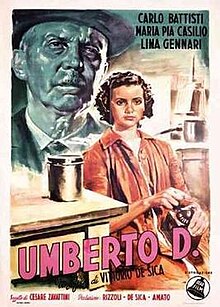
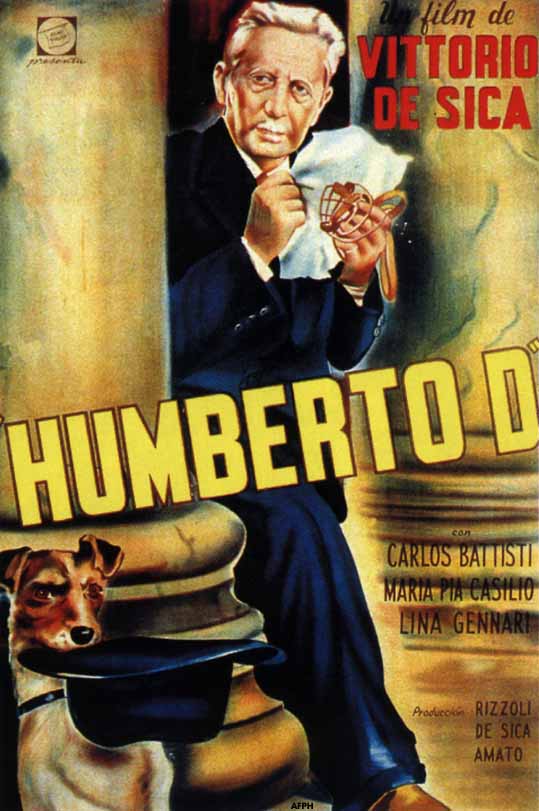
Film #36: Umberto D. (1952)


Director: Vittorio De Sica

Initial Release Country: Italy

Times Previously Seen: none

Teaser Summary (no spoilers)

Financially strapped geezer getting elbowed out of apartment ponders suicide. Has a cute dog.

Uncut Version (Full plot synopsis, spoilers and all. Fair warning)

Umberto Domenico Ferrari (Carlo Battisti) is a retired government pensioner in 1950 Rome. We see him with other retirees picketing for better pensions and learn that he is in some debt. This is only part of a larger problem, however.

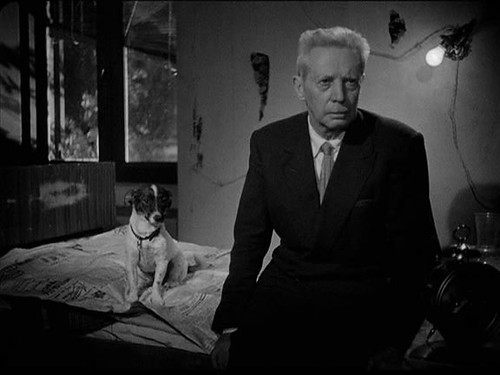
Umberto owes most of his debt to his landlady, a self-absorbed social climber who has been raising Umberto's rent in order to force him out of her building. Umberto's only real friends seem to be his spunky little dog, Flike (pronounced like...well, “like”) and the pretty, guileless young maid (Maria-Pia Casilio) in his building. It doesn't take long to see that he is a rather lonely man who has no prospects to speak of. The only things that seem to keep him going are Flike and a mild sense of spite for the world around him, most notably his landlady.

Umberto and Flike in their dank, lonely apartment.

After becoming sick with a fever and spending some time in a public hospital, Umberto attempts to track down past friends and co-workers to borrow some of the money he needs to stay in his apartment. All of his efforts are, however, rebuffed. In the middle of hustling around, he loses Flike. After a nerve-wracking trip to the local pound, where he witnesses dozens of dogs put down, Umberto finds his trusty canine companion.

Following another bout of loan refusals from friends, Umberto comes a hair's breadth from panhandling on the street. His dignity, alas, does not allow him to stoop, though he tries to let Flike hold his hat out for a brief moment. At this point, he returns to his room, which is being stripped of his goods and remodeled around him. Despondent, he plans to end his own life by jumping in front of a train. Only one obstacle exists: Flike.

Umberto tries to find a boarding home for his dog, but cannot. He tries to give him to a young girl whom he knows, but her guardians will not allow it. He tries to fool Flike into running off with a group of young children in a park, but Flike will not part with his master. Resigned, Umberto decides that the only thing left for him is to take Flike in his arms and end both of their lives together.

Grabbing Flike and cradling him, Umberto slowly and slyly crosses the guard rails as a train comes. Just as the train roars close and he prepares to step in front, though, Flike resists and fights his way out of Umberto's arms, running from the tracks. Umberto runs after Flike, who is now too scared to come near his master. Rather than abandon Flike and turn his back on his own life, Umberto decides to coax Flike's trust back out of him and play catch. Our old pensioner has decided to live, as sparse as that life might be.

Man's best friend, indeed.

Take 1: My Gut Reaction (Done before any research on the film)

This was an effort to get through.

I chalk this one up as another that fits in the category of “Great Films that I'll Never Watch Again”. I can't say that there's anything wrong with the movie. Judged on its own merit, it's brilliant. It does something that, at the time, was probably very new, and it has a genuine emotional impact in the end.

But God, did it take a long time to get there. And the movie is only 90 minutes long. It felt like 180 at times. Watching Umberto schlep around Rome from one miserable failure to the next was just plain depressing. It reminded me a lot of the only other De Sica movie I've seen: The Bicycle Thief. One unfortunate fellow with little to live for getting dumped on repeatedly by the people around him and life in general.

Doesn't sound like a fun viewing experience? It isn't.

As I said, though, I can't complain about any technical merits at all. The story is constructed well, the script seems decent (though what do I know – I don't speak Italian), the cast was solid, and the cinematography is incredible (probably the greatest strength, in fact). It's just that, in the end, I was left with a hollow feeling.

I must admit to how effective the sentimental aspects of the film are; namely, the relationship between Umberto and Flike. The three most striking scenes involve both characters: the rescue of Flike from the pound, Umberto having Flike hold out his hat to beg for money (for he's still too proud), and the grande finale of near-suicide/canicide. Still, I couldn't help but feel that this sentimentality was a bit cheap, as strong as it was.

This is a good example of one of the few Flike-less touching moments, when Umberto's desperation is high enough for him to consider begging:


Without knowing the exact history of cinema (though I'll be looking it up), this movie seems a forerunner of the French verite films of the 50s and 60s – that “realistic” approach that was rife with world-weariness and “everyday” problems, and the social ills that were the cause and/or effect. Those movies were hailed as edgy for their “realism” and their unflinching gaze at the uncomfortable truths of life. I hate them. They always seemed to have some sly tone of melancholy and apathy that was dressed up in a chic aesthetic, seeming to say “We're fashionable and hip, but we can be depressed, too.” Umberto D. has none of the fashion sense, but all of the sadness.

Of course, some movies are sad as hell and I still love them. For instance, Aronofsky's The Fountain or Wong Kar-Wai's In the Mood For Love. Umberto D. is a whole other kind of sad, even if there is redemption in the end. There's a worn-in, all-too-familiar feel to the situations in De Sica's movie. Perhaps this was his point; he wanted to make people squirm as they looked at the fallout of a society that turns its back on the elderly. For Umberto, the only thing that saves him is his faithful mutt, though even that's unintentional on said mutt's part.

A movie like this just leaves me feeling that humanity is scum, and I don't really need cinema to feel that way. Just watching the evening news is enough.

Take 2: Why Film Geeks Love This Movie (done after some further research)

After dwelling upon this movie for several days, and reading several essays on it, I've softened my stance a little bit. I am still quite positive, though, that I'll never watch it again.

It seems that this movie, according to people who know a ton more than I, that Umberto D. marked a bit of a transitional era in film making. Prior to its release, Vittorio De Sica could seemingly do no wrong. He had been a shining acting star in the 20s and 30s, and his first several films has met with popular and critical acclaim in the mid-40s. Umberto D., however, bombed horribly within Italy. Why? The explanation offers some interesting insights.

De Sica's earlier films were what is known as “neorealist”, meaning that they eschewed formal actors, formal stories, and elaborate production for much more naturalistic tales told by non-professional actors. The idea was to present fictional tales that told tragic tales in a near-documentary style. This approach apparently struck a chord with people, as they saw it as revelatory and cathartic. They made a clear statement about the ills of society and their effect on the individual.

Umberto D., while still in a neorealist style, removed some of the core elements, namely the overt condemnation of social malfunctioning. When I think back on it, this is true. One is not really meant to see Umberto as the victim of some soulless government machine. He's simply a lonely man whose seclusion is as much his own doing as his environment's. This seems like a small change of pace, so why such a dramatic shift in reception within its home country?

According to this essay by Peter Becker, it was basically timing. In the 50s, as opposed to the 40s, there was an optimism washing through Italy that precluded the “airing of dirty laundry” to other countries through film. The government of this time, which had considerable influence on media, saw Umberto D. as a pointless look at a tiny pocket of quiet sadness that still dwelt within its own borders. Feeling that it cast a poor light on their country, they panned it and stifled any chance it had at commercial success in Italy. Such was not to be the case in other countries, however, as places like the U.S., France and England hailed it as a masterpiece.


Umberto as he awaits the oncoming train that he hopes will end his life.

On revisiting the sentimentality of the movie, which I initially felt was a bit base, I think that my opinion has been swayed by Stuart Klawans in this essay of his. He analyzes the purpose of Flike in the movie and makes a great case that sentimentality need not necessarily cheapen a film's emotional impact. He sums it up with the line, “ If the main character feels that his humanity itself is slipping away, his sense of being a proper man, then why shouldn’t he have a sentimental relationship with a dog?” Well put, and this point actually makes me feel much better about being choked up at the end of the film.

Here's the final scene, which can certainly be appreciated without having seen the rest of the film. Be warned - it's a spoiler if you're into the mystery of the tale:


Umberto D. - certainly an excellent movie, though one that you need to be in a somber mood for.
That's a wrap. 36 down. 69 to go.

Coming Soon: Singin' In The Rain (1952)


If this blog has taught you anything about me, it's that I hate musicals. This movie, surprisingly, is one that I've seen and remember liking. I'll see if my opinion holds after another viewing.

Please be sure to pick up all empties on the way out.

Saturday, October 16, 2010

Film #35: A Streetcar Named Desire


Director: Elia Kazan

Initial Release Country: United States

Times Previously Seen: once (about twelve years ago.)

Teaser Review (no spoilers)

Loopy, pretentious southern belle moves in with sister and her abusive, salt-of-the-earth, meat-head husband in New Orleans.

Uncut Summary (The full monty, spoilers included. Fair warning)

In a rough quarter of 1950s New Orleans, the young and beautiful Blanche Dubois (Vivien Leigh) steps off of a train. She finds her sister, Stella, at a nearby bowling alley with her husband, Stanley (Marlon Brando). Blanche is searching for refuge at Stella and Stanley's house since the last bit of the family estate, Belle Reeve, is now lost. Stella welcomes her sister to stay with her and her husband, though Blanche is far from forthcoming and Stella and Stanley's place is modest, to say the least: a tiny tenement shared by several other people.

At Stella and Stanley's, things become trickier. Upon hearing Blanche's tale of the sale of Belle Reeve, Stanley begins to show the man he is. The handsome and imposing but territorial man that he is realizes that anything sold to his sister-in-law is, according to Louisiana law, half his. He sees Blanche as an interloper, and perhaps even a con artist who will merely take up limited space in his apartment.


One of Blanche & Stanley's earliest confrontations.

Months wear on, Blanche stays, and things become gradually more tense. Stanley and Stella show themselves to have a textbook abuser/victim, co-dependent relationship. Blanche quite heavily puts on the airs of a southern sophisticate, though the job is a bit poor and neurotically desperate. The brutish Stanley grows ever more frustrated and begins to dig into Blanche's past. What he finds is that Blanche, far from being an innocent victim of encroachment, was at the heart of a scandal in her and Stella's hometown. She had an “inappropriate relationship” with a 17-year-old student and was relieved of her duties. In addition to this salacious story, Stanley also uncovers various rumors that Blanche had been a months-long resident in the nearby town of Auriol, where she “entertained” many different men until she was kicked out of her hotel.

Just before and as Stanley is uncovering these dark details of Blanche's past, his friend, Mitch (Karl Malden) falls deeply in love with Blanche, seeing her as a true southern gentlewoman. Mitch is a lonely man, getting on in years, and sees Blanche as an undreamed of chance at marital happiness with a beautiful woman. One evening, while out with Mitch, Blanche has a moment of clarity, drops her guard, and confesses to a traumatic experience from her past: As a teenage girl, she had inspired the love of a young man. However, the young man learned that he could not be with her and killed himself. This seemed to create a fracture in Blanche's mind. One that never fully healed in the subsequent years.

The psychological fissure continues to be pulled apart by the forces at play in New Orleans: Mitch's desperate desire for her hand in marriage, her sister's need to know just how she can help, and, most strongly, Stanley's scalding rage at her mere presence and demand that she move out. Everything comes to a head on the night that Stella goes into labor and is brought to the hospital. Left alone with the mentally fragile Blanche, Stanley unloads on her. He bullies her, both physically and mentally, culminating in rape, and she snaps. Stella returns to her apartment to find her sister in mental shambles.

In the end, Blanche is taken away by people from a mental institution, under the auspices of taking a cruise with a past gentleman caller. Unable to any longer tell fantasy from reality, Blanche eventually goes, uttering the well-known line, “I've always relied on the kindness of strangers.” Watching impassively all through the heart-rending affair is Stanley, all but counting the seconds down that he will get his tortured sister-in-law out of his life. Mitch is present and is disgusted with Stanley's insensitivity, but nowhere near as disgusted as Stella. She takes their baby to the upstairs neighbors, swears never to return to such a callous man, and closes the door behind her.

Take 1: My Gut Reaction (Done after this most recent viewing, before any further research)

This is a weird one for me. Great story, great acting, fantastic direction. In fact, I can only think of one thing that I didn't like. Unfortunately, that one thing will keep me from ever watching this movie or the play again. What was the one thing?

A heaveh suhhthuhhhn drawuhl, maaahh deeyuh.

You can chalk this one up to being a peccadillo of mine, since it really makes no great sense. There aren't really too many accents that get on my nerves. When you add in the fact that I was raised in Texas, you wouldn't think that a southern drawl would bother me very much. Yet, in Streetcar, Blanche DuBois's accent is (intentionally) so put on and heavy that I couldn't take it. It merely accentuates (yuk-yuk) how flimsy the veneer is that she's trying to keep up.

Here's how I know I lost my rationality watching this film: I was actually pulling for Stanley for the better part of the movie. I did come around at the end, and see him for the detestable gorilla that he is; however, for most of the film, I wanted him to burn down the paper palace that Blanche had tried to construct around herself. I'm not exactly sure if this development was Tennessee Williams' intent, but I was so agitated by Blanche's airs that I wanted them utterly annihilated, even if it was done to satiate a modern day Thug like Kowalski.

Here's the famous "Stella" scene, which all by itself conveys the nature of the abusive relationship and primal, animalistic lust that Stanley inspires:


I can only liken this bizarre accent hatred of mine to the way that we all dislike certain foods – you can't fully explain why you don't like it – you just don't like it. I suppose its a testament to the tale that I was pulled back from the brink of seeing Stanley as some kind of blue collar hero, and actually seeing him for the lout that he is. In this spirit, let me move past my displeasure at Blanche DuBois's over-the-top Louisiana lilt and take a look at the many strengths of the film.

The story, while crushingly depressing, is brilliant. Blanche is an immediate enigma who we are interested in learning more about, just as Stanley is. Hers is one of the finest examples of character development through slow reveal that I've ever seen. I went from seeing her as merely arrogant to hopelessly selfish to pathetically abused, and finally to sadly wasted. While she does make this transition within the tale itself, the gradual revelations about her past offer different facets and causes for her twisted attempts at gaining attention. When I realized that she has, essentially, been used up and crushed by an unknowable number of people in her past, I saw her as far more sympathetic.

Stanley is, of course, the force of nature that makes things move in this story. His relationship with Stella seemed to lay bare all of the details of abusive relationships that now seem shamefully cliched: verbal bullying and physical abuse followed by the woman leaving him, only to return when he feels remorse. The remorse is certainly authentic, but born of a sad realization that he has harmed the one person who seems to understand and love him. Things calm down for a while, and then the cycle begins again. In the middle of such a dysfunctional relationship, a mentally ill person like Blanche doesn't stand a chance.

The performances are, truly, extraordinary. While his mumbling, guttural linguistic style was starting to settle in for this role, Marlon Brando is frighteningly believable as the barbaric Stanley Kowalski. As in roles like The Wild One and On the Waterfront, he was a slick-looking head-turner. This makes it all the more powerful when you see him turn into a reprehensible animal.

Vivien Leigh is the other obvious standout. As hard as I found it to sit through the interminable front that she puts up as Blanche, her performance is of undeniably brilliant quality. In a sense, she's almost like the dark, battered version of her role as Scarlett O'Hara in Gone With the Wind (a film that I really can't stomach). The nuances of shifting from manipulative to pathetic are so skilled that the uniquely sad character of Blanche is wholly plausible. When I look at it objectively, I can't deny how incredible Leigh truly was.

The semi-sleeper is Karl Malden, who does a great job as Mitch, the kindly, if somewhat dim, man who falls for the broken Blanche. Even if I didn't really identify with him, I had to come down on his side as being deeply saddened by Blanche's ultimate fate and fully sickened by the actions of his once-pal Stanley.

A Streetcar Named Desire is, without a doubt, a great story, and one which Elia Kazan did a masterful job of adapting to the screen. I almost regret not being able to get past that one trivial aural bugaboo of mine so that I would be able to watch and appreciate its merits again. Alas, I can't.

Take 2: Why Film Geeks Love This Movie (Done after further research)

Not much that's terribly surprising about this film in the articles and reviews, though the adaptation process contains some familiar plot-lines.

Tennessee Williams' original play apparently was even more brutal, dark, and vague in terms of the character representations. In the film, it's rather clear that Stanley in meant to be seen as more of a villain, and Blanche more sympathetic, even if neither one of these characterizations is black or white. This is more pronounced by the “punishment” of Stanley in the film version, by way of Stella leaving him at the end. The play is far less clear-cut, with Stella actually seeking comfort in her brutish husband's arms.

According to articles, including the original TIME magazine article, Streetcar was one of the earliest movies to truly deal with “adult” themes. Or at least, deal with them as much as it could within the confines of the Production Code, which was still in evidence, even if its grip was beginning to loosen.

Within the original TIME review, it was interesting to see that the reviewer was not really impressed with Vivien Leigh's performance, thinking that she was outdone by the surrounding cast. I can't say that I agree, as I think that Leigh was excellent. Just couldn't get past that da-yuhmn ayk-se-yunt.

That's a wrap. 35 down. 70 to go.

Coming Soon (I hope): Umberto D. (1952)


The list finally turns back to some foreign-language entries, though this is one I know nothing about. We shall see how it goes.

Please be sure to pick up all empties on the way out.
Sunday, August 8, 2010

Film #34: In A Lonely Place (1950)


Director: Nicholas Ray

Initial Release Country: United States

Times Previously Seen: none

Teaser Summary (no spoilers):

Brilliant but haunted screen-writer with vicious mean streak finds love amidst murder accusation.

Uncut Summary (The full plot, spoilers included. Fair warning)

Dixon Steele (Humphrey Bogart) is a phenomenally talented film writer, but one with demons. He has the love of loyal friends and the respect of the film industry, but has been out of work for some time. This is due to his penchant for getting into fist fights with anyone who he feels slights him. His career lull is also due to his lack of artistic inspiration.

One night in Hollywood, “Dix” meets several acquaintances in a favorite restaurant. He rubs elbows, and convinces the coat-check girl, Mildred, back to his apartment to give him a quick summary of a novel that he is supposed to adapt for the screen. Upon arriving at his apartment, Dix and Mildred catch a brief glimpse of Dix's neighbor, the beautiful Laurel. Inside Dix's apartment, the somewhat shady meeting of Dix and Mildred becomes quite benign as Mildred merely gives Dix a summary of the novel. Dix sends Mildred on her way and heads to bed.


Laurel and Dixon drive ahead, each shrouded in their own shadows.

The next morning, a cop, also an old army buddy of Dix's, arrives at his apartment and informs him that Mildred has been found murdered by the side of a road. Dix is taken to the police station and grilled by the police captain, but rebuffs any accusations of murder with chilling indifference. Dix is let off the hook when Laurel shows up and tells the police that she had seen Dix at his apartment, alone, after Mildred had left. For the moment, Dix is in the clear, though he remains a suspect, along with Mildred's boyfriend.

After she has provided him an alibi, Laurel and Dix fall deeply in love with one another. They spend nearly every waking moment together, seemingly to both people's benefit. Laurel sees and adores all of Dix's good qualities: his generosity, loyalty, and passion; and Dix has found his muse, which leads to a rekindling of his artistic gifts.

Nevertheless, certain threats remain. Through conversations with present and past friends of Dix, Laurel and the police start to realize just how violent the otherwise brilliant and charming Dix can sometimes be. Laurel comes to see this first-hand when, after a wrong word sends Dix on a rampage, he very nearly kills a local college student. Laurel begins to doubt whether Dix is truly innocent of Mildred's murder, and even wonders whether she could have a life with a man tormented by such dark demons.

Dix begins to sense Laurel's reluctance and grows increasingly paranoid and afraid of losing the one thing that he loves in the world. Despite having a newly-finished movie script that will likely reassert his position as a top-flight screen-writer, his obsession for Laurel's love blinds him. He pushes her into admitting her fear of him, and he comes within a hair's breadth of choking her to death. He pulls back at the last moment, leaving Laurel alive.

Just after this terrifying episode, Dix and Laurel learn that the Mildred was, in actuality, murdered by her ex-boyfriend, leaving Dix cleared of all suspicion. All this is for naught to Dix, though, as he realizes that he has brutally pushed away his final chance at love and redemption in the world.

Take 1: My Gut Reaction (Done after one viewing, before any further research):

This movie is incredible. It's been another of the fantastic surprises that have come from this list so far.

The basic “Netflix” summary of the film gives no indication of the many intricacies at play in this story. I thought I was more in for a “movie about movies” akin to something like Robert Altman's The Player. Instead, In A Lonely Place merely uses Hollywood and film-making as a backdrop for a haunting character study.

Dixon Steele (it only took about 10 minutes before I stopped giggling at the “porno name” thing) is a character unlike anyone that I've seen in movies. He may be the most realistic and well-rounded, if tragic, figure I can think of. He is a well-rendered example of a person who toes the elusive line between genius and insanity, and in Dix's case, the insanity is of a violent nature.

Humphrey Bogart pulls off this complex figure amazingly well. At this point in his career, Bogie had carved himself a place as a lovable, world-weary hero in films like Casablanca and even The Maltese Falcon. He had played the odd gangster and bad guy in early film roles, but his turn as Dixon Steele pulls together his ability to be supremely charming and disturbingly nasty in the same figure. He conjured up images of the few people I know of the same attitude: the real-life Jekyll and Hydes of the world who make for no easy answers in terms of loyalty and friendship. I think nearly all of us know the type – lovable in most circumstances, but thoroughly repellent when certain switches are thrown.

Here's the fiercest example of Steele's volatile temper (start at about 1:00 to get the full build-up and impact when he goes off on the college kid):


The story allows Dix's warring halves to be shown exceptionally well. The dark murder at the center of the study serves as the perfect foil for the viewer's shifting opinions of the tortured writer. At certain moments, you totally buy the possibility that Dix may have brutally murdered the innocent Mildred; at others, you almost feel guilty of having suspected the angry but highly principled artist.

In addition to the murder, the character of Laurel offers the other end of the spectrum. She is the oft-distant beauty who elicits Dix's passion and nearly all of the things that make him admirable. Gloria Grahame is great in the role, initially seeming cool but earnest in her attraction for Dix, but growing quickly as impassioned for him as he is for her. As her doubts and suspicions about him grow, she makes the transition from loving to horrified flawlessly.

This movie is yet another in which the supporting cast may be easily overlooked but shouldn't be. Dix's various friends and enemies serve their parts and purposes well, and they add the final brushstrokes needed to complete the portrait. Their own puzzlement at Dix's condition mirrors our own, and they offer some modicum of relief in admitting that Dix is not the complete villain that we at times are led to see him as. Of course, neither is he a man to be envied, despite his artistic gifts.

In A Lonely Place came out of nowhere to offer me a truly engaging tale of the pitch-black side of certain otherwise likable people. I'd recommend it to anyone who enjoys tense, dark character studies that revolve around romance, slightly twisted though it may be.

Even better, you can watch the whole thing for free, right here.

Take 2: Why Film Geeks Love This Movie (Done after some further research)

In A Lonely Place was not hailed as a masterpiece upon initial release. It was fairly well-respected, but not without its critics, including this one from TIME magazine itself back in 1950. Apparently, some felt that it belabored certain points and took too long in the telling.

But such assessments were few. Over the years, it has grown in stature among noir and all other films. Interestingly, it's less because it's considered a flawless film and more because it seems to have a clear peal of truth to it. Apparently, this wasn't a mystery. Bogart was, by many accounts, not too dissimilar from Dixon Steele himself: often personable, but sometimes frustrated into inexplicable bouts of depression that could lead to drunkenness and anger. No doubt this is why his performance seems so authentic.

Certainly another reason that this movie is not simply heaped in with other, more mundane, dark murder mysteries is the theme and actuality of story adaptation. One of the sources of Steele's frustration is the way that his artistry is regularly stifled by the Hollywood hit machine. Funny then, that this whole element was something completely added by director/co-screen-writer Nicholas Ray to the tale based on the novel by Dorothy B. Hughes.

This was far from the only change made. In the novel, Dixon Steele is a disturbed stalker and legitimate murderer. The filmmakers somehow saw the potential in a standard murder mystery and altered it into something far more creative and timeless: an existential tale of a man who nearly gains salvation through love and art, only to have the darkness within him blot out the light.

Here's the finale, perhaps one of the saddest and most quietly tragic in popular film history:


That's a wrap. 34 shows down. 71 to go.

Coming Soon: A Streetcar Named Desire (1951):


Stella!!! I've watched this one only once, it was about ten years ago, and I don't remember liking it too much. I'll see if an older, more seasoned me sees it any differently.

Please be sure to pick up all empties on the way out.

Sunday, June 27, 2010

Film #33: White Heat (1949)


Director: Raoul Walsh

Initial Release Country: United States

Times Previously Seen: once (about 8 years ago)

Teaser Summary (no spoilers):

Homicidal psychopath criminal grits teeth, kills cops, weasels, and dirty dames. Loves his mother, though.

Uncut Summary (the whole shebang, spoilers included. Fair warning):

Cody Jarrett (James Cagney) and his crew of thieves are bad dudes. In pulling a train robbery, Cody kills a few conductors before taking off with a stack of U.S. Treasury bonds. In the action, one of his crew has his face scorched by scalding steam.

Back at their hide-out, Cody and the crew meet up with Cody's mother and wife, both of whom are more than complicit in his illegal activities. In fact, his mother urges such action so that her son can carve out a path for himself and one day be “on top of the world.” Cody has to watch his back, though, since crew member “Big Ed,” his number two, has serious designs on usurping Cody's gang and his woman, the beautiful and high-maintenance Verna (Virginia Mayo).

While gathering up and preparing to hit the road, Cody suffers from a massive, crippling headache, a chronic condition that leaves him physically prone. He recovers with some soothing from his beloved mother and gathers the gang to head out, leaving behind their severely burned accomplice.

Left to right: Verna, Ma Jarrett, and Cody take a break from homicide & robbery for a quiet moment at the drive-in.

At police headquarters, FBI Agent Philip Edwards ponders how to find Cody. A series of clues lead him to where Cody is hiding with Verna and his mother. After a brief car pursuit, they get somewhat cornered in a drive-in theater. Cody tells Verna and his ma about his back-up plan in case of such a pinch: to turn himself in and admit to another, far lesser crime. This way, he will only do two years time, get released, and take control of the gang again.

After Cody turns himself in, Agent Edwards grills Ma and Verna Jarrett, but both are too smart to implicate themselves. Edwards seems a bit stuck, but he has another plan. He sends in fellow agent Hank Fallon to pose as a convict who will room with Cody in prison, hoping to gain enough confidence to learn where Cody has hidden the loot from the train robbery.

In prison, Fallon takes on the identity of Vincent Pardo, a fictitious con. While in, he eventually wins the excessively cagey and paranoid Jarrett's hard-fought trust. Just when it looks like they have a plan to “escape” together, everything goes to hell. From the convict grapevine, Jarrett learns that Big Ed, making his big move, has killed Ma Jarrett. Cody goes ballistic, punching out several jailers and getting sent to a solitary psych ward cell.

In the clink, Cody gives under-cover agent Fallon what-for.

Cody is far from done, though. He soon collects himself and stages a daring escape, capturing the prison doctor, killing a few guards, and lighting out with Fallon/Pardo and a few of his loyal crew on the inside. Cody Jarrett is once again on the loose.

First order of business is vengeance. Cody tracks down Big Ed and Verna at a hideout house. He catches Verna first, who lies through her teeth to avoid Cody's murderous rage. While she was the one to actually pull the trigger on Ma Jarrett, she pins it on Ed. Cody barely accepts the lie and goes after Ed, who he quickly dispatches with a few slugs to the back. The Jarrett Gang is now back in business again, with Fallon/Pardo now a full member of the crew.

The gang plans a massive score to knock off the payroll at a chemical plant. The plan is to use an empty gasoline truck and a Trojan Horse strategy. Unbeknownst to the rest of the crew, though, Fallon/Pardo has tipped off his fellow officers. Once the gang breaks into the plant and begins the heist, tons of cops show up to put an end to the robbery.

Inside the plant, Cody learns of Fallon's true identity and his impending capture. He finally loses whatever sanity he has left and goes on a killing rampage, though Fallon manages to escape in the chaos. Cody manages to scale one of the massive chemical towers and continues to fire upon the police. He finally makes it to the top, fires a few rounds into the container and screams, “Finally made it, Ma! Top of the world!!”

The container explodes into a massive mushroom cloud, taking Cody's psychosis and rage with it.

Take 1: My Gut Reaction (done after this most recent viewing, before any further research):

This movie is damn fun to watch. It's not high art, and it doesn't require any kind of background to enjoy, if one doesn't mind a high-octane shoot-em-up with a bit more depth than your average cops and robbers flick.

White Heat is noirish, though certainly not pure film noir. Many of the key noir elements are there: bad people doing bad things, a beautiful and dangerous woman in the mix, backstabbing, and a protagonist up to his neck in dastardly deeds. Yet, there is nothing admirable, enviable, or even very empathetic about Cody Jarrett, unlike other noir protagonists like Jeff Markham in Out of the Past or Walter Neff in Double Indemnity. Cody Jarrett is a pure psychopath: murderous, cunning, and driven.

James Cagney was the perfect guy for such a whack-job. Cagney may have been about 5-foot-nothing, but he exuded more toughness and lethal tension than nearly anyone I've seen in film. With his pug face, ever-present sneer, and cold, narrow eyes, it's not hard to see how he could play such a wild man so well. And yet, as scary as he is when in one of his psychotic rages, he was even more frightening when he would calmly look another character in the eye, and bold-facedly tell them that he was going to kill them. Said character was then no less that looking Death straight in that little squinched-up face.

I have to say that the dialogue is really amusing, as I'm sure it was meant to be, to an extent. Cagney delivering lines like, “If that radio's dead, it'll have company.” Or even the exchange when the worm-like con who tries unsuccessfully to kill Cody pleads, “You wouldn't kill me in cold blood, would you Cody?!” and Jarrett responds, “Nah, I'll let you warm up a while!” Pure gold, and there are plenty more like them.

Here's the clip of the prison escape, including one of the aforementioned "tough-guy" lines:


That Cody's crackers, I tells ya!

Still, while White Heat is essentially a cops-and-robbers movie on the surface, there's more to it than that. By adding in Cody's severe Oedipus complex, several layers are added to the tale. It becomes clear early on that Cody only really cares about two things: his mother and her edict that her son get to the top and stay there. The fact that “the top” is a twisted version of success built on thievery and murder is almost incidental.

And here lies the really interesting poser for me. When I think about Cody Jarrett and his ultimate goal, I almost can't help but see some warped version of the American dream at work. In a country in which individual accomplishment is prized above nearly all else, Cody Jarrett is a dark, mutilated, near-success story that ends in tragedy. Through the dialogue and story, we see that he only wants to appease his mother and do something grand with his life. His brand of slash-and-burn determination is not far from what one would have found in Nelson Rockefeller or J.P. Morgan. With this in mind, I almost liken Cody Jarrett to the Daniel Plainview character in Paul Thomas Anderson's epic There Will Be Blood. All of these men, both real and fictional, sought to define themselves by the money they made, by hook or by crook, and Cody Jarrett is no exception.

The non-noir elements in White Heat neither enhance nor take away from the film. There's a fair bit of over-the-shoulder exposition on the methods that law enforcement uses to track down the Jarrett gang. I suppose that this was interesting back in '49 the way that forensic cop shows can be interesting now – it's the basic human curiosity about methodology. Still, they are very dated in this film.

In that same vein, it's a bit of a shame that the movie quite obviously had to follow the “Hollywood” script. Sure, plenty of people get offed, but they're all extras. Even when it seems Fallon is a dead duck and is about to die a semi-noble death, the Hayes Code movie gods intervene and save his hide. Not that it's an altogether bad thing, but the movie lost a slight amount of punch to me by not having the insanity have more dire consequences for the more empathetic "good" characters.

These little things aside, I really liked White Heat, and would certainly watch it again. It's also one of those movies that you can judge for yourself by just watching the first five minutes. You get plenty of the action, depth, dialogue, and acting that make it a great one, and all before you can really relax in your easy chair.

Take 2: Why Film Geeks Love this Movie (done after some further research):

While reviewer after reviewer seems to hail White Heat as an undisputed classic, there's not a wealth of exposition on the film. It's one of the those movies that, like certain other classics, can be boiled down to a few key elements. With a Charlie Chaplin movie, for example, it's always the physical gags and comical situations. With White Heat, it's really two things: the amped up violence and James Cagney.

This film was really a grand return for Cagney. He had long before established his place as the face of cinema gangsterism. His sneering, pugnacious characters made films like Angels With Dirty Faces and Public Enemy. At the end of the 30s, however, he left Warner Brothers studios, turned away from the criminal roles and expanded his horizons, doing such films as the patriotic, light-hearted Yankee Doodle Dandy and others.

About eight years later, though, Warner offered him a deal he couldn't refuse; he went back and signed a contract loaded with residuals and, more importantly, a great deal of creative control. Cagney made the most of it, evidenced greatly in White Heat. Apparently, the true-crime inspirations were Cagney's suggestions, and the final rendition of Cody Jarrett was almost wholly Cagney's brainchild. Cagney reportedly wanted to make Cody a completely psychotic amalgam of all of his past gangster roles. Well, he did just that, and it worked like gangbusters.

One good story comes from the fact that Cagney did a fair bit of improvising on the set: during the famous scene in the prison mess hall, when Cody learns that his mother has been killed, Cagney's over-the-top berserk tirade actually scared the bejesus out of all of the extras, none of whom knew what was going to occur in the scene.

Here it is. It's amazing that Cagney didn't severely hurt himself while flailing around:


Much is made of the bizarre Oedipus complex that Cody has. Many critics point out that Raoul Walsh was so skilled that he managed to have a scene in which a distraught Cody actually sits on his mother's lap and allows her to sooth him, much like an eight-year old boy whose turtle just died. I have to concur since I remember the scene, but thought absolutely nothing of it since, by this time, Cody Jarrett's psychological deficiencies were so well fleshed-out that it seemed completely normal for him.

White Heat. It may not be high art, and it may not have been a grand leap forward for cinematic storytelling, but it sure is one helluva ride and a prime performance by an actor the likes of which Hollywood may never see again.

That's a wrap. 33 shows down. 72 to go.

Coming Soon: In A Lonely Place (1950):

Another Bogie movie! On top of that, I've never seen it, and know almost nothing about it. If you read my Casablanca review, you know how I feel about Bogart. Come back and see how I think this later addition to his resume stacks up.

Please be sure to pick up all empties on the way out.