Saturday, March 2, 2013

FIlm #96: Pulp Fiction (1994)


Director: Quentin Tarantino

Initial Release Country: United States

Times Previously Seen: around nine or ten, at least (last seen about five years ago)

(Relatively) Rapid-Fire Plot Synopsis

*For those who haven’t seen it, Pulp Fiction is told in non-linear style, making summation a rather odd task. I will present it in the only way that I can manage to keep it reasonably concise. However, I am aware that events play out in the film in a different order. Bear with me…

Los Angeles, the early- to mid-1990s. Jules Winfield (Samuel L. Jackson) and Vincent Vega (John Travolta) are low-rent hit men for local crime kingpin, Marsellus Wallace (Ving Rhames). The two appear at the apartment of a few younger guys who have a briefcase belonging to Marsellus. Jules and Vincent spend some time intimidating the young men before killing them and taking the case. After they kill two of the young men, a hidden third man nearly kills them, though all six of his shots freakishly miss their targets, from virtually point-blank range. Jules and Vincent kill their assailant, but Jules feels that God had a hand in saving him from death.

Jules and Vincent complete their executions of the unfortunate rubes who tried to rip off Marsellus Wallace, the kingpin of Los Angeles.

Shortly after, in their car with their inside informant, Marvin, Jules and Vincent debate whether their escape from certain death was an act of the Almighty. In the midst of the discussion, Vincent accidentally shoots and kills Marvin – the result of careless handling of his pistol. Jules and Vincent then hurriedly get their car to a friend’s house, where they spend the next hour or so in a race against he clock to clean their car and dispose of the body. With the help of a professional “cleaner,” Winston Wolf (Harvey Keitel) the men are able to dispatch the car and body, though not without a fair amount of tension.

After the ordeal, Jules and Vincent have some breakfast at a diner. They continue their discussion of their avoidance of death earlier, and Jules decides that he is going to give up his life as a hit man and become a wanderer who rights wrongs. Vincent is highly skeptical and all but mocks his colleague. While Vincent is in the restroom, a pair of boyfriend/girlfriend thieves rob the diner. When the man attempts to rob Jules of Marsellus Wallace’s briefcase, Jules turns the tables and pulls his gun on the robber. After several minutes of tense discussion, Jules explains that he has given up killing people, pays off the robber, and lets him and his girlfriend go, all of this to the great chagrin of Vincent.

A day or two after, Vincent has an assignment to be a guard and companion to Marsellus Wallace’s wife, Mia (Uma Thurman). Vincent takes Mia to a retro restaurant, where the two engage in stimulating discussion and even win a dance contest.

The unlikely dancing duo of hit man Vincent and mob wife Mia. This joyous routine will soon be followed by a harrowing drug overdose that puts a serious damper on the evening.

Back at the Wallace residence, as Vincent struggles in the bathroom over his growing attraction to Mia, she discovers a bag of heroin in Vincent’s discarded coat pocket. Thinking it to be cocaine, she snorts it, goes into immediate shock and collapses. Vincent discovers her and rushes her to the house of his drug dealer, Lance (Eric Stoltz). Vince and Lance get through their extreme panic and manage to revive Mia with an adrenaline shot directly to her heart. After these harrowing events, Mia and Vincent amicably agree to keep the entire affair a secret from Marsellus, and they go their separate ways for the evening.

Several days later, a major boxing match takes place. Aging but capable boxer Butch Coolidge (Bruce Willis) shocks Marsellus Wallace by actually winning a fight that the crime boss has bribed him to lose. Butch, in a supremely risky double-cross, took the cash from Wallace, wagered all of it on himself, and won big. The only thing that he needs to do is quietly flee from the country the next morning. This simple plan is foiled, however, when Butch learns that his girlfriend, Fabian, has left his most prized possession - an heirloom watch that his forebears took unspeakable pains to pass down to him. Butch must risk returning to his apartment to retrieve the watch.

Butch carefully returns to his apartment, which at first seems to be empty. He grabs the watch, and then notices a silenced machine gun sitting on the kitchen counter. In an odd turn of luck for Butch, the hit man sent to stake out his apartment is in the bathroom at the exact moment Butch has arrived. When the assassin emerges, it turns out to be Vincent Vega, whom Butch quickly kills with his own weapon.
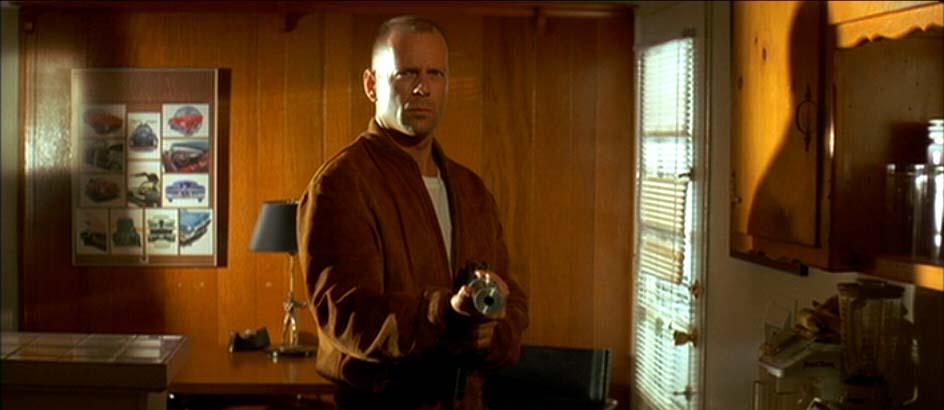
Butch prepared to take out Vincent, the man who would have killed him had the careless hit man not left his gun outside of the bathroom.

Upon fleeing his apartment in his car, Butch unfortunately runs across Marsellus Wallace himself. Wallace chases Butch into a pawn shop run by a redneck, Maynard. Maynard pulls a shotgun on them both, knocks them out, and brings them to the basement where he and his perverted companion, Zed, make clear that they will take sexual advantage of both men and kill them. While Maynard and Zed have their way with Wallace, Butch quietly manages to free himself. Rather than escaping and leaving his adversary Wallace to a horrible fate, however, Butch decides to save him. After the rescue, Wallace grants Butch a sort of amnesty, telling him to leave L.A. for good. Butch readily accepts, returns to pick up his girlfriend, and leaves.


My Reaction to the Film (Done after this most recent viewing)

I think I could go another 50 years before watching this film again, and I still could not see it with fresh eyes. That is how much of an impact it had on me when I first saw it, and that’s how much impact it’s had on countless films since its release.

Back in 1994, I was 19 years old when I saw Pulp Fiction for the first time. I had no idea who the director was, but the movie blew me away. I had never seen a film so funny, engaging, tense, entertaining, novel, and just plain fun. There were so many different things to soak up that I went back to the theater to watch it three more times, over the course of the next few weeks. Any time I found a friend who hadn’t seen it, I would bring them immediately. It quickly became a mainstay of the pop culture landscape, and references to nearly everything in the film have abounded ever since.

Now that nearly 20 years have passed and Quentin Tarantino has released several other movies, it’s become rather easy to deconstruct his work and view it as overdone and perhaps a bit too heavy on style at times. Still, this doesn’t take away from just how novel a blend it all was back in 1994, and it still shows his style as a brilliant one that is, as the saying goes, “often imitated, never duplicated.”

Of course, the dialogue is the most engaging part of watching Pulp Fiction the first, third, or even tenth time you see it. Basically every line shows a certain amount of wit or unexpected humor. Tarantino’s hallmark of seasoning the dialogue with pop culture references was put on full display in Pulp Fiction. He had done it to a degree in his previous film, Reservoir Dogs, but not to this extreme. In the same way that details and references make a good stand-up comedian funny, the running spoken interplay between characters in Pulp Fiction is as entertaining as it gets. Virtually every line from the film is quotable, and I was just like millions of others in going back to the theater repeatedly in order to soak it all up and commit it to memory.

Vincent and Jules in the diner. Arguably the best of the many great conversations in the film. Samuel L. Jackson's take on Jules's introspection earned him a well-deserved Oscar.

When describing a Tarantino film (especially the earlier ones), fans will never have the word “cool” very far from their vocabulary. The characters themselves are all great archetypes of “cool.” The stony-eyed hit men, the mythically-powerful mob boss, the aging boxer with one last shot to hit it big – these major characters were all drawn from countless noir and pulp stories from the previous several decades. Tarantino cast them into modern settings masterfully and made them fun to watch. Even all of the minor characters – Pumpkin and Honeybunny, Lance the drug dealer, Maynard and Zed the perverted rednecks, Winston Wolf, and all of the others have become almost iconic, based on amazingly composed vignettes. Tarantino is obviously a lover of what he terms “badasses,” and Pulp Fiction probably has the highest badass factor of all of his movies.

Yet another element to the Tarantino film is the music. Never before had I taken in a movie in which the music enhanced the atmosphere so effectively. From the moment that Miserlou relentlessly kicks in during the opening credits, the soundtrack deepens the mood with every song. Once again, the word “cool” finds its way to the forefront.

Though I’ve seen this movie at least ten times, and I know it basically by heart, one thing was more noticeable to me this time around. I had never really taken in just how obviously “cinematic” it all is. Sure, there is a certain amount of realism to some of the settings, and the actors’ deliveries of the dialogue are astoundingly naturalistic. Still, when you focus on the costumes, the set designs, and the composition of the other elements, it’s abundantly clear that the world of Pulp Fiction is just that – fiction. From the eye-popping colors of Jack Rabbit Slims to the minimal yet memorable suits of Jules and Vincent, and even the obviously phony backdrop in the cab that Butch takes from the boxing arena, there are plenty of moments that remind you that you are, indeed, watching a movie. Sure, there are really tense and violent moments (something for which Tarantino has been recognized and criticized for two decades now), but it is quite clear that these are, in many ways, comic book characters. In film, this makes for pure cinema through a concoction that very few directors can manage.

Butch peruses which weapon he will use to kill a couple of deranged hillbillies. This visceral scene is one of several almost cartoonish ones that show off Tarantino's skill with the nearly-lost art of visual storytelling.

I don’t know if Pulp Fiction will be as enjoyable thirty, twenty, or even ten years from now, when the pop culture references lose their sparkle and meaning and more and more filmmakers try to ape its magic. But no critic can ever diminish the effect it had on the cinematic landscape. It’s still a really fun movie to watch, and may be the quintessential “1990s American” movie.

Some Final Thoughts on Tarantino:

As stated, I became a tremendous fan of Quentin Tarantino after Pulp Fiction, and I still go to see every movie that he either directs or for which he writes the screenplay. Here are my quick thoughts on each of his major motion pictures:

Reservoir Dogs (1992): Outstanding crime flick, featuring everything that a Tarantino fan could love. The sharp dialogue, intensity, and non-linear storytelling are all tight, and the acting is absolutely top-notch.

True Romance (1993): Director Tony Scott took Tarantino’s script and fashioned another great movie. It has one of my all-time favorite movie scenes – in which Dennis Hopper and Christopher Walken stare each other down and engage in a captivating exchange.

Natural Born Killers (1994): Director Oliver Stone took Tarantino’s basic story and some of his script and created an uneven mess. Stone can never help himself from making grandiose statements, and he went way over the top in this one, often drowning out the strengths of the Tarantino-penned script.

From Dusk ‘Till Dawn (1996): Directed by Robert Rodriquez, a great vampire movie that combines Tarantino’s strengths with crime writing and vampire lore. Over-the-top fun that I still occasionally watch and enjoy.

Jackie Brown (1997): The sleeper Tarantino movie. It’s actually my second favorite, behind Pulp Fiction. Adapting an Elmore Leonard novel, Tarantino put together his most accessible movie, for those who are put off by the graphic violence in most of his movies. I always recommend this one to people who haven’t seen it.

Tarantino's most underrated film, in my view. Great direction and acting bring a cracking Elmore Leonard tale to life. If you dig crime movies, check it out.

Kill Bill, volumes 1 and 2 (2003, 2004): Tarantino’s homage to kung-fu and spaghetti western movies. They work very well in some places, and they’re quite a bit of fun; however, they became a bit tiresome by the end of the second part. The movie gore hits new heights in these ones.

Grindhouse/Deathproof (2007): This is where my patience with Tarantino started to wear thin. This is his most self-indulgent, tiresome film. There is some great acting and decent verbal exchanges, but Tarantino was clearly in love with his own dialogue just as much as the B-movie exploitation horror films that he was channeling. Not a bad movie, but I’ll never watch it again.

Inglorious Basterds (2009): Still overly enamored of his own dialogue, Tarantino nonetheless made a solid World War II flick. It’s a preposterous re-imagining of history, but still an entertaining watch. Could have been edited down a bit, but I enjoy it. Christoph Waltz and Brad Pitt help with excellent performances.

Django Unchained (2012): Very much like the previous movie, only set in the 1850s old West. Again, Tarantino falls back on his passion for spaghetti Westerns, but does it with his own panache. Also a bit long, but still a solid movie. Like “Basterds,” it’s worth watching just for Christoph Waltz.

As of now, I still consider myself a fan, but I now qualify it a bit more. At this point, I would really like to see Tarantino get away from the same wells that he’s drawn from for years now – exploitation, kung-fu, and spaghetti western films. I understand that these are his strengths and passions, but I think he’s a capable enough filmmaker to try something a bit different. Although, with word coming out that there is a “Kill Bill, part 3” in the works, I probably shouldn’t hold out much hope.

That’s a wrap. 96 shows down. 9 to go.

Coming Soon: Chunking Express (1994)
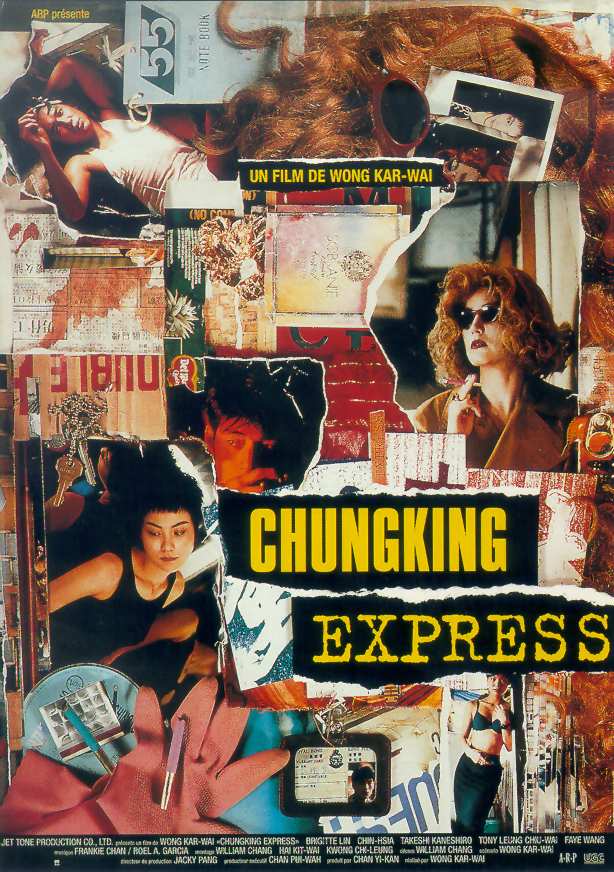

 I know a few of director Wong Kar-wai’s movies, and I’ve liked them. I’ll see how this early work of his stacks up.

Please be sure to pick up all empties on the way out.

Monday, February 25, 2013

Film #95: Legend of Drunken Master (1994)


Original Chinese Title: Jui kuen II

Directors: Chia-Liang Liu, Jackie Chan

Original Release Country: Hong Kong (China)

Times Previously Seen: once (about 14 years ago)

Kung-fu Quick Summary:

China, approximately the 1930s or 1940s. Young man Wong Fei-hung (Jackie Chan) is returning by train with his father from a business trip. His father is a respected herbalist, and they have been on a buying expedition. The impetuous Fei-hung gets caught up in trying to smuggle some ginseng onto the train, to avoid paying a tax, and his plant gets swapped with an antique stone. After a few fights and further confusion, Fei-hung, his father, and their assistant arrive home safely.

After arriving back at his father’s shop, Fei-hung and his clownish step-mother cover up their father’s missing ginseng through various tricks. Amidst all of this, Fei-hung gets caught up in a street fight in which he utilizes his “drunken boxing” style – a form of kung-fu that is virtually unbeatable but requires the practitioner to consume ever-increasing amounts of alcohol. For this reason, Fei-hung’s father forbids it.

Fei-hung, getting loaded in the middle of just one of many ass-whippings that he delivers in the movie. Sure, the idea of alcohol-fueled martial arts invincibility is ridiculous. But it's fun.

Fei-hung and his family are eventually visited by Master Fu Wen-Chi, China’s top counter-intelligence officer, and a man whom Fei-hung had fought during the train ride that set all of his trouble in motion. Wen-Chi explains that the antique stone that Fei-hung had found is one of an entire hoard of Chinese historical treasures that are being stolen and smuggled out of China by a corrupt British diplomat and his regional Chinese cronies.

With the help of miners abused by the diplomat’s henchman and Master Fu Wen-Chi, Fei-hung leads an assault on the thieves headquarters – the mines from which they are excavating and stealing the national treasures. Fei-hung fights his way through a gauntlet of ever-more skilled adversaries and, by embracing his drunken boxing skills, defeats them all. The treasures are returned to their rightful owners, the Chinese people, and the fiendish British diplomat is banished.

My Gut Reaction to the Film (Done after this most recent re-viewing)

I assume that this film was put on the “All-TIME 100 list” because it is considered the absolute pinnacle of what kung-fu movies can offer.

If this is the case, then I can now say that kung-fu is simply not a genre that holds my attention.

In an odd way, my feelings towards the kung-fu genre are similar to the way I feel about the musical or even dance film genres. I can appreciate the planning, skills, and execution that they all require, and I can even marvel at these things for a while. Eventually, though, I’m always left wanting more narrative and emotional substance. Legend of Drunken Master is no exception.

Whether you're a fan of martial arts flicks or not, you have to marvel, even if only for a few moments, at the physical skill exhibited throughout the movie.

Story-wise, you have a nationalistic tale that is threadbare and so simple that it almost insults your intelligence. While the thievery of Chinese treasures of antiquity has been and is a real problem, this film’s treatment of it makes it clear that it is only meant to imbue the goofy Fei-hung with some sort of heroic purpose. I guess even Hong Kong kung-fu movies need their McGuffin.

In reality, the nefarious thievery acts more like whatever throw-away premise would get used in a W.C. Fields movie – it’s simply something that serves as an excuse for the star to do what he is best known for. In Fields’ case, it was begin a drunken, wise-cracking buffoon. In Jackie Chan’s case, it is being a lightning-quick contortionist/martial artist who dispatches hordes of enemies. The reason is completely inconsequential, so long as the star gets to do his thing. This keeps things rather simple, which can be both good and bad.

Interestingly, this film’s connections to the movies of long ago do not lie in its simplistic plot alone. One can easily see a very heavy dose of silent-film era shenanigans in Legend of Drunken Master. Between Chan and his step-mother, played by Anita Mui, the goofy slapstick is never very far. Chan himself often channels the great Buster Keaton, as far as pulling off effortless acrobatic and gymnastic moves, even when doing what would otherwise be routine movements. At times, I was also reminded of a quote I once heard about Fred Astaire – that he was “always dancing,” even during non-dancing scenes. Chan doesn’t “always” dance through his scenes, but when he does, it is to excellent effect. However, I must say that the slapstick eventually became more sophomoric than amusing to me.

The thing that makes this movie stand out is, of course, the action sequences. Jackie Chan and co-director Chia-Liang Liu (also a long-time stuntman in Hong Kong martial arts flicks) concocted and executed some phenomenal sequences in this movie. The speed and precision of the movements create a ballet of violence that will mesmerize any viewer. At least, for a little while. This was my problem. Like the slapstick elements of the movie, what begins as magnetic eventually became tiresome to me. The latter half of the film, with Chan facing down dozens and dozens of generic thugs and henchman, had lost its luster. I realize that not everyone feels this way. There are plenty of kung-fu movie fans who live for this stuff, and those fans would surely love every minute of every fight scene in this movie. I, however, grew weary of them.

One other gripe I have regarding the action sequences is their authenticity. One legitimate claim to fame that Chan has always had is that he and everyone in his movies perform all of their own stunts. However, in Legend of Drunken Master, it is quite clear that suspension wires are used during several of the fights and stunts. This is a bit disappointing since part of the intrigue of these movies is seeing just how far the stuntmen and women can push the limits of the human body, in terms of agility, flexibility, and coordination. Some of this wonder is diminished, though, when I can tell that they are “cheating” somewhat by using tools that any old “action” star could use. It would be like seeing Swan Lake when you know that the ballerina is using support wires. Not nearly as impressive.

One of the most obvious of several scenes that used wires to hold the actors up, allowing them to preform stunts and moves that seemingly defied gravity. Rather cheap, in my view. 

So I’m pretty much done with kung-fu movies. Perhaps there are still some out there that show the depth and development that I’ve always found lacking in them. Unless I hear of an unusually thoughtful or meditative film like the previously reviewed classic, A Touch of Zen, or the much more recent Crouching Tiger, Hidden Dragon, I’ll be staying away from this brand of film.

That’s a wrap. 95 shows down, 10 to go.

Coming Soon: Pulp Fiction (1994)


“Bring out the gimp.”

Please be sure to pick up all empties on the way out.

Saturday, January 19, 2013

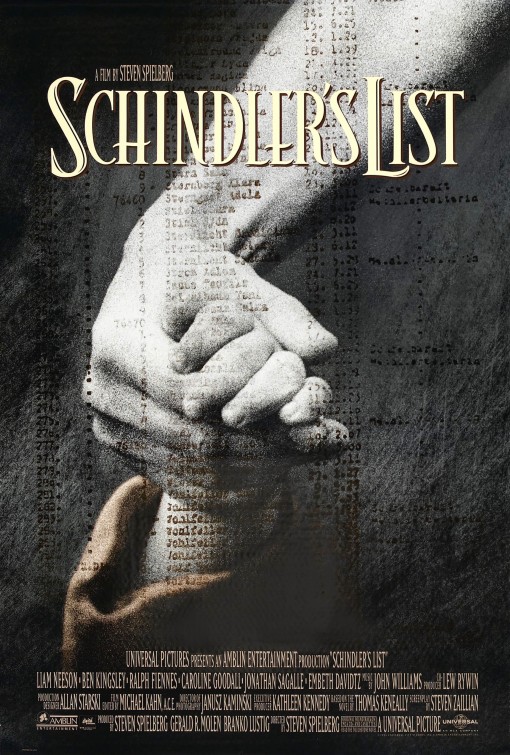
Film #94: Schindler's List (1993)


Director: Steven Spielberg

Initial Release Country: United States

Times Previously Seen: twice (last time about twelve years ago)

Rapid-Fire Summary

For a complete plot synopsis, check here at imdb’s website.

In 1940, the Nazi machine is taking hold in Poland. They are starting to herd all Jews together and force them into ghettos. Amidst these massive and horrific changes, the Czech-German businessman Oskar Schindler (Liam Neeson) arrives in Krakow with dollar signs in his eyes. Through clever business machinations and a flare for panache, Schindler quickly ingratiates himself to Nazi high commanders, secures a factory and a Jewish prisoner labor force for himself.

Over the next few years, business is good for Oskar Schindler. His factory produces quality pots and other metal goods, and his chief accountant, the Jewish Itzhak Stern (Ben Kingsly) sees that the factory runs smoothly and profitably. IN the early going, the only seeming bump in the road is the assignment of Nazi officer Amon Goeth (Ralph Fiennes) as the commander of the labor camp in Krakow. Goeth is an unpredictable and homicidal maniac who kills Jews without rhyme or reason. Schindler, however, manages to become civil, if not friendly, with the treacherous killer, in the name of keeping the money flowing in.

Oskar Schindler - in the middle of one of his many negotiations. These eventually evolve from purely self interested to completely altruistic.

Gradually, Schindler begins to have a change of heart, though a somewhat quiet and slow-building one. Upon seeing the murderous brutality of the Nazis against the Jews, Schindler, on the gentle but unwavering urging of Stern, begins to bring more Jewish laborers into his factory. He tells everyone that it is simply to maintain efficiency, but those who are closest to him can see that his sympathies for the Jews are growing. Schindler even tries, unsuccessfully, to change the brutal nature of Goeth. This failure aside, he continues to take Jewish prisoners into his factory to save them from the horrors of working in the labor camp every day.

As the War enters its final year, things become more desperate. Word comes down that Hitler has ordered the complete extermination of Jews – the so-called “Solution.” In the face of this, Oskar Schindler takes all of his massive profits, and even convinces a few other businessmen to do the same, and purchases over a thousand Jewish laborers. He assures Goeth that it is merely for convenience, as these laborers and their children are known commodities. The deal is made, and Schindler even ensures their safe transport to Czechoslovakia after his Jewish workers are mistakenly sent to Auschwitz and nearly killed, along with thousands of their fellow Jews.

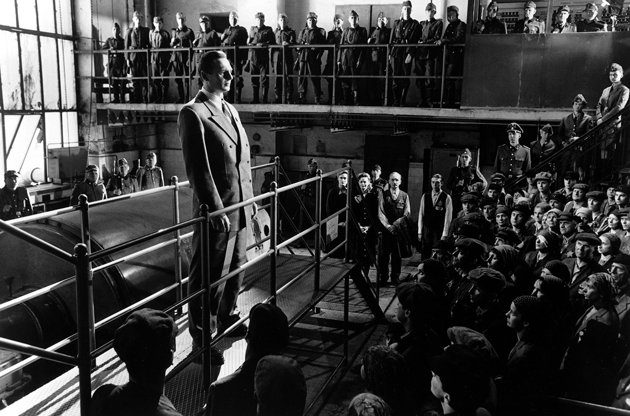
At the official surrender of the Nazis to the Allied forces, Schindler addresses the hundreds of people that he has saved. The following day, as an ultimate irony and sacrifice, he must flee punishment for the crime of war profiteering.

When the war ends with the unconditional surrender of the Axis powers, the Jews are free, but Oskar Schindler is now, officially, a war criminal for profiteering. With the blessing of the thousand that he helped save, Schindler and his wife flee into the night.

My Take on the Film (done after this most recent viewing)

This was the third time that I’ve seen this movie, and my feelings haven’t changed – it’s a very good film in many ways, but there are a few things that irk me.

Schindler’s List is definitely one of the boldest of Spielberg’s films. The movie portrays the stark and horrific actions of the Nazi regime against the Jews in a way that I had never seen before. It goes far beyond mere sensational, almost action/suspense route that could have been taken. Seeing silent, morose masses of Krakow’s Jewish citizens, lined up to be classified and segregated by the conquering Germans has much more authentic emotional power. This is one of many subtle details that the movie exhibits in order to convey the crushing reality of the Holocaust.

As always, Spielberg is a master of the technical aspects of film. The man has always known how to tell stories through the moving picture, and Schindler’s List is no exception. From the opening scenes of Oskar Schindler schmoozing his way into the good graces of the Nazi commanders, to and through Goeth’s failed attempt at becoming a forgiving overlord, the movie balances dialogue and visuals to tell the tale as well as anything Spielberg has ever done.

The maniacal Goeth and the savior Schindler, during one of their many talks. The two are dark-and-light reflections of one another. This scene displays how effectively Spielberg used the black and white medium. No one can say that the man doesn't know what he's doing with a camera.

Unfortunately, as important as these things are, and as well as the movie does them, there are several gripes that I have. One is that I have always found a certain flatness to the main characters. Oskar Schindler’s soul goes through a massive transformation, and yet we are left with virtually nothing to explain why this might have occurred. Aside from a few ponderous gazers at the horrors around him, we are left in the dark as to why, exactly, this self-absorbed capitalist would abandon his fortune to save a group of people whom he has only seen as a means to his financial ends. There are moments when we get hints, but I’ve always felt a little cheated when it comes to this aspect of the film. There is also an enigmatic quality to Goeth. The character never feels completely real to me – almost more of a monster construct than a person who actually could have existed.

The idea of constructs is another problem I have with the film. Far too many times, I felt as if I could see Steven Spielberg’s hand prints on the movie, and not in a good way. He was clearly trying to present a “realistic” look at the terrors of the Holocaust, and in some notable ways, he succeeded. However, there are a few too many scenes and moments that feel very contrived to me. One is the “secretary” scene, when the libidinous Schindler is “interviewing” potential secretaries by watching them type. This sequence, with no dialogue, is a very wink-wink, nudge-nudge, humorous moment in the movie. In other words, it seems way out of place. There are several others, but none so egregious as the final scene in which Schindler is walking towards his car, about to leave behind all of the people he has saved. In a scene that seemed straight out of a hackneyed melodrama from the 1940s, the hundreds of Jews quietly stand around him as he slowly starts to cry and despair over how many more lives he could have saved, had he not been so selfish. On paper, it seems to make for a great scene. On film though, to me, it seems rather artificial.

The final scene, in which Spielberg and Neeson overplay their emotional hands (in my opinion). The melodrama becomes thick to the point that it does a disservice to the reality upon which the film is based.

Related to this is something that has been a bugaboo in virtually every Spielberg film – shying away from truly, completely shocking the audience, even when it may be appropriate. The particular scene I have in mind is towards the end of the movie, when Schindler’s Jews have all been mistakenly taken to Auschwitz. The women are all stripped naked and forced into a large warehouse, which they and we the audience all presume to be a gas chamber in which they will all be killed. Just at the height of our fears, water rather than gas rains down from the shower heads, merely cleaning the terrorized women. I don’t know whether this event actually occurred, but it struck me as strange that the director, who has already shown us multiple brutal murders in the movie, would shy away from presenting perhaps the most disturbing crimes perpetrated during those years – the mass executions of helpless innocents. I’m not saying that I would have enjoyed seeing such a thing, but this film is clearly not about enjoying what you are seeing. It is about witnessing the atrocities committed against the Jews, and it only seems right to witness the greatest of those atrocities.

Schindler’s List is one of those films on historical tragedy that merely makes me want to learn more about the actual story, not unlike The Last King of Scotland or Hotel Rwanda. In fact, the scene that has by far the most impact on me, and the only one during which I cry, is at the very end, when the credits start to roll. We shift to 1993, when the film was released, and we watch the surviving “Schindler’s Jews” and some of their descendants process towards the real Schindler’s grave and place flowers along it. This is when the reality of the story hits me, and this is when I feel a real sense of loss.

I ultimately think of Schindler’s List as a “near miss.” It tells an important story, and it does many things well. However, I feel that, had the few “Hollywood” moments been eliminated and had Spielberg gone more minimalist in a few of his techniques, the movie would have had even more power.

In other words, three times in more than enough for me. I don’t need to watch this movie ever again.

That’s a wrap. 94 shows down; 11 to go.

Coming Soon: The Legend of Drunken Master (1994)


Ahhhh. A nice breath of fresh air, after emotional weightiness of the prior three movies. Kung-fu action up the wah-zoo. As of writing this, apparently Jackie Chan is in some hot water for an anti-American rant. Whatever. I just want to see one guy jumping around, kicking the stuffing out of a bunch of other guys. 

Sunday, January 6, 2013

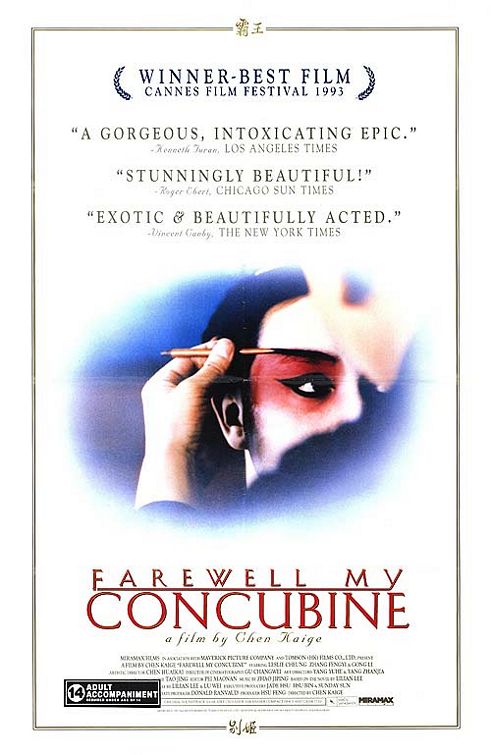
Film # 93: Farewell, My Concubine (1993)


Original Chinese Title: Ba wang bie ji

Director: Kaige Chen

Initial Release Country: China

Times Previously Seen: none

Rapid-Fire Summary

For a more complete synopsis, you can check out this one at wikipedia. Here is my simplified version:

In China in 1924, the young boy Douzi is given by his prostitute mother to an academy for opera performers. His mother even goes to the extreme length of chopping off little Douzi’s unusual sixth finger, to make him appealing enough to the school’s exacting headmaster, Guan. This is just the first of many forms of suffering that Douzi will face in the course of his next decade of training. For another decade, Douzi and his peers are put through a brutal regimen – one which even results in the suicide of one of his closest friends. Douzi does, however, become very close with Shitou, who becomes his “stage brother” in operatic performances.

Douzi and Shitou graduate from the academy and become opera sensations, taking on the stage names of Cheng Dieyi (Leslie Cheung) and Duan Xiaolou (Fengyi Zhang). The two are most noted for their performances of the classic Chinese opera, Farewell, My Concubine, with Cheng playing the role of the royal concubine and Duan playing the role of the king. Cheng clearly has deeper feelings for Duan and wishes for them to be together in all ways, not merely as operatic partners. Duan, however, refuses Cheng’s advances and eventually marries Juxian, a courtesan who manipulates Duan into the union.

Cheng (right) prepares Duan's makeup before another of their famous performances. The care shown here echoes the tenderness that Cheng harbors for his stage brother.

Over the succeeding four decades, Cheng and Duan’s relationship undergoes several changes, due in no small part to the massive political upheavals of the times. From the Japanese invasion in the late 1930s to the return of nationalism in the late 40s, and all through Mao’s forms of revolution, the two actors experience equally tumultuous emotional shifts. Though they continue to perform their most famous opera intermittently, they must fight through Cheng’s opium addiction, accusations of being counter-revolutionaries, and the ever-present resentment of Cheng towards Juxian. In 1966, after the Cultural Revolution, the two men are forced by a raving communist mob to turn on each other and abandon their passion for the opera and each other.

In 1977, eleven years after their public renunciation of each other and their craft, the two men join up one more time. As they are practicing for a return performance of Farewell, My Concubine, they share a tender moment of recollection at how their close friendship began several decades earlier. Then, in imitation of the forlorn character that he has played so famously, Cheng commits suicide.

My Gut Reaction to the Film:

For as long and ultimately tragic as the story is, I found this movie quite compelling. Though it may be a case of trying to do more than can be done in 180 minutes, there’s still a lot to be said for how strong a film this is.

The most immediately striking feature to anyone who watches even a few brief moments of the movie is the visual aesthetic. The vibrancy and majesty of the emotional, political, and artistic themes explored in the movie come through the stunning sets and costumes. Put simply, the movie is a joy to look at. It calls to my mind another fantastic Chinese epic film – The Last Emperor, which made similar use of color, shading, and lighting to build atmosphere so effectively.

This still shot of Duan and Cheng in costume only gives the slightest hint of just how lavish the film's visuals are. Virtually every scene, including those away from the opera stage, is brilliantly composed and drawn the eye.

The visuals, though, are the window dressing for the real heart of the movie – the tortured existences of Cheng and Duan. The story of these two men could easily be seen as the struggle of artistry and human emotions against overwhelming social pressures towards conformity. Even before the political upheavals begin, it is clear that the Chinese cultural concepts of fate and hard work leave the young Douzi and Shitou no option but to be beaten into what society tells them – actors. There is beauty in the tragedy, as seen by the successes that the two men find on the stage, but it is ultimately doomed to be crushed by blind ideologies that do not seem to allow for individual feelings. Normally, I would not be so interested in the emotional turmoil of a depressive dramatist such as Douzi/Cheng. Yet with this film, I found the tale extremely engaging.

One of the amazing feats of this movie is its dealing with desire and sexuality. I honestly don’t know what the popular Chinese conception is of homosexuality, but it is presented in Farewell, My Concubine as a simple matter of course. Yes, Cheng is gay and seeks to be the lover of his stage partner, but Cheng’s homosexuality is not really the focal point of the issue. The movie makes clear that the driving force is his fierce desire for something that cannot be.

In similar fashion, the tale’s portrayal of political machinery is pleasantly unpatriotic. China is, without a doubt, one of the more fiercely nationalistic countries in the world. I can only assume that a fair amount of “art” produced there in the last century can well be classified as mere propaganda. A film like Farewell, My Concubine not only avoids that label, but even castigates such hive-mindedness by showing how damaging it is to individual liberty. The psychological toll on Cheng and Duan both transcends and is dwarfed by the onward march of Chinese history, making their story both intriguingly regional and surprisingly universal.

As the communist revolution sweep the country, a frightening zeal for conformity and blandness overtakes the populace. Independent thinkers and artists are just some of the many who suffer the rise of this humorless movement. 

There are some aspects of the film that would most likely prevent me from watching it again, however. In a general sense, there is a certain cultural gap that I, as an American, couldn’t completely traverse. Though I consider myself more culturally aware and sensitive that most people, some of the behaviors and attitudes in the film seem to require an understanding of the subtler aspects of Chinese codes and mores. There is a reverence for the Confucian master/student relationships that is puzzling, if not outright perplexing, to someone of my Western upbringing. It can be fascinating at times, but frustratingly enigmatic at others.

On a technical level, the pacing of the film is occasionally herky-jerky. I suppose that it is inevitable when trying to tell a tale that spans 50 years while maintaining emotional depth, and the film probably does it as well as possible. Still, there are some tremendous time jumps that are a tad disorienting. This is exactly the kind of story that would benefit from being told as a television series over the course of six or eight hours, rather than crushed into three.

My most subjective, and probably most lasting, gripe is my feeling towards classic Chinese opera, something that understandably and necessarily is featured throughout the picture. I find the singing style absolutely intolerable. I know, I know. This is my “ethnocentric, Western ear,” but I can’t help it. Try and I might (and I tried the same thing with Japanese noh theater when I lived in that country for two years), I can’t find any pleasure in listening to the high, whining vocalizations that are the hallmark of the art. I’m sure someone with an ear for it would find Cheng’s performances breathtaking. Alas, I found myself simply wishing them to be over so that the story could continue.

The actual opera performance scenes are visual spectacles, but I simply do not have the ear to appreciate the style of the art. 

Farewell, My Concubine is a great film, and I one that enjoyed. It features all that any fan of epic tales of touching, personal tragedy would surely enjoy. I don’t see myself watching it again, but it’s an easy one to recommend.

That’s a wrap. 93 shows down, 12 to go.

Coming Soon: Schindler’s List (1993):


And rounding out the current trilogy of tragedy is Spielberg’s holocaust offering. I’ve seen it a few times, and I found it flawed. I’ll see if my opinion holds after this next (and probably final) viewing.

Please be sure to pick up all empties on the way out.

Friday, December 28, 2012

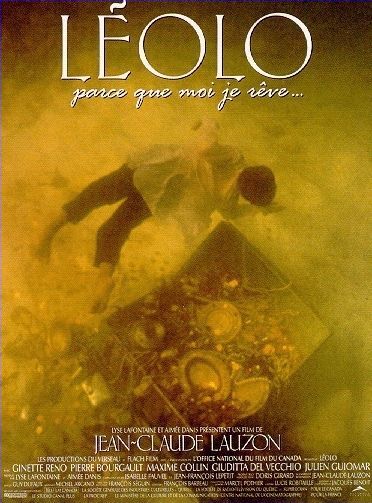
FIlm #92: Leolo (1992)


Director: Jean-Claude Lauzon

Initial Release Country: Canada

Times Previously Seen: none

Rapid-Fire Summary

In a Montreal, Quebec slum, twelve-year old Leolo Lazone is steeped in misery. His family is impoverished, and all of his relatives suffer from some form of severe limitation. His brothers and sisters are all either mentally challenged or lapse into insanity on regular bases. His loving but completely uneducated parents obsess over their children’s bowel movements, and his grandfather not only tries to kill Leolo, but is also a sexual deviant.

While there is no true physical escape for Leolo from his warped environment, he is able to escape within his mind. Through a little bit of reading and a lot of his own writing, he concocts various tales about his own origins and the people around him. Envisioning himself as the son of an unknown Italian, he constantly dreams of being on the gorgeous Italian coast with his beautiful neighbor, Bianca. It is with similar imagination that he deals with the extremely strange behavior of his family and the ways that it affects him.

Leolo in two of his refuges - the bathroom and his writing. The noose around his neck can certainly be seen as a not-too subtle symbol of his life circumstance.

Eventually, the final straw is placed. After attempting to kill his perverted and unstable grandfather and bearing witness to one too many distorted sexual acts around him, Leolo finally snaps. He becomes catatonic and is placed in a mental institution, presumably for the rest of his days.

My Take on the Film

I’ll never watch this movie again.

Don’t take that completely the wrong way. Leolo is, indeed, unique and shows a wealth of skill on the part of writer/producer Jean-Claude Lauzon. In reading a brief summary like mine above, it will seem that the movie has little more than depravity and depression to offer a viewer. This is certainly not the case, but these dour themes are what I ultimately take away from the film.

For a good part of the movie, Leolo actually keeps just to the right side of the line between darkly humorous and simply dark. During the earliest scenes, depicting a very young Leolo being forced by his delusional parents to ingest laxatives and defecate on command, one is almost overwhelmed by how repulsive, desperate, and hopeless his situation is. Yet, once he begins to twist his surroundings into his own imaginative reality, some welcome levity is added. Seeing his pathetically dull older brother go from the classic “90 pound weakling” to a muscle-bound body builder is rather amusing. Also, his regular trips to the psychiatric ward to visit his other family members as they enter and exit various stages of psychosis provide some humorous moments.

One of the somewhat lighter moments in the film - Leolo (middle) about to be hurled into the sea by his brother (left) and an accomplice, so that he can retrieve fishing hooks to be resold.

Still, by the end of the film, there is nothing left at which to laugh. Once his siblings have all gone thoroughly insane and Leolo bears witness to a wretched act of bestiality by one of his peers, the little boy joins his brothers and sisters in their inescapable states of catatonia. For me, at this point, any of the lighter moments from earlier in the film had ceased to have much meaning. While Leolo’s fertile and active mind had given some entertaining and touching attempts at escape, they are all for naught in the end.

Another lesser problem I had with the film is that it is not exactly as original as one would believe, reading many of the critical reviews. One of the more notable scenes, in which the adolescent Leolo explores his sexuality with liver (no, that is not a typo – it is just the kind of thing that this film offers), is actually ripped off from Philip Roth’s novel Portnoy’s Complaint. More generally, the graphic nature of the sordid, impoverished sexuality is something that I have seen in other films such as Sergio Leone’s Once Upon a Time in America. And so, there was not even some sense of “bravura” novelty to be taken in.

I must say that the visuals are stunning in the film. The technical merits are laudable, and there is a wealth of clever framing and shooting. The contrasts between Leolo’s stark reality and his vibrant imaginings are made very clear through the camera work and frame compositions. In many scenes, the film is pleasant to look at. However, once again, there are many scenes in which the actions taking place are repugnant enough to undermine an appreciation of the aesthetic skill.

Leolo finds warmth and refuge in this makeshift shelter with his sister. The soft glow of the candles is captured extremely well and conveys the sense of comfort.

On a final note, this film brought to mind a few other, more recent pictures – Terry Gilliam’s Tideland and Guillermo del Toro’s Pan’s Labyrinth. Tideland tried to pull a very similar trick, telling the story of a young girl in absolutely miserable circumstances (drug addict parents who both die of overdoses) who copes by envisioning an entire fantasy world around her. Alas, like Leolo, Gilliam failed in my mind, and the story is just far too depressing to be overcome by some bright visuals. Pan’s Labyrinth, on the other hand, actually succeeded. The overall tale is arguably just as downbeat as Leolo or Tideland, but del Toro managed to find the right balance and leave the viewer with the right amount of sweetness to accompany the bitterness.

I would only recommend Leolo to those who are not put off by extremely depressing movies. If such themes do not bother you, you may very well find this movie one of the more creative and engaging of its type. To me, though, one viewing was plenty.

That's a wrap. 92 shows down. 13 to go.

Coming Soon: Farewell, My Concubine (1993):


Don't know much about this one, except that it has the look of a rather sad tale. This will make number 2 in the "depresso 1-2-3 punch" of current films for me, preceded by Leolo and succeeded by Schindler's List. I'll be mixing in some Farrelly brothers movies, just to maintain some kind of balance here. 

Sunday, December 2, 2012

Film # 91: Unforgiven (1992)


Director: Clint Eastwood

Initial Release Country: United States

Times Previously Seen: around five or six

Rapid-Fire Summary

In the small town of Big Whiskey, Montana, in 1881, a cowhand becomes enraged at a prostitute named Delilah over a minor insult and slashes her face. Despite calls from Delilah’s fellow prostitutes that the cowhand and his companion be hanged, the sheriff, “Little Bill” (Gene Hackman) merely demands that the two boys pay the proprietor of the saloon/cathouse in the form of horses. The furious prostitutes then secretly pool their money and start spreading word of a bounty for anyone who kills the two cowboys.

To the south, in Kansas, a brash young man calling himself “The Schofield Kid” finds the middle-aged farmer William Munny and asks him to partner up to kill the cowboys for the bounty. The Kid has heard from that Munny was once a fearless and vicious killer who would make a perfect partner for such a dark deed. Munny, now a widower who has forsworn his previously murderous life and with two young children to support, at first refuses The Kid. With his farm failing, though, he changes his mind. He convinces one of his old partners, Ned (Morgan Freeman), to join him on this final killing in order to have a new start for his children.

Will Munny, a brutal killer in the past, now struggles on his farm with his two your children.

Back in Big Whiskey, Little Bill has now heard of the bounty put out and brutally beats and casts out the first bounty hunter who drifts into town to inquire after it – the noted gunman “English” Bob (Richard Harris). When the Kid, Will, and Ned come into town some days after, Will is himself beaten by Little Bill, while Ned and The Kid escape. The three rally themselves and set out after the first of the two cowboys, undeterred by Little Bill’s edict against assassins. When they find the cowboy, however, Ned is unable to bring himself to kill him. Will instead takes Ned’s rifle and shoots the cowboy dead. Ned, realizing that he no longer has what it takes to kill a man, parts ways with Will and The Kid, with Will promising to bring Ned his share of the bounty after the job is finished.

Will and The Kid then find the second cowboy, who actually cut up Delilah, holed up at the ranch he works on. The Kid kills the cowboy and the two make a narrow escape. When Will and The Kid return to just outside of Big Whiskey to collect the bounty, however, they discover that Ned has been captured, tortured, and killed. Suddenly overcome by a dark cloud of vengeance, Will plies himself with alcohol and rides into town alone. Calmly walking into the saloon where Ned’s corpse is prominently displayed outside, Will coldly kills six men, including the saloon owner, four deputies, and Little Bill himself. Though plenty of the townspeople are still alive to stop Will from leaving, they are all too terrified of the killer to even make the attempt.

Will, in Skinny's saloon as he slays all those he feels are responsible for Ned's death. During these moments, all traces of the quiet, tortured farmer have been burned away.

We are told in the end that Will returned to his farm and used his bounty money to move himself and his children away, possible to California where he “prospered in dry goods.”

My Take on the Film (Done after this most recent viewing):

Unforgiven is, in my mind, the greatest Western film. There are others that are more exciting and entertaining, but this one has by far the most depth and arguably the greatest acting.

Clint Eastwood’s masterpiece probably couldn’t have been made much earlier than it was. Being a deconstruction of the mythical West and Western stories, it required all of the popular lore that preceded it, both in literature and film. Eastwood set out tell a story that took a dark and realistic look into the souls of truly dangerous men in the old West, and he did it with expert precision.

At the heart of the film are all of the popular notions of the “Wild West” gunslinger. The mythology around that time and place has been the inspiration for countless tales of adventure for well over a century. The archetypal “deadly guman” has long been one of the most attractive characters in U.S. narrative. Unforgiven gives voice to this attraction through the character Beauchamp, a bumbling fiction writer who at first is following around English Bob as his biographer. His stories of Bob cast him as a noble warrior whose skills with a pistol make him a modern-day knight. Once Bob is thrashed and imprisoned by Little Bill, however, the myth starts to fall apart.

English Bob, left, and his biographer, Beauchamp. It is initially through these two characters that the myths of honorable gunfighters are taken apart.

It is during the scenes between Little Bill and Beauchamp, with English Bob watching from his cell, that we start to get at the reality of killers. With his first-hand knowledge of Bob, Little Bill tears apart Beauchamp’s notions of his idol. We soon see that Bob, though a truly dangerous gunman, is actually a vicious murderer unworthy of any admiration.

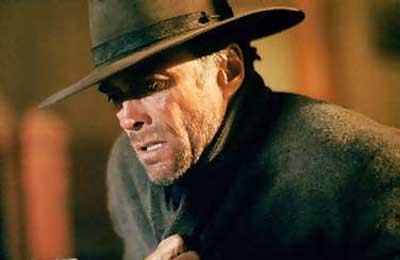
But the deconstruction of English Bob is only a prelude. It is with the tale of Will Munny that the truly disturbing truths about gunfighters emerge. With incredible pacing, Munny’s regression from penitent farmer back to unrepentant killer is as captivating as it is terrifying. For most of the film, Munny’s murderous past is merely hinted at, through stories told by other characters such as The Schofield Kid and even Will’s riding partner, Ned. As each bloody story is revealed, Munny tries to assure Ned and himself that he, “ain’t like that no more.” Watching him cling to the new self into which his dead wife molded him is like watching a time bomb trying to diffuse itself.

During his arrival at Bog Whiskey, Munny is still tortured and ill. It's almost as if his modern, peaceful self is slowly coming apart under the burden of trying to keep his homicidal nature at bay.

Any doubt about Munny is removed about halfway through the film, upon the death of the first cowboy. When Ned is unable to pull the trigger, Munny reverts to form. Without blinking, he takes the rifle from Ned’s uncertain hands, takes aim, and kills the young man. It is now clear that, while Ned truly has left his homicidal past behind him, Munny still possesses a true murderer's instinct. As if the contrast between Ned and Munny isn’t enough, is becomes all the more clear when Munny allow The Kid, eager for a kill, to execute the second cowboy later. After the deed is done, The Kid shakily admits that, contrary to his prior boasting, it was his first kill. The Kid is all too aware of the difference between himself and Munny, stating, “I ain’t like you Will.” Will’s response is right at the heart of the film – “It’s a hell of a thing, killin’ a man. You take away everything he’s got and everything he’s ever gonna have.” The Kid then swears off guns and killing for the rest of his life.

It is then, in the final ten minutes of the movie, that we see the true horror of William Munny. After he is told of Ned’s death, a terrifying transformation takes place. For most of the story, Will has been the picture of anguished restraint. He has refused to take a drop of alcohol and has only killed the two cowboys condemned by the bounty. However, when he learns that his friend has been tortured, killed, and put on display, his previous decade of temperance thoroughly vanishes. A cold fire alights in his eyes, his teeth clench, and he grabs a whiskey bottle and methodically starts to drink. By the time he enters the saloon at nightfall, he is Vengeance personified. In front of the group of puzzled and uncertain deputies and other town residents, he brutally shoots the saloon owner, Skinny. Even then, the deputies are clearly too frightened to try and bring down Munny. Even when they do gather their wits and try to square off against him, Munny is too calm under fire to be brought down. By doing little more than keeping his composure, he proceeds to shoot the five men remaining with weapons in their hands. The writer Beauchamp, who has been cowering in a corner and witnesses everything, then tries to question Munny on his “strategy.” Munny debunks any notion of skill or strategy by simple saying, “I was lucky…I’ve always been lucky when it comes to killin’ folks.” With this line, there is nothing left to be lauded in Munny’s actions, not even any kind of “skill.” Like English Bob, he is a mass murderer, though an uncommonly effective one.

Munny's execution of Little Bill. It may be one of the coldest, most haunting killings in all of film. 

Following the rapid departure of Beauchamp, Munny then steps up to Little Bill, who has been wounded but is not dead. Little Bill looks up at Will Munny, and instead of begging or pleading, simply says, “I don’t deserve to die like this.” Munny stares him in the face and delivers perhaps the most haunting line of the film when he proclaims, “Deserve’s got nothin’ to do with it.” At this moment, Munny is no longer even a spirit of vengeance. He is death itself. Unfeeling. Unthinking. Uncaring of right or wrong.

Those final lines, and others like them in the film, are what set Unforgiven apart. The only other Western I know of that even came close to taking such a hard look at the makeup of the Western gunfighter was The Searchers, with John Wayne. However, The Searchers still had a solid dose of romantic hokum blended into it, and it’s not nearly as even in execution as Unforgiven. Clint Eastwood directed this movie as well as anything he’s ever done, encompassing all of the things that make Western films great, while adding unprecedented philosophical depth.

The story and characters are undoubtedly what make the movie great, but I’d be remiss if I didn’t at least briefly mention its other merits. The cinematography is incredible, with all of the gorgeous wide-angle shots that you could hope for in a sweeping Western. Even more is the acting. Clint Eastwood does a fine enough job, and it helped that the character Will Munny didn’t call for any spectacular range of emotions (not Eastwood’s forte). The standout performances are Morgan Freeman and Gene Hackman, the latter of whom justifiably raked in a ton of awards for his turn as Little Bill. But even the smaller roles are all played perfectly, from Richard Harris as English Bob right down to the lowly prostitutes and townspeople.

Little Bill, in front of the townspeople of Big Whiskey. Just as important to the tone of the movie, the smaller roles all convey very realistic reactions to violence and death - rage, frustration, and fear.

When I think about Unforgiven as a whole, one thing I often come back to is the notion of freedom. For fans of Western tales, it is often the sense of freedom that is most appealing. The wide-open spaces of the old West have always been thought of as places where a person is free from the restrictions and expectations of “civilized” society. We often assume that this is essentially a positive thing, as it allows a person to be whoever they want to be or discover who they really are. This is a beautiful idea, if you assume that the person you really are is one to be loved and admired. But what if who you really are is someone as terrifying as William Munny? What if, in spite of your every effort to escape it in the quiet, isolated, wind-swept plains of Kansas, you are something that frightens yourself to your very soul? I don’t know if this is one of the intended themes of the film, but it is one that stays with me.

Additional Note: I came across the news that there is currently under production a remake of Unforgiven, set in feudal Japan and starring Ken Watanabe as the "Will Munny" character. Normally, I would be disgusted at the thought of a remake of Unforgiven; however, I can see the potential for a samurai setting to be very successful. I hope they can pull it off.

That’s a wrap. 91 shows down, 14 to go.

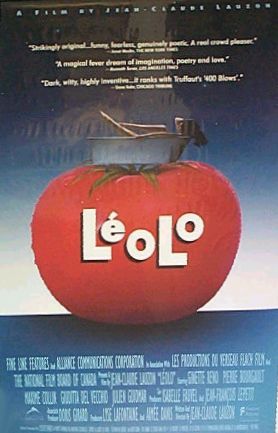
Coming Soon: Leolo (1992)


Don’t know anything about this one, but I’m guessing it doesn’t involve Clint Eastwood, ruminations on murder, or and Englishman getting his ass whipped. You never know, though…

Please be sure to pick up all empties on the way out.

Friday, November 23, 2012

Film #90: Goodfellas (1990)


Director: Martin Scorsese

Initial Release Country: United States

Timed Previously Seen: probably around eight or nine. Maybe more. 

Rapid-Fire Summary

Goodfellas is a rather epic movie, spanning several centuries. I’ll keep my summary short, but if you want many more of the details, you can check out the synopsis here at imdb’s website. Here’s my version:

In the late 1950s in Queens, New York, young teenager Henry Hill has big dreams. He dreams of becoming a gangster, like the fellows that he sees regularly on the streets of his neighborhood. Though his parents completely disapprove, Henry gets more and more involved with the crime circuit in the area – starting with simple errand-running for book-makers, progressing to orchestrated property destruction, and advancing to the sale of stolen goods. The more he gets entrenched in the life of a criminal, the more he feels welcomed by his fellow criminals, and the more normal it all becomes for him.

This normalized life of larceny follows Henry into adult life (played by Ray Liotta), when he regularly partners with two other noted crooks – the thief and hitman, Irishman Jimmy Conway (Robert De Niro) and the volatile yet charismatic Sicilian mobster Tommy DeVito (Joe Pesci). These three, along with many other local hoods, spend the next few decades of their adult lives robbing, and occasionally killing, their way to lives of luxury for themselves, their wives, children, and mistresses. Though their methods of attaining wealth are highly illegal, all of them keep up the appearances of being responsible family men who are “providers” for their friends and families. This is all in keeping with the Italian mafia tenets of organized crime, to which all of these three men pay homage.

Tommy, Henry, and Jimmy taking a look at on of their many stashes of ill-gotten money.

Eventually, however, things start to crumble. Starting in the later 1970s and into the early 1980s, Henry starts to get involved in selling cocaine. Despite clear warnings from the mafia father-figure, Paulie Cicero (Paul Sorvino), Henry continues to sell the highly illegal substance. His mistakes catch up to him, and he is caught by the police. Now facing the very likely prospect that he will be killed by any one of his criminal associates, in order to prevent him from informing on them, Henry and his wife Karen (Lorraine Bracco) decide that their only recourse is to join the witness protection program. Henry testifies against all of his former friends and criminal associates, thus escaping jail time. However, he lives out the rest of his days in a sterilized suburban neighborhood, far removed from the action, money, and excitement of his former life of crime.

My Take on the Film (Done after this most recent viewing)

Goodfellas is an absolute classic, and it may be the only English-language mafia movie that can hold a candle to The Godfather, in terms of scope, technique, and revolutionizing the genre.

I first saw this movie in the theater when my mother brought me to see it. I was only fourteen or fifteen at the time, and I remember the language blowing me away. The characters drop the f-bomb like most people blink, and violence is as normal as getting a haircut. About an hour into the movie, my mother, who grew up in Queens right at the time that this movie’s events were taking place, leans over to me and says “I think I grew up with these guys.” Now, she didn’t mean that she literally grew up with Henry Hill and the gang; she just meant that she grew up with guys eerily like them. She always said that the dialogue and attitudes depicted in Goodfellas were spot-on, in terms of how the guys from those neighborhoods spoke and acted.

This authenticity has been a hallmark of Scorsece’s New York pictures right from the very beginning. While he’s certainly done other excellent movies that are not based in New York (The Departed, Kundun, et al), his street-level stories have always been his signature ones. The verbal exchanges in Goodfellas, like Raging Bull and Taxi Driver, feel completely organic. Despite being so deeply rooted in a particular region, even people who have never been within a thousand miles of Long Island can sense and be hypnotized and amused by it.

Just another night of booze and poker. This is one of the many scenes in which the dialog and interactions between the New York tough guys are at their most realistic. 

But the dialogue is simply one of several triumphs of this movie. If The Godfather was the ultimate American criminal take on a classical Greek tragedy, Goodfellas is the ultimate deconstruction of the gangster myth. Based on the real story of Henry Hill, the movie depicts the ground-level thugs who made the mob go. There are no honorable Vito Corleones here. Henry Hill and his cohorts were unapologetic thieves and murderers who reveled in their power over others. One line that sums them up fairly well is when Henry Hill is describing Jimmy: “The one thing Jimmy loved to do was to steal. I mean, he actually liked it. Jimmy was the kind of guy who rooted for the bad guys in the movies.” These guys knew they were bad, embraced it, and pummeled anyone who had a problem with it.

Tied to this is probably the element that truly sets the movie apart from other classic gangster movies. Through Henry Hill’s life story, we see the complete and utter sham that the “honor” of the mafia is. All of the seeming friendships that Henry makes are only authentic as long as they don’t threaten any of his fellow thieves’ illicit livelihoods. The moment any one of the crew is suspected of threatening others’ freedom and fortunes, that crew member is not long for this world. The camaraderie is revealed as shallow in the face of real adversity, as evidenced by the protagonist himself. After decades of thinking of his criminal associates as family, he turns on them to protect himself and sends them all to prison. Goodfellas may have been the first film to so carefully and stylishly deconstruct the myth of honor among mobster thieves.

Normally, much of the above would make for thoroughly repugnant, unwatchable characters. Yet herein lies one of the most brilliant part of this movie – at times, you forget what they are and get completely caught up with who they are. Whether it’s Tommy cracking up his fellow mobsters with hilarious stories, Jimmy railing against the stupidity of his partners in crime, or Henry trying to juggle his passionately crazy wife and mistresses, it’s simply fun to watch. Most of the time, you laugh at them, but some of the time you actually laugh with them. There are even times when you feel a twinge of sympathy, as when Henry learns that Karen has flushed their bags of cocaine, their only remaining source of revenue, down the toilet, effectively flushing his entire life down the toilet. His desperation and fear are so palpable that you might be tempted to forget, just for a few seconds, that it’s all his selfish own doing.

Karen visits Henry while he serves time. At this point, it almost seems as normal for us the viewers as it does for the troubled couple and their kids.

All of these moments come through in large part due to the acting. While De Niro rightfully got top billing for this movie and did an outstanding job as Jimmy, it was Pesci, Liotta, and the entire ensemble crew that fully rounds out the picture and makes it come to life. By using that rare combination of world-class actors with lesser known, fully capable New York regionals, not one moment of Goodfellas rings untrue. For the full two-and-a-half hours, they pull you right into a completely different world.

It goes without saying that Scorsese was arguably at his finest with this movie. The cinematography, editing, and music are all blended into a fast-paced story that hums along without missing a single beat. Of his great films (of which there are many), this one is arguably his very best, and one would be hard-pressed to find much fault with it. At this point, anyone who is into crime movies has seen and loves this film. If, by chance, you haven’t seen it, do yourself a favor. As long as you are not put off by rough language and graphic violence (none of which is gratuitous, by the way – we need to see how visceral these thugs can be, lest we start to glamorize them), you need to watch this true modern masterpiece.

Henry takes one last look at us from his quaint little house, courtesy of the Witness Protection Program. While he survives, he would hardly call it a "life," as he came to know it on the streets of New York.

A side-note: Any fan of Goodfellas should watch Casino. It’s sometimes called “Goodfellas 2” with good reason. It’s certainly not a sequel, but so much of the tone and feel of it is the same, that one might feel like they’re watching the companion piece to the earlier film. Casino is a bit more sprawling, and some say bloated (I disagree), but it’s another excellent film in the same vein.

That’s a wrap. 90 shows down. 15 to go.

Coming Soon: Unforgiven (1992)


From the movie that deconstructed mafia gangsterism to the movie that deconstructed the American Western film. This is another of my absolute, hands-down, all-time favorites. I’m looking forward to watching it again and writing out my thoughts on the dark tale of Will Munny.